Connexions HTA

9 ag.


Des del blog AQuAS hem parlat del projecte europeu EUnetHTA, del registre d’artroplàsties de Catalunya, dels canvis de paradigma en l’atenció als ictus aguts i de la melatonina.

Comencem amb EUnetHTA, un projecte europeu integrat per diferents institucions que treballen per unir esforços i metodologies per evitar duplicitats, amb l’objectiu de disposar, adaptar i compartir coneixement útil per als sistemes sanitaris. Quan parlem d’HTA, bàsicament parlem d’avaluació.

Emmanuel Giménez posava de manifest que en un món en moviment és necessari un sistema robust metodològicament però també àgil que pugui adaptar-se a la velocitat de les diferents innovacions.

“La determinació i priorització dels productes per a ser avaluats (a mode d’Horizon Scanning), així com l’equilibri entre innovació i desinversió, són temes extensament abordats i en debat continu”

Marta Millaret aportava l’element de la comunicació i la disseminació d’un projecte perquè fer és important, però explicar i compartir el que es fa, també és important.

“Implicar en la disseminació significa aconseguir que les persones que treballen en un projecte difonguin, al mateix temps, la seva feina i el projecte. Així tots hi surten guanyant”

Continuem amb el Registre d’Artroplàsties de Catalunya, una eina del sistema de salut amb impacte en bona part de la ciutadania.

A partir d’una entrevista, Olga Martínez i Xavier Mora van compartir aspectes sobre la indicació i el pronòstic de les artroplàsties i, sobretot, van aportar claredat al valor dels registres.

“Els registres d’artroplàsties poden ajudar a detectar models de pròtesis amb un mal funcionament, a curt i llarg termini, i identificar els pacients als quals s’hagi implantat aquestes pròtesis”

Justament aquest estiu s’han publicat dos informes d’AQuAS que s’han pogut fer gràcies al registre.

En vam voler més i vam fer una segona entrevista a Olga Martínez i Xavier Mora. En aquesta ocasió van posar el focus en els materials que s’utilitzen per fer pròtesis.

“Amb la nova legislació europea aprovada el 2016 sobre productes sanitaris es vol augmentar la supervisió sobre la indústria, amb normes més estrictes i l’obligatorietat de l’avaluació clínica, alhora que s’incentiva la innovació”

Canviem cap a un altre tema. El coneixement avança i té implicacions en la pràctica mèdica. Exemple d’això és aquest text de Sònia Abilleira que mostrava un canvi de paradigma que obliga a repensar els sistemes organitzats d’atenció de les persones amb ictus agut.

“Aquesta tendència recentralitzadora de la realització del tractament endovascular contrasta amb la descentralització que en el seu moment es va fer per assegurar un accés adequat al tractament trombolític que necessàriament ha de ser administrat en les primeres 4,5 hores posteriors a l’inici dels símptomes”

Per acabar aquest recorregut, un tema 100% quotidià: la melatonina. Joan MV Pons va compartir consideracions després de la realització d’un informe d’avaluació.

“Cada dia es descobreixen noves accions fisiològiques d’aquesta hormona que fa que quasi adquireixi la qualitat de “molècula miraculosa” per la seva ubiqüitat i nombre d’activitats en les quals participa (antioxidant, neuroprotectora, anticàncer, immunomoduladora, etc.)”

Què tenen en comú totes aquestes iniciatives tan diferents? L’avaluació. A tot arreu on hi hagi la voluntat d’identificar, analitzar i utilitzar el coneixement de millor qualitat usant la millor metodologia disponible, considerant el context i tota la complexitat possible. No és pas poca cosa!
Who talks about what at EUnetHTA?

3 maig
Marta Millaret

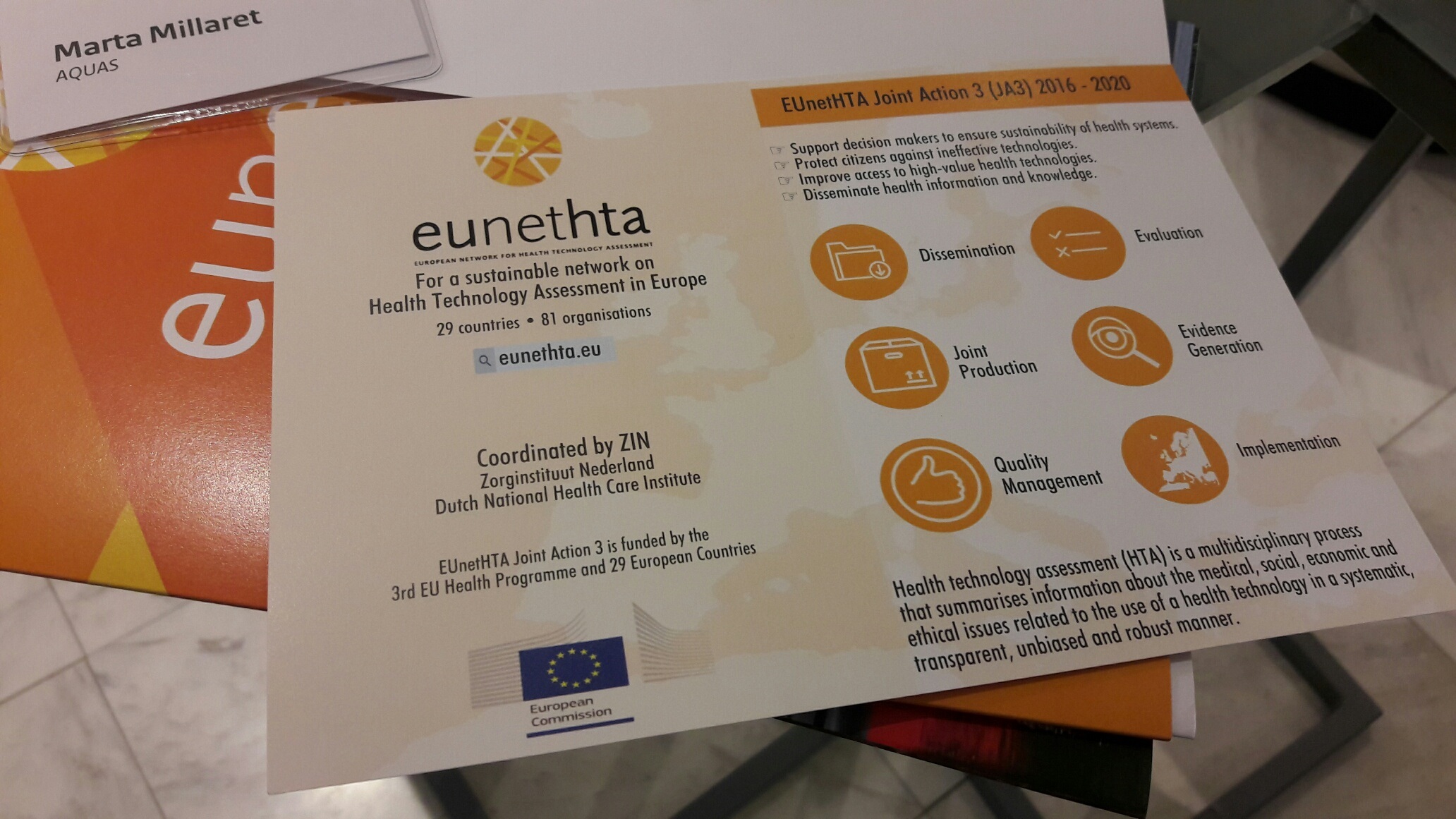
AQuAS is analysing the activities of dissemination of the EUnetHTA project, a European Joint Action comprised of 61 organisations from 29 countries and coordinated from the Zorginstituut Nederland in Holland. It is the European health technology assessment network.

Assessment, as Emmanuel Giménez talked about in this post,”can directly help in the practice, management and sustainability of different health systems” by providing the best available knowledge for taking decisions at different levels.

It is precisely on this subject that a proposal has recently been published regarding the regulation of drugs and health products within the framework of the European Commission and which is being debated and outlined for implementation.

The aim of the EUnetHTA project is to facilitate cooperation between different institutions in the field of health technology assessment to take advantage of expertise and useful knowledge to favour health systems which will consequently provide potential benefits for the health of citizens. It is about generating quality knowledge by using common methodologies in a systematic and transparent way and it is about doing this by working collaboratively and by avoiding duplicities.

AQuAS participates very actively in different work groups in the project (assessment, implementation, generation of evidence, dissemination) and today we are going to put the spotlight on the dissemination group, led by Iñaki Imaz of the Instituto de Salud Carlos III (Institute of Health Carlos III) in Madrid. This work group has the challenge of communicating more and better regarding what the EUnetTHA project is.

To do this, there are different strategies and one of these is the assessment of the dissemination itself, a task led by AQuAS. To this end, the different activities are being brought together and a first analysis has been carried out which will be repeated every four months with the idea of obtaining recommendations and specific actions.

In the first intake, almost a 100 activities have been included. 78% correspond to the activities in scientific meetings (workshops, presentations, oral communications and posters); 5% are articles in scientific publications with an impact factor in the Journal Citation Reports and the remainder (17%) are other publications, e-meetings and activity done in social networks.

This analysis will make it possible to look at who disseminates, what is disseminated and where it is disseminated as well as looking at the content and who the majority target audience is of these dissemination activities within the framework of the EUnetHTA project. The results of the first analysis will be presented at the next general assembly of the project in Cologne (Germany) at the end of the month.

We feel that it is interesting to find the way to involve all those participating in facilitating the dissemination of the project so as to achieve a more active communication of the EUnetHTA project. Involvement in dissemination means getting the people that work on a project to disseminate both their work and their project at the same time. In this way, everyone stands to gain.

Will we succeed in getting all participants more involved in the activities of dissemination? Will our assessment serve to improve things? That is to be seen.

Post written by Marta Millaret (@MartaMillaret).

¿Quién habla de qué en EUnetHTA?

3 maig
Marta Millaret

AQuAS está analizando las actividades de diseminación del proyecto EUnetHTA, Joint Action europea integrada por 81 organizaciones de 29 países y coordinada desde el Zorginstituut Nederland de Holanda. Se trata de la red europea de evaluación de tecnologías sanitarias.

La evaluación, como comentaba Emmanuel Giménez en este post, “puede ayudar directamente a la práctica, a la gestión y a la sostenibilidad de los diferentes sistemas de salud” al facilitar el mejor conocimiento disponible para la toma de decisiones en diferentes niveles.

Justamente sobre este tema, recientemente se ha publicado una propuesta de regulación sobre evaluación de fármacos y productos sanitarios en el marco de la Comisión Europea, que se está debatiendo y perfilando para su puesta en funcionamiento.

El objetivo del proyecto EUnetHTA es facilitar la cooperación entre diferentes instituciones en el ámbito de la evaluación de tecnologías sanitarias para aprovechar conocimiento experto y útil para los sistemas sanitarios y, por tanto, con potenciales beneficios para la salud de la ciudadanía. Se trata de generar conocimiento de calidad utilizando metodologías comunes de una forma sistemática y transparente, y se trata de hacerlo trabajando colaborativamente y evitando duplicidades.

AQuAS tiene una fuerte participación en diferentes grupos de trabajo del proyecto (evaluación, implementación, generación de evidencia, diseminación) y hoy pondremos el foco en el grupo de diseminación, liderado por Iñaki Imaz del Instituto de Salud Carlos III de Madrid. Este grupo de trabajo tiene como reto comunicar más y mejor qué es el proyecto EUnetHTA.

Para hacerlo, hay diferentes estrategias y una de ellas es la evaluación de la propia diseminación, tarea liderada por AQuAS. En este sentido, se están recogiendo las distintas actividades realizadas y se ha realizado un primer análisis que está previsto que se repita cada 4 meses con la idea que de ello se puedan derivar recomendaciones y acciones concretas.

En esta primera fotografía se han recogido casi 100 actividades. El 78% se corresponden con actividades en reuniones científicas (workshops, ponencias, comunicaciones orales y pósters); el 5% son artículos en publicaciones científicas con factor de impacto en el Journal Citation Reports y el resto (17%) son otras publicaciones, e-meetings y actividades en redes sociales.

Este análisis va a permitir estudiar quién difunde, qué se difunde, dónde se difunde, así como el contenido o el público mayoritario al que van destinadas las actividades de diseminación en el marco del proyecto EUnetHTA. Los resultados del primer análisis se presentarán en la próxima asamblea general del proyecto en Colonia (Alemania) a finales de este mes.

Pensamos que es interesantes buscar la forma de implicar y facilitar la diseminación del proyecto por parte de sus participantes para conseguir una comunicación más activa del proyecto EUnetHA. Implicar en la diseminación significa conseguir que las personas que trabajan en un proyecto difundan, al mismo tiempo, su trabajo y el proyecto. De este modo, todos salen ganando.

¿Conseguiremos implicar más a todos los participantes en las actividades de diseminación? ¿Lograremos que nuestra evaluación sirva para mejorar? Lo iremos viendo.

Entrada elaborada por Marta Millaret (@MartaMillaret).

Qui parla de què a EUnetHTA?

3 maig
Marta Millaret

AQuAS està analitzant les activitats de disseminació del projecte EUnetHTA, Joint Action europea integrada per 81 organitzacions de 29 països i coordinada des del Zorginstituut Nederland d’Holanda. Es tracta de la xarxa europea d’avaluació de tecnologies sanitàries.

L’avaluació, com comentava Emmanuel Giménez en aquest post, “pot ajudar directament a la pràctica, a la gestió i a la sostenibilitat dels diferents sistemes de salut” al facilitar el millor coneixement disponible per a la presa de decisions en diferents nivells.

Justament sobre aquest tema, recentment s’ha publicat una proposta de regulació sobre avaluació de fàrmacs i productes sanitaris en el marc de la Comissió Europea que s’està debatent i perfilant per a la seva posada en funcionament.

L’objectiu del projecte EUnetHTA és facilitar la cooperació entre diferents institucions en l’àmbit de l’avaluació de tecnologies sanitàries per aprofitar experteses i coneixement útil per als sistemes sanitaris i, per tant, amb potencials beneficis per a la salut de la ciutadania. Es tracta de generar coneixement de qualitat utilitzant metodologies comunes d’una manera sistemàtica i transparent, i es tracta de fer-ho treballant col·laborativament i evitant duplicitats.

AQuAS té una forta participació en diferents grups de treball del projecte (avaluació, implementació, generació d’evidència, disseminació) i avui posarem el focus en el grup de disseminació, liderat per Iñaki Imaz de l’Instituto de Salud Carlos III de Madrid. Aquest grup de treball té com a repte comunicar més i millor què és el projecte EUnetHTA.

Per fer-ho, hi ha diferents estratègies i una d’elles és l’avaluació de la pròpia disseminació, tasca liderada per AQuAS. En aquest sentit, s’estan recollint les diferents activitats i s’ha realitzat una primera anàlisi que està previst repetir cada 4 mesos amb la idea que se’n puguin derivar recomanacions i accions concretes.

En aquesta primera fotografia s’han recollit gairebé 100 activitats. El 78% es corresponen amb activitats en reunions científiques (workshops, ponències, comunicacions orals i pòsters); el 5% són articles en publicacions científiques amb factor d’impacte en el Journal Citation Reports i la resta (17%) són altres publicacions, e-meetings i activitat en xarxes socials.

Aquesta anàlisi permetrà estudiar qui difon, què es difon, on es difon, així com el contingut i el públic majoritari a qui van destinades les activitats de disseminació en el marc del projecte EUnetHTA. Els resultats de la primera anàlisi es presentaran en la propera assemblea general del projecte a Colònia (Alemanya) a finals de mes.

Pensem que és interessant buscar la manera d’implicar i facilitar la disseminació del projecte per part de tots els seus participants per aconseguir una comunicació més activa del projecte EUnetHA. Implicar en la disseminació significa aconseguir que les persones que treballen en un projecte difonguin, al mateix temps, la seva feina i el projecte. Així tots hi surten guanyant.

Aconseguirem implicar més a tots els participants en les activitats de disseminació? Aconseguirem que la nostra avaluació serveixi per millorar? Ho anirem veient.

Entrada elaborada per Marta Millaret (@MartaMillaret).

Is assessment still the pending issue of health apps?

22 març
Marta Millaret

An article in JAMA has recently been published presenting the first smart watch approved by the FDA to predict epileptic seizures. It is called Embrace, a connected device which detects seizures linked to movement and electric fluctuations in the skin of a person and sends an alert so they can receive medical attention.

Last February, the Mobile World Congress was held in Barcelona. Among the different activities to be highlighted which are organised around this congress there is one called 4 Years From Now (#4YFN18), the part of the Mobile which connects companies, investors and institutions with each other to encourage collaboration in developing different ideas, business models and technological solutions.

The Digital Health & Wellness Summit 2018, organised by 4YFN Connecting Startups, the Mobile World Capital Barcelona and the Mobile World Congress with the collaboration of ECHAlliance, the European Connected Health Alliance, is the meeting point of technological and health issues. This year, among others, Neil Gomes, Maria Salido and Elena Torrente participated.

Neil Gomes from the Thomas Jefferson University of the USA pointed out that one of the challenges in mHealth is facilitating feedback between patients and health professionals.

Maria Salido, co-founder and CEO of the health app, SocialDiabetes, raised key issues for success with health apps: regulation + industry + users. And in particular, she highlighted the importance of the final users. An article published in The Economist was much commented on here with a provocative title:

Elena Torrente, Digital Health Coordinator at DKV, commented on Digital Doctor, a health app that incorporates a detector of symptoms and a tool to request a doctor’s appointment. She pointed out that there were more women than men in the user profile of the app.

In general, there was consensus on the fact that prior to developing an app, an analysis to identify needs must be done. That is, the first step should be to detect the needs of a user and then, based on the mapping of these needs, the moment would come to develop technological solutions.

The content of all these presentations is available and you can also read a compilation of the main ideas that were highlighted here and here.

Despite it not being the main subject of their presentations, in the follow up debate the need and convenience of assessment was brought up. At present, there are already 320,000 health apps on the market. But,… How are they assessed? Who does this? With what criteria? Can we already talk about the safe prescription of health apps?

We close the circle once again with the conceptual framework of mHealth Assessment published in JMIR mHealth and uHealth with which the Agency for Health Quality and Assessment of Catalonia (AQuAS) provides the culture of assessment to the everyday reality in which we find ourselves (in 2016 it was published in the first quartile, in the categories “Health Care Sciences & Services” and “Medical Informatics”, respectively, in the Journal Citation Reports). There are an increasing number of health apps and the debate concerning their assessment remains open.

Post written by Marta Millaret (@MartaMillaret).

L’avaluació és encara l’assignatura pendent de les apps de salut?

22 març
Marta Millaret

Recentment s’ha publicat un article a la revista JAMA on es presenta el primer rellotge intel·ligent aprovat per la FDA per a predir atacs d’epilèpsia. Es tracta d’Embrace, un dispositiu connectat que detecta convulsions a partir del moviment i les fluctuacions elèctriques en la pell de la persona i envia un senyal d’alerta per tal de poder generar atenció mèdica.

El passat mes de febrer, es va celebrar el Mobile World Congress a Barcelona. Entre les diferents activitats que s’organitzen al voltant d’aquest congrés, destaca l’anomenat 4 Years From Now (#4YFN18), la part del Mobile que connecta empreses, inversors i institucions per a què col·laborin en el desenvolupament de diferents idees, models de negoci i solucions tecnològiques.

El Digital Health & Wellness Summit 2018, organitzat per 4YFN Connecting Startups, el Mobile World Capital Barcelona i el Mobile World Congress amb col·laboració amb ECHAlliance, l’European Connected Health Alliance, és el punt de trobada de temes tecnològics i de salut. Aquest any, entre altres, hi van participar Neil Gomes, Maria Salido i Elena Torrente.

Neil Gomes de Thomas Jefferson University dels Estats Units va destacar que un dels reptes de l’mHealth és facilitar el feedback entre pacients i professionals de la salut.

Maria Salido, cofundadora i CEO de l’app de salut SocialDiabetes, va plantejar elements clau per a l’èxit de les apps de salut: regulació + indústria + usuaris. I molt especialment va destacar la importància dels usuaris finals. Va ser molt comentat aquí un article publicat a The Economist amb un títol provocatiu:

Elena Torrente, Coordinadora de Salut Digital a DKV, va comentar Digital Doctor, una app de salut que incopora un detector de símptomes i una eina per demanar hora al metge. Va destacar que en el perfil d’usuari de l’app hi havia més dones que homes.

En general, va haver-hi consens sobre el fet que abans del desevolupament d’una app cal fer una anàlisi d’identificació de necessitats. És a dir, el primer pas hauria de ser detectar necessitats de l’usuari i després, a partir d’aquest mapeig de necessitats, vindria el moment de desenvolupar solucions tecnològiques.

El contingut de totes les presentacions es troba disponible i també podeu llegir un recull de les principals idees destacades aquí i aquí.

Malgrat que no era el tema principal de les seves presentacions, sí que en el debat posterior es va plantejar la necessitat i conveniència de l’avaluació. Actualment, ja hi ha 320.000 apps de salut al mercat. Però… Com s’avaluen? Qui ho fa? Amb quins criteris? Podem parlar ja de prescripció segura d’apps de salut?

Tanquem el cercle amb el marc conceptual d’avaluació d’mHealth publicat a la revista JMIR mHealth and uHealth (l’any 2016 en el primer quartil en les categories “Health Care Sciences & Services” i “Medical Informatics”, respectivament, del Journal Citation Reports) amb el qual l’Agència de Qualitat i Avaluació Sanitàries de Catalunya (AQuAS) aporta la cultura de l’avaluació a aquesta realitat quotidiana on ens trobem. Cada cop hi ha més apps de salut i el debat sobre la seva avaluació continua obert.

Entrada elaborada per Marta Millaret (@MartaMillaret).

Consulting the library from any place

19 oct.
Marta Millaret

Times change and sometimes we are not fully informed on the latest developments and facilities we have at our disposal. Nowadays, the staff at AQuAS can access the contents of the  Library of Health Sciences of Catalonia in a virtual manner which is very good news.

The library is a support tool for all researchers and technicians. Having access to available resources from any place is a step forward, leaving behind the model of being tied to an intranet to be able to access all the resources of the library.

Knowing that these tools exist and that they can be accessed from any place nowadays can be very useful at a particular time when researchers from AQuAS might need to use them.

We would like to present some interesting developments of the library:

Virtual Library of the Public Health System of Catalonia. It facilitates the access to the bibliographic services and resources of the Library of Health Sciences of Catalonia. Professionals that work in the general public health sector have access to the bibliographic resources that the Health Department subsidises for the entity they work for.

The professionals at AQuAS have the opportunity to register (with a user name provided by the institution) and can thus access all the bibliographic contents that are available from any physical location and device.

These available resources include e-magazines, e-books, bibliographic data bases, thematic bibliographies, the catalogue of the bibliographic funds in print of the Library, Scientia (digital information deposit of the Department of Health), collections of clinical practice guidebooks, of health legislation and health news, reference works, the press and electronic summaries.

You only need to register. By doing so, professionals at AQuAS can access a systematic review of the Cochrane Library, for example, or an article from the magazine Gaceta Sanitaria, an article from The Lancet or an article from the magazine Health Research Policy and Systems, all from any place.

Scientia. It is the institutional repository of the Department of Health. It was created with a view of storing and making the scientific production of the entities of the general public health sector of Catalonia openly accessible with the aim thereby of fostering accessibility, visibility, impact and recognition.

Presently, you can find publications from the Health Department, CatSalut and AQuAS, three of the entities which have already signed an agreement of participation.

The added value that this repository offers is the search and retrieval of results in three languages (Catalan, Spanish and English), a permanent URL of each publication, a standardised bibliographic citation and the impact index in social networks (Almetrics). The ORCID identification of each author is also included.

There are many ways you can stay informed of the latest developments which are published: by syndicating contents (RSS) available in the different sections of Scientia and from Twitter; by means of the hashtag #publicaDSalut or following the account of the library @bibliotecasalut.

One of the main aims of this tool is the safekeeping of the scientific production generated in the area of health and its effective dissemination.

An example of a search of studies and technical reports of the AQuAS in Scientia, by author:

Inquiro. It is what is known as a “discovery tool”, an intelligent tool which searches and explores within the contents of all the bibliographic, digital and printed resources available in the library stemming from a simple question using natural language.

The results that are obtained can be filtered by type of document, access (complete text or bibliographic citation), chronological period, subject and resource.

The most potent feature is that the results are obtained organised in order of relevance or by date. There is also the option of using an advanced search, and refining the search by fields, using Boolean operators (AND OR NOT).

Having a single gateway of access to all the bibliographic resources of the library, being able to explore the content of all these resources at the same time and filtering the contents organised in order of relevance is the major new development.

Example of a search for “indicators” with the results organised in order of relevance:

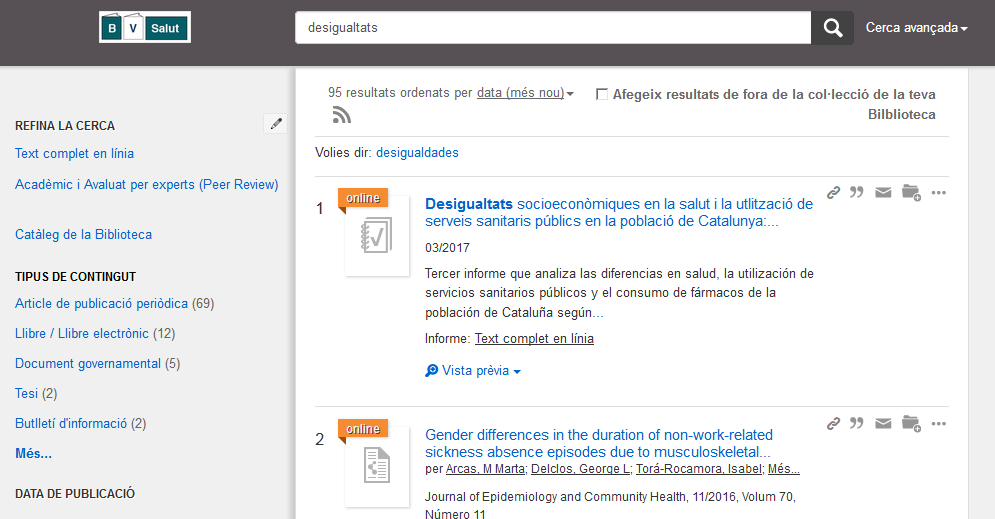
Example of a search for “inequalities” with the results ordered by date:

Ask us. This is the user services department and reference of the Library for Health Science of Catalonia. This tool is very practical to make a search and the answer is practically immediate. It is well worth knowing that this service exists!

That is all, for today. We are completely sure that all these tools are very useful and that they are the results of a concerted effort by the library to give answers to users, technicians and researchers that carry out research in our field.

Post written by Marta Millaret (@MartaMillaret) with the collaboration of Toni Parada and Pilar Roqué, head of the Library of Health Sciences of Catalonia (Biblioteca de Ciències de la Salut de Catalunya).

Consultar la biblioteca desde cualquier lugar

19 oct.
Marta Millaret

Los tiempos cambian y, a veces, no estamos al día de todas las novedades y facilidades que tenemos a nuestro alcance. Actualmente, los trabajadores de AQuAS ya podemos acceder de forma virtual a los contenidos de la Biblioteca de Ciències de la Salut de Catalunya y esto implica muy buenas noticias.

La biblioteca es una herramienta de apoyo para todos los investigadores y técnicos. Disponer de los recursos accesibles desde cualquier lugar supone un paso adelante, salir del modelo de estar atados a una intranet para poder acceder a todos los recursos de la biblioteca.

Saber que estas herramientas existen y que se encuentran disponibles desde cualquier lugar puede ser muy útil en el momento que los investigadores de AQuAS puedan tener la necesidad de usar cualquiera de estas herramientas.

Os queremos presentar algunas novedades interesantes de la biblioteca:

Biblioteca Virtual del Sistema Sanitari Públic de Catalunya. Facilita el acceso a los servicios y recursos bibliográficos de la Biblioteca de Ciències de la Salut de Catalunya. Los profesionales que trabajan en el sector público mayoritario de salud catalán tienen acceso a los recursos bibliográficos que el Departament de Salut de la Generalitat de Catalunya subvenciona a la entidad donde trabajan.

Los profesionales de AQuAS tienen la oportunidad de registrarse (a partir de un usuario facilitado por la institución) y así acceder -desde cualquier lugar físico y dispositivo- a todos los contenidos bibliográficos que tienen disponibles.

Estos recursos disponibles incluyen revistas electrónicas, libros electrónics, bases de datos bibliográficas, bibliografías temáticas, catálogo del fondo bibliográfico en papel de la biblioteca, Scientia (dipòsit d’informació digital del Departament de Salut), recopilaciones de guías de práctica clínica, de legislación sanitaria y de noticias sanitarias, obras de referencia, prensa y sumarios electrónicos.

Sólo hace falta estar registrado. Haciéndolo, los profesionales de AQuAS podrán acceder desde cualquier lugar, por ejemplo,  a una revisión sistemática de The Cochrane Library, a un artículo de la revista Gaceta Sanitaria, a un artículo de The Lancet , o a un artículo de la revista Health Research Policy and Systems.

Scientia. Es el repositorio institucional del Departament de Salut de la Generalitat de Catalunya. Nace con la voluntad de recoger la producción científica de las entidades del sector público mayoritario de salud catalán con el objetivo de favorecer su accesibilidad, visibilidad, impacto y reconocimiento.

Ahora mismo, podréis encontrar publicaciones del Departament de Salut de la Generalitat de Catalunya, CatSalut y AQuAS, tres de las entidades que ya han firmado el acuerdo de participación.

El valor añadido que ofrece el repositorio es la búsqueda y la recuperación de los resultados en tres idiomas (catalán, castellano e ingés, una URL permanente de cada publicación, una citación bibliográfica estandardizada y el índice de impacto en redes sociales (Almetrics). La identificación ORCID de cada autor también se incluye.

Podéis estar al día de las novedades que se publican de muchas formas. A  través de la sindicación de contenidos (RSS) disponibles en los diferentes apartados de Scientia y desde Twitter: a través del hashtag #publicaDSalut o siguiendo la cuenta de la biblioteca @bibliotecasalut.

Uno de los principales objetivos de esta herramienta es preservar la producción científica producida en el entorno de salud y difundirla de forma efectiva.

Ejemplo de búsqueda de estudios e informes técnicos de AQuAS en Scientia, por autores:

Inquiro. Se trata de lo que se conoce por una “herramienta de descubrimiento”, una herramienta inteligente que busca y explora dentro de los contenidos de todos los recursos bibliográficos, digitales y en papel, disponibles en la biblioteca, a partir de una interrogación simple usando lenguaje natural.

Los resultados que se obtienen pueden ser filtrados por tipo de documento, de acceso (texto completo o cita bibliográfica), período cronológico, materia y recurso.

El elemento más potente es que los resultados se obtienen ordenados por orden de relevancia o por fecha. También hay la opción de utilizar la búsqueda avanzada y perfilar la búsqueda por campos, usando operadores booleanos (AND OR NOT).

Disponer de una puerta de acceso única a todos los recursos bibliográficos de la biblioteca, poder explorar a la vez el contenido de todos estos recursos y filtrar los contenidos ordenados por relevancia es la gran novedad.

Ejemplo de búsqueda sobre “indicadores” con los resultados ordenados por relevancia:

Ejemplo de búsqueda sobre “desigualdades” con los resultados ordenados por fecha:

Pregunteu-nos. Es el servicio de atención al usuario y referencia de la Biblioteca de Ciències de la Salut de Catalunya. Esta herramienta es muy práctica para hacer consultas y la respuesta es casi inmediata. ¡Merece mucho la pena saber que existe este servicio!

Hasta aquí, por hoy. Estamos muy seguros que todas estas herramientas son muy útiles y que son el resultado de un esfuerzo activo por parte de la biblioteca para dar respuesta a los usuarios, técnicos e investigadores que hacen investigación en nuestro entorno

Entrada elaborada por Marta Millaret (@MartaMillaret) con colaboración de Toni Parada y Pilar Roqué, responsable de la Biblioteca de Ciències de la Salut de Catalunya.

Consultar la biblioteca des de qualsevol lloc

19 oct.
Marta Millaret

Els temps canvien i, a vegades, no estem al dia de totes les novetats i facilitats que tenim al nostre abast. Actualment, els treballadors d’AQuAS ja podem accedir de manera virtual als continguts de la Biblioteca de Ciències de la Salut de Catalunya i això implica molt bones notícies.

La biblioteca és una eina de recolzament per a tots els investigadors i tècnics. Disposar dels recursos accessibles des de qualsevol lloc suposa un pas endavant, sortir del model d’estar lligats a una intranet per poder accedir a tots els recursos de la biblioteca.

Saber que aquestes eines existeixen i que es troben actualment disponibles des de qualsevol lloc pot ser molt útil en el moment que els investigadors d’AQuAS puguin tenir la necessitat d’utilitzar-les.

Volem presentar-vos algunes novetats interessants de la biblioteca:

Biblioteca Virtual del Sistema Sanitari Públic de Catalunya. Facilita l’accés als serveis i recursos bibliogràfics de la Biblioteca de Ciències de la Salut de Catalunya. Els professionals que treballen en el sector públic majoritari de salut tenen accés als recursos bibliogràfics que el Departament de Salut subvenciona a l’entitat a la qual treballen.

Els professionals d’AQuAS tenen l’oportunitat de registrar-se (a partir d’un usuari facilitat per la institució) i d’aquesta manera podran accedir -des de qualsevol lloc físic i dispositiu- a tots els continguts bibliogràfics que tenen disponibles.

Aquests recursos disponibles inclouen revistes electròniques, llibres electrònics, bases de dades bibliogràfiques, bibliografies temàtiques, catàleg del fons bibliogràfic en paper de la Biblioteca, Scientia (dipòsit d’informació digital del Departament de Salut), reculls de guies de pràctica clínica, de legislació sanitària i de notícies sanitàries, obres de referència, premsa i sumaris electrònics.

Només cal registrar-s’hi. Fent-ho, els professionals d’AQuAS podran accedir, des de qualsevol lloc, per exemple, a una revisió sistemàtica de The Cochrane Library, un article de la revista Gaceta Sanitaria, un article de The Lancet o un article de la revista Health Research Policy and Systems.

Scientia. És el repositori institucional del Departament de Salut. Neix amb la voluntat de recollir en obert la producció científica de les entitats del sector públic majoritari de salut de Catalunya amb l’objectiu d’afavorir-ne l’accessibilitat, la visibilitat, l’impacte i el reconeixement.

Ara mateix, hi podreu trobar publicacions del  Departament de Salut, CatSalut i AQuAS, tres de les entitats que ja han signat l’acord de participació.

El valor afegit que ofereix aquest repositori és la cerca i la recuperació dels resultats en tres idiomes (català, castellà i anglès), una URL permanent de cada publicació, una citació bibliogràfica estandarditzada i l’índex d’impacte en xarxes socials (Almetrics). La identificació ORCID de cada autor també hi és inclosa.

Podeu estar al dia de les novetats que es publiquen de moltes maneres. A través de la sindicació de continguts (RSS) disponibles en els diferents apartats de Scientia i des de Twitter: a través del hashtag #publicaDSalut o seguint el compte de la biblioteca @bibliotecasalut.

Un dels principals objectius d’aquesta eina és preservar la producció científica produïda en l’entorn de salut i difondre-la de manera efectiva.

Exemple de cerca dels estudis i informes tècnics d’AQuAS a Scientia, per autors:

Inquiro. Es tracta del que és conegut com a “eina de descoberta”, una eina intel·ligent que cerca i explora dins dels continguts de tots els recursos bibliogràfics, digitals i en paper, disponibles a la biblioteca, a partir de la interrogació simple utilitzant el llenguatge natural.

Els resultats que s’obtenen poden ser filtrats per tipus de document, d’accés (text complet o cita bibliogràfica), període cronològic, matèria i recurs.

L’element més potent és que els resultats s’obtenen ordenats per ordre de rellevància o per data. També hi ha l’opció d’utilitzar la cerca avançada, i perfilar la cerca per camps, utilitzant operadors booleans (AND OR NOT).

Disposar d’una porta d’accés única a tots els recursos bibliogràfics de la biblioteca, poder explorar a la vegada el contingut de tots aquests recursos i filtrar els continguts ordenats per rellevància és la gran novetat.

Exemple de cerca sobre “indicadors” amb els resultats ordenats per rellevància:

Exemple de cerca sobre “desigualtats” amb els resultats ordenats per data:

Pregunteu-nos. És el servei d’atenció a l’usuari i referència de la Biblioteca de Ciències de la Salut de Catalunya. Aquesta eina és molt pràctica per a fer consultes i la resposta és gairebé immediata. Val molt la pena saber que existeix aquest servei!

Fins aquí, per avui. Estem molt segurs que totes aquestes eines són molt útils i que són el resultats d’un esforç actiu per part de la biblioteca per donar respostes als usuaris, tècnics i investigadors que fan recerca al nostre entorn.

Entrada elaborada per Marta Millaret (@martamillaret) amb la col·laboració de Toni Parada i Pilar Roqué, cap de la Biblioteca de Ciències de la Salut de Catalunya.

mHealth & user experience: the user decides

23 febr.
Marta Millaret - Elisa Puigdomènech - MWC2017
Marta Millaret and Elisa Puigdomènech

The Economist recently published an article in which they reported that the number of mobile health applications, or apps, was in the region of 165.000, a very high figure that poses many questions.

A large part of these apps are related to well-being and promoting healthy lifestyles, but what makes us choose one over another?

The first thing that comes to mind is that mobile health apps, being a health technology, could and should be assessed based on their impact on health and this is where we are faced with our first problem.

While there is a gold standard when assessing this impact in the area of medication and static interventions in randomized clinical trials, how is this impact assessed in a highly dynamic world? In a world that can include a range of components that users can use depending on their needs? Where pressure is added due to the fact that advances in technology are being made in leaps and bounds and we cannot wait for years before getting results? It is not that simple.

If we venture into the area of mHealth, the first thing we find is great diversity. The design, requirements and assessment of an app developed to help manage diabetes in older people is very different to an app aimed at providing a dose for some medication where improving its adherence is sought, or an app to promote not drinking alcohol among young people before sitting in the driver’s seat, or an app to manage depression and anxiety.

What are we trying to say with all this? Easy and complex at the same time: the intervention that one wants to do via a health app and the target users will determine their use and their adherence.

And we are only just beginning. Apart from aspects related to health and the suitability of content or other more technological factors such as interoperability and security -by no means simple-, other factors come onto the scene such as acceptability, usability and satisfaction, factors related to User Experience (UX).

User Experience in mHealth is essential given that the main aim of it all is to make the tools which are being developed viable, accepted and used by the population who they are meant for, and also that the aim for which they were designed be respected.

After all, the end user who has the last word in deciding whether a health app is used or not, and this is why their participation in all phases of developing these mHealth tools is crucial.

Pursuing these aims of feasibility, acceptability and usability can make us reflect on, for example, the difficulty some old-age people may have when learning to use a smartphone for the first time. However, these obstacles related to the generational factor also exist among young people with new languages.

We suggest let yourself surprised by this video that shows how some adolescents react and interact when using Windows 95 for the first time.

The Mobile World Congress 2017 will be taking place in Barcelona next week. Monday will be one of the days circled into the diary of many professionals interested in subjects on mobiles and health with the Digital Health & Welness Summit 2017 programme.

DWHW 2017

But not everything will be happening at the Mobile. Another important mHealth event will take place on March 1st at the Palau Robert in Barcelona with the DECIPHER project final event.

logo decipherTo be continued

Post written by Elisa Puigdomènech and Marta Millaret (@martamillaret).