Implementation Science and new HTA regulation: two very different subjects

31 oct.

The implementation of improvements, changes in procedures, the introduction of good practices in specific health contexts and the new regulation regarding the assessment of health technologies, respectively, are subjects on the agenda at the AQuAS. Today, we will look at them in broad terms and in the future we will delve into them in more detail from this space.

To learn more about “implementation science” or “research implementation” we held a workshop at the headquarters of AQuAS with Laura J. Damschroder, an expert consultant in implementation science and researcher in the United States.

From her talk we highlight the idea of building collective knowledge and identifying the barriers and facilitators in implementation, the time factor and the value of assessment.

It is also important to know the theoretical and conceptual framework of implementation and the “basics” of implementation science which is useful for any project being implemented, as is designing and following an adequate plan of action.
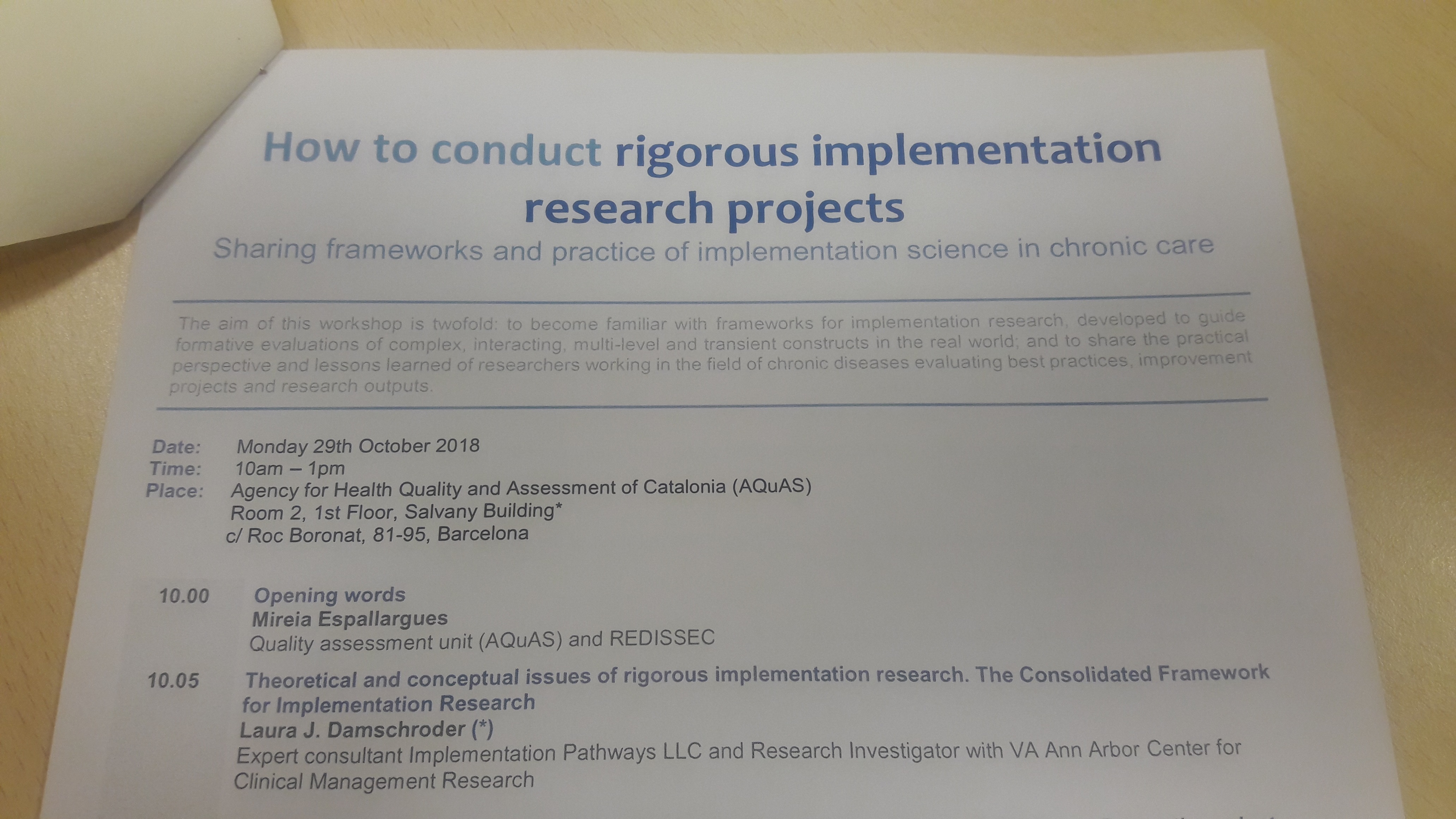
 

The workshop proceeded by looking at different examples of the implementation of good practices in the context of REDISSEC, the Health Services Research on Chronic Patients Network.

It all stems from the annual meeting of this network held in Madrid last week at the Instituto de Salud Carlos III, in which the idea of organising this workshop was put forward in order to bring some of the contents of the meeting closer to the Catalan context, with the participation of the AQuAS, the Hospital del Mar, and the Fundació Avedis Donabedian.

In terms of the AQuAS, three talks were given on projects in which implementation research is being done, with a different perspective in each case:

  • Quality standards in implementation by Vicky Serra-Sutton from the European project on dementia Act on Dementia Joint Action. The AQuAS team involved in this project was in fact given a mention this week at the Alzheimer Europe Conference which was held in Barcelona
  • The transfer of good practices and impact assessment by Elisa Poses-Ferrer from the European Project CHRODIS PLUS on chronicity
  • The assessment of projects for improvement in integrated care by Jillian Reynolds from the European project SUSTAIN on integrated care for older people.

Regarding the Hospital del Mar, we heard a talk by Maria Sala on the personalisation of screening for breast cancer and regarding the Fundació Avedis Donabedian, we heard a talk by Carola Orrego and Marta Ballester, who brought reflections on aspects of improvement and lessons learnt in implementation.

This workshop was a good opportunity for speakers and attendees to share experiences and knowledge.

Moving on to the second subject.

In terms of the new European HTA regulation, which is in its final stages of discussion in the European Parliament, Iñaki Imaz, from the Instituto de Salud Carlos III in Madrid gave a seminar which we were able to follow live at the AQuAS.

It was very interesting for many reasons. Situations were contextualised that justify the need for health technology assessment (HTA) as a starting point, which is always present in our context.

The emphasis was also placed on the complexity of assessment and the different possible scenarios (or levels). On the other hand, aspects being discussed regarding the proposal for legislation which would allow for, among other objectives, joint clinical assessment at a European level, were commented on in detail.

The seminar can be found on the following link:

Imaz I. The future of health technology assessment in Europe. Regarding the proposal for regulation passed by the European Parliament. Madrid: Agency for Health Technology Assessment. Instituto de Salud Carlos III, 30 November, 2018.

Talking about HTA in Europe, a lot has been done (more than 30 assessments available within the framework of EUnetHTA), there is work in progress and, above all, there is the desire for all to gain in terms of confidence, guarantees, transparency and the sustainability of health systems. What is especially sought after is to avoid duplicities and to share knowledge and methodologies.

We will keep track of all these subjects.

Who talks about what at EUnetHTA?

3 maig
Marta Millaret

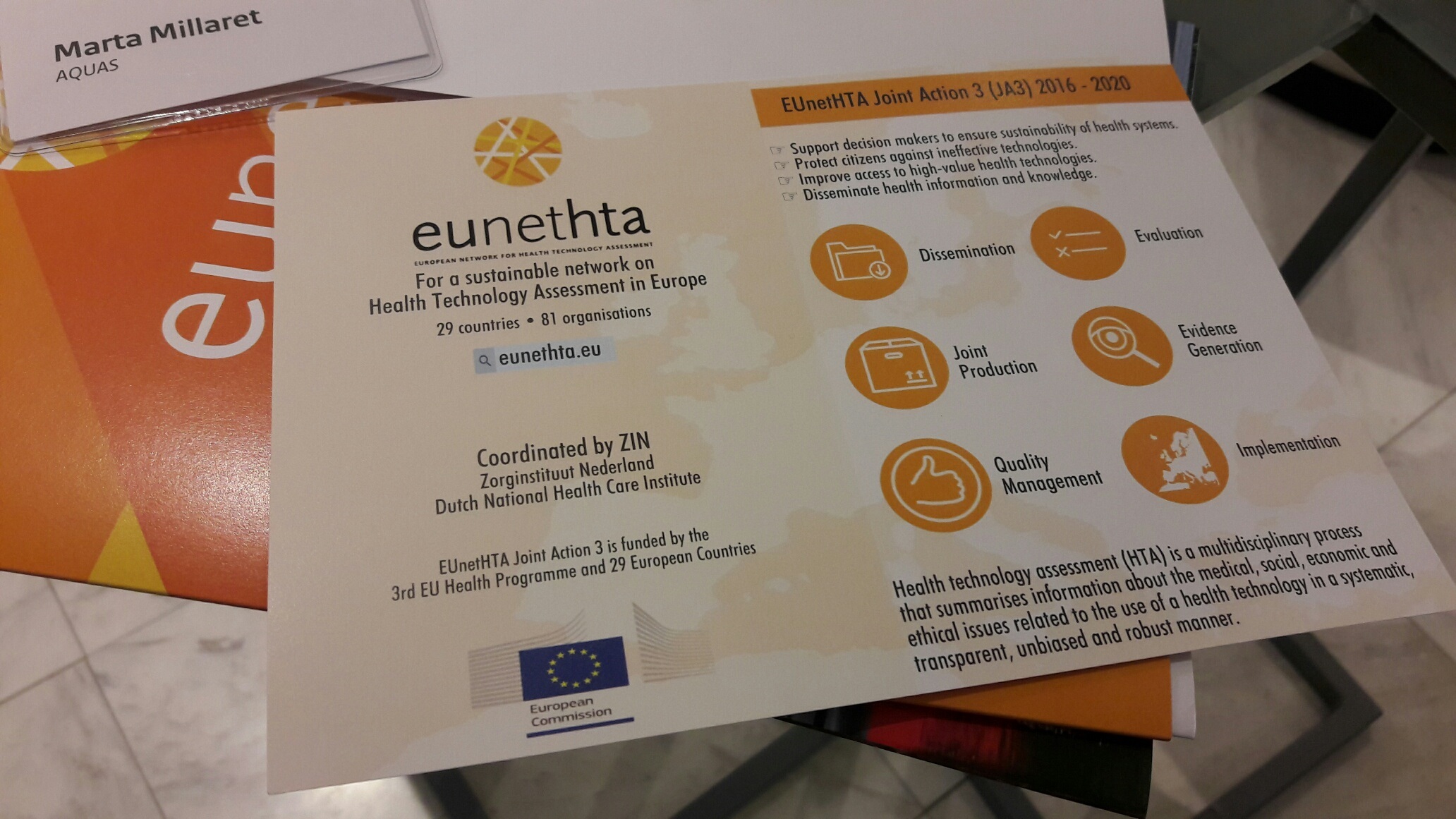
AQuAS is analysing the activities of dissemination of the EUnetHTA project, a European Joint Action comprised of 61 organisations from 29 countries and coordinated from the Zorginstituut Nederland in Holland. It is the European health technology assessment network.

Assessment, as Emmanuel Giménez talked about in this post,”can directly help in the practice, management and sustainability of different health systems” by providing the best available knowledge for taking decisions at different levels.

It is precisely on this subject that a proposal has recently been published regarding the regulation of drugs and health products within the framework of the European Commission and which is being debated and outlined for implementation.

The aim of the EUnetHTA project is to facilitate cooperation between different institutions in the field of health technology assessment to take advantage of expertise and useful knowledge to favour health systems which will consequently provide potential benefits for the health of citizens. It is about generating quality knowledge by using common methodologies in a systematic and transparent way and it is about doing this by working collaboratively and by avoiding duplicities.

AQuAS participates very actively in different work groups in the project (assessment, implementation, generation of evidence, dissemination) and today we are going to put the spotlight on the dissemination group, led by Iñaki Imaz of the Instituto de Salud Carlos III (Institute of Health Carlos III) in Madrid. This work group has the challenge of communicating more and better regarding what the EUnetTHA project is.

To do this, there are different strategies and one of these is the assessment of the dissemination itself, a task led by AQuAS. To this end, the different activities are being brought together and a first analysis has been carried out which will be repeated every four months with the idea of obtaining recommendations and specific actions.

In the first intake, almost a 100 activities have been included. 78% correspond to the activities in scientific meetings (workshops, presentations, oral communications and posters); 5% are articles in scientific publications with an impact factor in the Journal Citation Reports and the remainder (17%) are other publications, e-meetings and activity done in social networks.

This analysis will make it possible to look at who disseminates, what is disseminated and where it is disseminated as well as looking at the content and who the majority target audience is of these dissemination activities within the framework of the EUnetHTA project. The results of the first analysis will be presented at the next general assembly of the project in Cologne (Germany) at the end of the month.

We feel that it is interesting to find the way to involve all those participating in facilitating the dissemination of the project so as to achieve a more active communication of the EUnetHTA project. Involvement in dissemination means getting the people that work on a project to disseminate both their work and their project at the same time. In this way, everyone stands to gain.

Will we succeed in getting all participants more involved in the activities of dissemination? Will our assessment serve to improve things? That is to be seen.

Post written by Marta Millaret (@MartaMillaret).

Qui parla de què a EUnetHTA?

3 maig
Marta Millaret

AQuAS està analitzant les activitats de disseminació del projecte EUnetHTA, Joint Action europea integrada per 81 organitzacions de 29 països i coordinada des del Zorginstituut Nederland d’Holanda. Es tracta de la xarxa europea d’avaluació de tecnologies sanitàries.

L’avaluació, com comentava Emmanuel Giménez en aquest post, “pot ajudar directament a la pràctica, a la gestió i a la sostenibilitat dels diferents sistemes de salut” al facilitar el millor coneixement disponible per a la presa de decisions en diferents nivells.

Justament sobre aquest tema, recentment s’ha publicat una proposta de regulació sobre avaluació de fàrmacs i productes sanitaris en el marc de la Comissió Europea que s’està debatent i perfilant per a la seva posada en funcionament.

L’objectiu del projecte EUnetHTA és facilitar la cooperació entre diferents institucions en l’àmbit de l’avaluació de tecnologies sanitàries per aprofitar experteses i coneixement útil per als sistemes sanitaris i, per tant, amb potencials beneficis per a la salut de la ciutadania. Es tracta de generar coneixement de qualitat utilitzant metodologies comunes d’una manera sistemàtica i transparent, i es tracta de fer-ho treballant col·laborativament i evitant duplicitats.

AQuAS té una forta participació en diferents grups de treball del projecte (avaluació, implementació, generació d’evidència, disseminació) i avui posarem el focus en el grup de disseminació, liderat per Iñaki Imaz de l’Instituto de Salud Carlos III de Madrid. Aquest grup de treball té com a repte comunicar més i millor què és el projecte EUnetHTA.

Per fer-ho, hi ha diferents estratègies i una d’elles és l’avaluació de la pròpia disseminació, tasca liderada per AQuAS. En aquest sentit, s’estan recollint les diferents activitats i s’ha realitzat una primera anàlisi que està previst repetir cada 4 mesos amb la idea que se’n puguin derivar recomanacions i accions concretes.

En aquesta primera fotografia s’han recollit gairebé 100 activitats. El 78% es corresponen amb activitats en reunions científiques (workshops, ponències, comunicacions orals i pòsters); el 5% són articles en publicacions científiques amb factor d’impacte en el Journal Citation Reports i la resta (17%) són altres publicacions, e-meetings i activitat en xarxes socials.

Aquesta anàlisi permetrà estudiar qui difon, què es difon, on es difon, així com el contingut i el públic majoritari a qui van destinades les activitats de disseminació en el marc del projecte EUnetHTA. Els resultats de la primera anàlisi es presentaran en la propera assemblea general del projecte a Colònia (Alemanya) a finals de mes.

Pensem que és interessant buscar la manera d’implicar i facilitar la disseminació del projecte per part de tots els seus participants per aconseguir una comunicació més activa del projecte EUnetHA. Implicar en la disseminació significa aconseguir que les persones que treballen en un projecte difonguin, al mateix temps, la seva feina i el projecte. Així tots hi surten guanyant.

Aconseguirem implicar més a tots els participants en les activitats de disseminació? Aconseguirem que la nostra avaluació serveixi per millorar? Ho anirem veient.

Entrada elaborada per Marta Millaret (@MartaMillaret).

The speed and relevance of assessing health products

5 oct.
Emmanuel Giménez

The European market of health products has been widely affected by the sudden emergence of a new legislative framework with the new regulations (2017/745 and 2017/746). The subtle difference between directive and regulation is paramount, they say, but we’ll leave that for another occasion. This new framework in the field of health products is characterised among other things by:

  1. A stricter control of high risk health products (for example, certain implantable products)
  2. The strengthening of rules of clinical evidence by including a coordinated procedure at a European level for the authorisation of multicentre clinical research.
  3. The reinforcement of requirements and the coordination between European countries regarding controls and after sales aspects.

In this context of important changes, the assessment community is also clearly active. Thus, on 19 June this year, there was a panel on health products at the international meeting of Health Technology Assessment HTAi, where a new and innovative Italian programme for health products was presented.

The programme, explaining the work carried out over several years in terms of definition and its pilot phase, includes three work packages: appraisal, methodology and monitoring. In another panel closely related to the previous one, in the field of methodology, the presentation of the categories to decide on what to invest in and what to disinvest win clearly stood out.

When talking about monitoring and collecting information, an example that stood out was the debate on the need for early assessments given that the life cycle of a health product tends to be short.

The significant increase in new products available and all the work objects previously mentioned are some of the things that position the importance of specific assessment in health products.

The importance of the assessment of health products is, therefore, undeniable. In the joint production work package of EUnetHTA JA3, in which AQuAS is participating, as many or more assessments of “other technologies” (health products, health interventions,…) have been planned as of the known assessments of drugs. In a sense, the numbers of one or other necessity are matched. The importance of the assessment of “other technologies” was in fact reflected in the HTAi annual meeting in a presentation by Wim Goettsch, director of EUnetHA.

The identification and prioritisation of products to be assessed (the Horizon Scanning system), as well as the balance between innovation and divestment, are also extensively discussed subjects and under continuous debate. Thus, in the REDETS network (in which the AQuAS is also actively participating) and with the leadership of Avalia-T, a public access tool was identified that helps in approaching this subject: the PriTec.

Assessment, therefore, can help directly in the use, management and sustainability of different health systems. In conclusion, new opportunities are provided for improving decision making in the area of health products and some of them will come through demonstrating efficiency by means of the adequate use and definition of health technology assessments (HTA).

Post written by Emmanuel Giménez.

La velocidad y la relevancia de la evaluación de productos sanitarios

5 oct.
Emmanuel Giménez

El mercado europeo de productos sanitarios ha resultado ámpliamente afectado por la irruptiva aparición de un nuevo marco legislativo con las nuevas regulaciones (2017/745 y 2017/746). El matiz entre directiva y regulación es fundamental -dicen- pero dejamos este tema para otra ocasión. Este nuevo marco en el ámbito de los productos sanitarios viene caracterizado, entre otras cuestiones, por:

  1. Un control más estricto de los productos sanitarios de alto riesgo (por ejemplo, ciertos productos implantables)
  2. El refuerzo de las reglas de evidencia clínica incluyendo un procedimiento coordionado a nivel europeo para la autorización de investigaciones clínicas multicéntricas
  3. El fortalecimiento de los requerimentos y la cordinación entre países europeus en vigilancia y aspectos de post-venta

En este contexto de importantes movimientos, la comunidad de evaluación está claramente activa. Así, el pasado 19 de junio, en el congreso internacional de evaluación de tecnologías médicas HTAi, se celebró un pánel sobre productos sanitarios donde se presentó un nuevo e innovador programa italiano para productos sanitaros.

El programa, exponiendo el trabajo realizado durante unos años de definición y fase piloto, incluye tres grupos de trabajo: valoración (appraisal), metodología y monitorización. En otro panel muy relacionado con el anterior, en el campo de la metodología, destacó la presentación de las categorías para decidir en qué invertir y en qué desinvertir.

Si hablamos de monitorización y recogida de información, destacó, por ejemplo, el debate sobre la necesidad de las evaluaciones tempranas (early assessments) por el hecho que el ciclo de vida de un producto sanitario suele ser muy corto.

El incremento relevante de nuevos productos disponibles y todos los objectos de trabajo anteriormente mencionados son algunos de los hechos que posicionan la importancia que tiene la evaluación específica de productos sanitarios.

La importancia de las evaluaciones de productos sanitario es, por tanto, indiscutible. En el grupo de trabajo de producción conjunta de EUnetHTA JA3 -con participación de AQuAS– están planificadas tantas o más evaluaciones de “otras tecnologías” (productos sanitarios, intervenciones sanitarias, …) que de las conocidas evaluaciones de medicamentos. En cierto sentido, se equipara el número de una y otra necesidad. La importancia de la evaluación de las “otras tecnologías” se vio precisamente reflejada en el congreso HTAi con una presentación de Wim Goettsch, director de EUnetHTA.

La determinación y priorización de los productos para ser evaluados (a modo de Horizon Scanning), así como el equilibro entre innovación y desinversión, son también temas extensamente abordados y en debate continuo. De este modo, en la red española de agencias de evaluación de tecnologías sanitarias REDETS (donde AQuAS también participa activamente) y con el liderazgo de Avalia-T, se determinó una herramienta de acceso público que ayuda a la aproximación de este tema: la herramienta PriTec.

La evaluación, en definitiva, puede ayudar directamente a la práctica, a la gestión y a la sostenibilidad de los diferentes sistemas de salud. En conclusión, se abren nuevas oportunidades para la mejora de la toma de decisiones en el ámbito de los productos sanitarios y una parte de éstas passan por la demostración de la eficiencia a través de la utilización y definición adecuada de evaluaciones de tecnologías médicas (HTA).

Entrada elaborada por Emmanuel Giménez.

La velocitat i la rellevància de l’avaluació de productes sanitaris

5 oct.
Emmanuel Giménez

El mercat europeu de productes sanitaris s’ha vist àmpliament afectat per la irruptiva aparició d’un nou marc legislatiu amb les noves regulacions (2017/745 i 2017/746). El matís entre directiva i regulació és cabdal -diuen- però això ho deixem per a una altra ocasió. Aquest nou marc en l’àmbit dels productes sanitaris ve caracteritzat, entre d’altres, per:

  1. Un control més estricte dels productes sanitaris d’alt risc (per exemple, certs productes implantables)
  2. El reforçament de les regles d’evidència clínica incloent un procediment coordinat a nivell europeu per l’autorització d’investigacions clíniques multicèntriques
  3. L’enfortiment dels requeriments i la coordinació entre països europeus en vigilància i aspectes de post-venda.

En aquest context d’importants moviments, la comunitat d’avaluació també està clarament activa. Així, el passat 19 de juny, al congrés internacional d’avaluació de tecnologies mèdiques HTAi, va haver-hi un panell sobre productes sanitaris on va presentar-se un nou i innovador programa italià per a productes sanitaris.

El programa, exposant el treball realitzat durant  uns anys de definició i fase pilot, inclou tres grups de treball: valoració (appraisal), metodologia i monitorització. En un altre panell molt relacionat amb l’anterior, en el camp de la metodologia, va destacar la presentació de les categories per decidir en què invertir i en què desinvertir.

Si parlem de monitorització i recollida d’informació, va destacar, per exemple, el debat sobre la necessitat de les avaluacions primerenques (early assessments) pel fet que el cicle de vida d’un producte sanitari acostuma a ser molt curt.

L’increment rellevant de nous productes disponibles i tots els objectes de treball anteriorment esmentats són alguns dels fets que posicionen la importància que té l’avaluació específica dels productes sanitaris.

La importància de les avaluacions de productes sanitaris és, per tant, indiscutible. En el grup de treball de producció conjunta d’EUnetHTA JA3 -en què participa AQuAS– estan planificades tantes o més avaluacions d’”altres tecnologies” (productes sanitaris, intervencions sanitàries, …) que de les conegudes avaluacions de medicaments. En cert sentit, s’equipara el nombre d’una i altra necessitat. La importància de l’avaluació de les “altres tecnologies” es va veure precisament reflectida en el congrés HTAi amb una presentació de Wim Goettsch, director d’EUnetHTA.

La determinació i priorització dels productes per a ser avaluats (a mode d’Horizon Scanning), així com l’equilibri entre innovació i desinversió, són també uns temes extensament abordats i en debat continu. Així, a la xarxa REDETS (on AQuAS també participa activament) i amb el lideratge d’Avalia-T, es va determinar una eina d’accés públic que ajuda a l’aproximació d’aquest tema: l’eina PriTec.

L’avaluació, doncs, pot ajudar directament a la pràctica, a la gestió i a la sostenibilitat dels diferents sistemes de salut. En conclusió, s’obren noves oportunitats per a la millora de la presa de decisions en l’àmbit dels productes sanitaris i una part d’elles passen per la demostració de l’eficiència a través de la utilització i definició adequada d’avaluacions de tecnologies mèdiques (HTA).

Entrada elaborada per Emmanuel Giménez.