Hip and knee arthroplasty: What prosthesis did you say I would get? (part two)

1 febr.
Olga Martínez, Xavier Mora

We continue the interview with Olga Martínez expert at the Catalan Arthroplasty Register (RACat) and Xaxier Mora, specialist in traumatology and orthopaedic surgery with a Master in biomaterials.

The aim of today’s post is to know a little more about prostheses and the biomaterials used in arthroplasties.

With this post and the previous one, we have wanted to present the opinions of these two professionals.

Are all prostheses the same?

Xavier: No, because each patient is different. Therefore, the orthopaedic surgeon will recommend one type of prosthesis or another, depending on the extent to which the bone is affected, the patients’ age, associated diseases and the daily activity of a the patient.

Olga: At present, there are different types of prosthesis on the market in terms of design, materials used in their manufacture and the way they are anchored to the bone. There are prostheses that range from replacing only a part of the joint to more complex joint replacements in situations where bone damage is extensive.

As a user of the health system, to which hospital should I go to receive the best prosthesis?

Xavier: One cannot talk about better or worse prostheses because all prostheses used for implants have to follow a standardised procedure according to specific international standards, such as those of the American FDA and the European CE seal of approval, for materials that will be implanted in humans. In the same way, hospitals in Catalonia are certified to be able to carry out this type of surgery.

Olga: The prostheses which are commercialised in Catalonia meet the international standards of quality and public hospitals base their choices of prostheses on the scientific evidence available. This is allows them to select those with the best results according to arthroplasty registries, using recommendations from different institutions such as the NICE (National Institute of Healthcare and Clinical Excellence) and the ODEP (Orthopaedic Data Evaluation Panel).

Olga: In addition, the new European legislation passed in 2016, regarding implants used in health, aims to increase the supervision of the industry by implementing stricter norms and regulations including the obligation of clinical assessment, while at the same time fostering innovation in this field.

Who does the research into the best materials available and what factors are taken into account?

Olga: These days, the research of new materials and manufacturing techniques as well as the design and improvement of new prosthetic implants is a multidisciplinary process. The contributions of orthopaedic surgeons are especially important together with studies in joint biomechanics and surgical technique. In Catalonia there are research centres in biomaterials such as Leitat and the Technical University of Catalonia (UPC).

Olga: From the AQuAS we have written up and published short reports on biomaterials (polyethylene, cements and ceramics and metals) aimed at professionals that work in services of orthopaedic surgery and traumatology, with the aim of updating their knowledge.

Reports available in Catalan:

Xavier: Nowadays, when manufacturing new materials, the interaction between the surface of a biomaterial and the bone is taken into account more and more often, so that bone cells can consider an implant as part of its own structure and thereby avoid the prosthesis from moving about because this is one of the biggest problems in getting an implant to function well.

How have materials evolved since the first prostheses to the present day?

Olga: The discovery of new materials and/or the progress made both in terms of manufacturing techniques and the knowledge gained in the biomechanics of the human body have influenced the design of prostheses over time.

Xavier: The first experiences in joint implants date back to the 20s of last century. One of the first attempts at replacing the surface of the head of the hip was done by manufacturing a metal socket or dome (Smith-Petersen).

Xavier: In the last 20 years, many important advances have been made regarding the use of new biomaterials, much safer and of greater resistance to wear, thus extending the life of an implant in a biological environment such as the human body. Together with metallic biomaterials, these days ceramic biomaterials are used with good results in relation to their integration in bone tissue.

Xavier: On the other hand, research in 3D technology has paved the way for a more precise surgery, and in the future it will be possible to manufacture more personalised implants.

Xavier and Olga: We both agree that we are getting closer and closer to having a prosthesis that is for life.
Scientific evidence and clinical practice: the case of hip prostheses in Catalonia

9 març
Daniel Chaverri, Miquel Pons, Luis Lobo

A total hip replacement is one of the surgical procedures which provide greatest satisfaction among patients due to the significant improvement in the quality of life they experience.

So much so, that it has been defined by some authors as the surgery of the 20th Century. It is a procedure which consists in substituting the hip joint with an artificial joint or prosthesis.

The most common reason for surgical intervention is arthrosis, a disease caused by the wear-and-tear of the cartilage which leads to a malfunction of the joint. It is especially common in older people, older than 65, who live with pain and which can limit their day-to-day activities considerably.

In today’s context of continuous technological innovations and advances and facing the enormous pressure from manufacturers, the range of prosthesis available to orthopaedic surgeons is wider than ever. This situation demands that the prostheses used have supporting scientific evidence based on clinical studies or on data from arthroplasty registries.

The legislation which regulates the commercialisation of medical devices, such as prostheses, is more lax than that which regulates drugs which means that not the same type of studies are required for their approval and in consequence, neither is the scientific evidence. In fact, this precise legislation is undergoing a review at present and a new one on this matter will soon be made available.

Several years ago, the prestigious journal BMJ (British Medical Journal) published an article in which it was highlighted that in the UK, 24% of hip prostheses used had no scientific evidence to demonstrate their clinical effectiveness.

As a consequence of that publication and applying the same methodology, at the Hospital Sant Rafael and in collaboration with the Catalan Arthroplasty Registry (RACat) of the Agency for Health Quality and Assessment of Catalonia (AQuAS), we embarked on the task of analysing what the scientific evidence was on hip prostheses used in public hospitals in Catalonia which had sent their data in to the RACat during the period 2005-2013.

We did this via a search on different platforms putting the spotlight on Orthopaedic Data Evaluation Panel (ODEP), as well as Tripdatabase, PubMed and Google acadèmic.

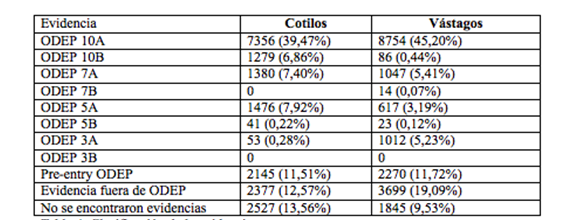
Following the analysis of the 18,816 acetabular or hip cups and 19,546 femoral stems (the main components of the hip prosthesis) collected in the registry, our first surprise was to observe that 123 different models of cups had been used and 138 different models of stems. In the group of participating hospitals in the RACat during the period of the study, it was seen that with many of these models less than 10 units in number of each had been used.

As these models only represent 1% of implants used, they were excluded from the study and in the end 74 models of hip cups and 75 models of femoral stems were studied.

Artroplàsties PTM

The results of the analysis, either recently published or not yet published, now at a pre-publication stage, show that less than 50% of components used had the highest level of scientific evidence in accordance with the ODEP. This top level is achieved when there are studies having 10 years at least of monitoring with a number of prostheses evaluated exceeding 500 units.

What also caught our attention was not finding any evidence for 18 hip cups or 16 femoral stems which represented, respectively, 13.56% and 9.53% of all implants carried out during this period.

Artroplàsties -taula

All scientific studies show limitations and it is not always possible to offer exhaustive results. Aware of this, and of the fact that the data in our study are the results of a research project which might not be able to reflect what the reality of public hospitals in Catalonia is in absolute terms.

We do want to stress that the task of the orthopaedic surgeon needs to be more and more regulated by evidence based medicine and this is, precisely, one of main purposes of arthroplasty registers: to carry out studies like the one we have been able to do at Hospital Sant Rafael with the aim of improving the health care of people.

Post written by Miquel Pons, Danieol Chaverri and Luis Lobo, Hospital Sant Rafael, Barcelona.

Evidència científica i pràctica clínica: el cas de les pròtesis de maluc a Catalunya

9 març
Artroplasties - Equip
Daniel Chaverri, Miquel Pons, Luis Lobo

L’artroplàstia total de maluc és una de les cirurgies que proporciona major satisfacció per la gran millora en la qualitat de vida que genera entre els pacients.

Tant és així que ha estat definida per alguns autors com la cirurgia del segle XX. Es tracta d’un procediment que consisteix en la substitució de l’articulació del maluc per una articulació artificial o pròtesi.

El motiu d’intervenció més comú és l’artrosi, una malaltia causada pel desgast del cartílag que acaba produint un mal funcionament de l’articulació. Es tracta d’un procés especialment comú en persones grans -majors de 65 anys- que cursa amb dolor i que pot limitar de manera important les activitat quotidianes de la persona.

En el context actual d’innovacions i avenços tecnològics continus i davant d’una gran pressió per part dels fabricants, el ventall de pròtesis a disposició dels cirurgians ortopèdics és cada vegada més gran. Aquesta situació fa necessari que les pròtesis que s’utilitzin presentin evidència científica basada en estudis clínics o bé en dades de registres d’artroplàsties.

La legislació que regula la comercialització de dispositius sanitaris (medical devices en anglès), com ara les pròtesis, és més laxa que la que regula els fàrmacs de manera que no cal el mateix tipus d’estudi i, per tant, d’evidència científica per a la seva aprovació. Justament aquesta normativa està en procés de revisió i aviat estarà disponible una nova legislació al respecte.

Fa un parell d’anys, a la prestigiosa revista BMJ (British Medical Journal) es va publicar un article en el qual es mostrava que al Regne Unit el 24% de les pròtesis de maluc utilitzades no tenien cap evidència científica que recolzés la seva efectivitat clínica.

Arran d’aquesta publicació i aplicant la mateixa metodologia, des de l’Hospital Sant Rafael de Barcelona i amb la col·laboració del Registre Català d’Artroplàsties (RACat) de l’Agència de Qualitat i Avaluació Sanitàries de Catalunya (AQuAS), ens vam proposar analitzar quina era l’evidència científica de les pròtesis de maluc utilitzades en els hospitals públics de Catalunya que havien enviat les seves dades al RACat durant el període 2005-2013.

Vam fer-ho mitjançant una cerca en les diferents plataformes destacant l’Orthopaedic Data Evaluation Panel (ODEP), així com Tripdatabase, PubMed i Google acadèmic.

Després de l’anàlisi de les 18.816 còtiles o acetàbuls i de les 19.546 tiges femorals (els components principals de les pròtesis de maluc) recollides en el registre, la primera sorpresa va ser observar que s’havien utilitzat 123 models diferents de còtiles i 138 models diferents de tiges, molts d’aquests models en un nombre inferior a 10 unitats en el conjunt d’hospitals participants en el RACat durant el període d’estudi.

Pel fet de representar menys de l’1% dels implants utilitzats, aquests últims models mencionats van ser exclosos de l’estudi i es van estudiar, finalment, 74 models de còtiles i 75 models de tiges femorals.

Artroplàsties PTM

Els resultats de l’anàlisi -recentment publicats- van mostrar que menys del 50% dels components utilitzats tenien el màxim nivell d’evidència científica segons l’ODEP. Aquest nivell màxim s’obté quan hi ha estudis de més de 10 anys de seguiment amb un nombre de pròtesis avaluades superior a les 500 unitats.

També ens va cridar l’atenció que no es va poder trobar cap evidència de 18 models de còtiles i de 16 models de tiges que representaven el 13.56% i el 9.53%, respectivament, de tots els implants realitzats en aquest període de temps.

Artroplàsties -taula

Tots els estudis científics presenten limitacions i no sempre és possible poder oferir resultats taxatius. Som conscients d’això i del fet que les dades del nostre estudi són els resultats d’un treball de recerca que és possible que no pugui reflectir de manera absoluta com és la realitat dels hospitals públics catalans.

Però sí que volem remarcar que la tasca del cirurgià ortopèdic cada vegada ha de regir-se més en la medicina basada en l’evidència i aquest fet és, justament, una de les principals raons de ser dels registres d’artroplàsties: permetre realitzar estudis com el que hem pogut dur a terme des de l’Hospital Sant Rafael amb la mirada posada en la millora de l’atenció sanitària de les persones.

Entrada elaborada per Miquel Pons, Daniel Chaverri i Luis Lobo, Hospital Sant Rafael de Barcelona.