The speed and relevance of assessing health products

5 oct.
Emmanuel Giménez

The European market of health products has been widely affected by the sudden emergence of a new legislative framework with the new regulations (2017/745 and 2017/746). The subtle difference between directive and regulation is paramount, they say, but we’ll leave that for another occasion. This new framework in the field of health products is characterised among other things by:

  1. A stricter control of high risk health products (for example, certain implantable products)
  2. The strengthening of rules of clinical evidence by including a coordinated procedure at a European level for the authorisation of multicentre clinical research.
  3. The reinforcement of requirements and the coordination between European countries regarding controls and after sales aspects.

In this context of important changes, the assessment community is also clearly active. Thus, on 19 June this year, there was a panel on health products at the international meeting of Health Technology Assessment HTAi, where a new and innovative Italian programme for health products was presented.

The programme, explaining the work carried out over several years in terms of definition and its pilot phase, includes three work packages: appraisal, methodology and monitoring. In another panel closely related to the previous one, in the field of methodology, the presentation of the categories to decide on what to invest in and what to disinvest win clearly stood out.

When talking about monitoring and collecting information, an example that stood out was the debate on the need for early assessments given that the life cycle of a health product tends to be short.

The significant increase in new products available and all the work objects previously mentioned are some of the things that position the importance of specific assessment in health products.

The importance of the assessment of health products is, therefore, undeniable. In the joint production work package of EUnetHTA JA3, in which AQuAS is participating, as many or more assessments of “other technologies” (health products, health interventions,…) have been planned as of the known assessments of drugs. In a sense, the numbers of one or other necessity are matched. The importance of the assessment of “other technologies” was in fact reflected in the HTAi annual meeting in a presentation by Wim Goettsch, director of EUnetHA.

The identification and prioritisation of products to be assessed (the Horizon Scanning system), as well as the balance between innovation and divestment, are also extensively discussed subjects and under continuous debate. Thus, in the REDETS network (in which the AQuAS is also actively participating) and with the leadership of Avalia-T, a public access tool was identified that helps in approaching this subject: the PriTec.

Assessment, therefore, can help directly in the use, management and sustainability of different health systems. In conclusion, new opportunities are provided for improving decision making in the area of health products and some of them will come through demonstrating efficiency by means of the adequate use and definition of health technology assessments (HTA).

Post written by Emmanuel Giménez.

Innovate or innovate

29 set.

What do the following have in common? An integrated circuit of home based hospitalisation, a telephonic nursing management project, a plan to minimise risks and the safe use of drugs, the use of ICTs in patients treated with oral anticoagulants, an assistance route of collaboration between primary and specialised care, the redesign of a programme of assistance in sexual and reproductive health, a functional unit of chronic and subacute patients, the optimisation of assistance to a patient who has undergone surgery and an oncological-geriatric unit of intermediary care?

They are all innovative projects or experiences which are compiled in the  Observatory of Innovation in Healthcare Management, a reference framework to detect innovative initiatives and tendencies in the Catalan Health System. You can read about it in this post by Dolors Benítez.

“Promoting collaborations between organisations by creating synergies, interest groups and setting up challenges.”

If talking about challenges, we have quite a few and innovation is in fact intended to provide solutions to make improvements.

Innovating, therefore, can be seen as a constant and necessary attitude that we can identify in all professional fields and areas of life.

In the AQuAS blog, we have shared some projects with a strong innovative component.

Is it possible to combine active and healthy ageing with innovation?

Pediatrics in the Pyrinees, an innovative experience in the Alt Urgell (Catalonia)

“Virtual Nurse”, a promotional and educational portal for health at the service of people

Elderly person with stroke: integrated care from the acute phase to the return home

Post written by Marta Millaret (@MartaMillaret)

The DECIPHER Project: from the interoperability to the procurement of innovation

8 juny
Jean Patrick Mathieu

In 2013 when Agència de Qualitat i Avaluació Sanitàries (AQuAS) relaunched the project DECIPHER (@DECIPHERpcpEU), we were pioneering in the field of Procurement of Innovation and little did we know on the journey ahead. The project proved to be a big challenge for the AQuAS, the Catalan Department of Health and the all consortium involved.

The European Commission Officers and the projects evaluators would also be faced with a new type of project and with the projects consortium and stakeholders, we all learned a lot in this exciting adventure.

The journey would end in March 2017 with the Barcelona final event, but the aftermath of the projects will definitely be felt in the years to come.

Rossana Alessandrello at the DECIPHER – FINAL EVENT (Barcelona 2017)

DECIPHER was a project funded by the European Commission under the 7th  Framework Programme (FP7) under a call for project in 2011 whose topic was “Patient Guidance Services (PGS), safety and healthcare record information reuse”.

The objective of the project was to enable secure cross-border mobile access to existing patient healthcare portals which are individually supported by public bodies.

DECIPHER would deploy Pre-commercial Procurement (PCP) to create step-change innovations in mobile patient ICTs. Using electronic patient records as the key enabling technology, this joint PCP would create technology-led service transformation in cross-border mobile healthcare, delivering qualitative and significant benefits to patients and healthcare organisations.

The Consortium consisted of ESTAR Centro (Tuscany), TicSalut (Catalonia) and CMFT (Manchester).  Suppliers will be challenged to build on outputs from epSOS, CALLIOPE, and LOD2, and advances in mobile technology. Moreover, experts from Greece, France, Finland, UK, Sweden and Ireland will provide support.

DECIPHER will generate a portfolio of interoperable applications, deployed on a pan-European platform. This resource will improve existing healthcare services by supporting mobility of patients and healthcare providers.

As a use-case scenario, the solutions were to focus on patients with a chronic health condition and Diabetes type II was selected.

From anywhere in the European Union, a patient will be able to use a secure mobile device safely to gain 24/7 access to their prescription data, emergency data, examination results and other health information.

By the end of the project, 6 prototypes solutions were funded of which 3 finalists received full funding to develop a full final version. Although the respective national Personal Health Records (PHRs) systems of the three procuring authorities are not able to implement those solutions in their current state, the achievements are important for DECIPHER:

  1. Invaluable experiences were gathered by all stakeholders involved in the project
  2. SMEs from all over Europe came under the radar of potential clients, the public procuring authorities in the consortium and those who were interested on the project
  3. AQuAS acquired an expertise in procurement of innovation that is now well-renowned in Europe and beyond.
  4. The lessons learned will be applied in the new PCP project coordinated by AQuAs, Antisuperbugs.

DECIPHER project was initially designed to address the interoperability issue in the healthcare sector. But, this project has been fundamental in the development of a model of procurement of innovation useful for the set-up of this kind of project. With this objective in Catalonia, we consider DECIPHER as a case use where AQuAS lead the path with a set of toolkit, methodology and expertise.

Post written by Jean Patrick Mathieu.

Analysis of research data in health: opportunities within reach

9 febr.
Xavier Serra-Picamal

The generation and storage of data is omnipresent nowadays. The costs have fallen drastically and the health sector is not alien to this. To illustrate this, it is worth having a look at the following graph created by the National Institutes of Health about the human genome, which shows the evolution of the cost of sequencing a genome:Cost per genome

As can be seen, since 2007, the cost of sequencing a genome has fallen dramatically. Having one’s own genome sequenced is now possible and in the future it may become commonplace. Bearing in mind that a copy of the human genome is made up of aproximately 3 million base pairs (3 million adeninines, thymines, citosines or guanines arranged sequentially in 23 chromosomes ) it is easy to infer that, also within this field, the quantity of data generated in the coming years will be massive.

This tendency is repeated in other areas of health care: among other, clinical history data in electronic format, medical imaging, primary care data or that of drug consumption are obtained and stored in registries, in general, structured and interlinked. The potential of this data for carrying out research in order to provide better health care is notable, in the way of faster and more accurate diagnoses, improved therapeutic approaches and a better management of the system.

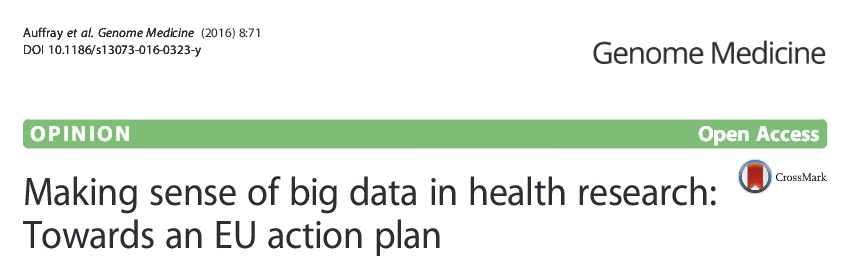
To analyse the challenges and opportunities at a European level, a work session organised by the Directorate-General for Research and Innovation of the European Commission was held in Luxembourg with representatives from AQuAS. The points discussed have been gathered in the article Making sense of big data in health research: Towards an EU action plan, published in the Genome Medicine magazine and of open access. As explained in the article, using this information to provide better healthcare is a challenge but a great opportunity at the same time.

Making sense of big data in health research

Nevertheless, a big effort is required to transform this data into knowledge and specific actions. However much the costs of generating and storing data may drop, the management of information, its interpretation, and the generation of knowledge needs considerable investment and resources. This means having adequate information systems as well as the economic and human resources so that the data can be treated efficiently and the protection of individual rights guaranteed. In addition, the participation, commitment and effective communication of all the agents of the system is needed (including the scientific community, patients, citizens, the administration, and so on) to guarantee that this data is used efficiently, responsibly and that it promotes research which is efficient and of quality.

Catalonia, because of the size of its population, the fact that it has an integrated health system and the work done over many years, is well positioned to be able promote the reuse of health data for research. At an international level, some comparable projects exist and new projects exist with the goal of integrating and consolidating data from different sources, with some very ambitious and attractive programmes. The  PADRIS Programme, presented last 12 January, aims to centralise and make the data generated in health available to researchers in research centres in Catalonia and universities so as to provide better healthcare with a maximum guarantee in security and privacy. The work to be done is considerable. The resources needed too. The opportunities to provide better research and better healthcare are within reach.

Post written by Xavier Serra-Picamal, researcher at the Karolinska Institutet (Sweden).

* TERMCAT (the centre for terminology in the Catalan language) has recently dealt with the question of how to say data scientist in Catalan. The subject is very much a current issue!

Analítica de datos en investigación en salud: oportunidades al alcance

9 febr.
Xavier Serra-Picamal

La generación y almacenaje de datos es ya omnipresente. Los costes han disminuido de forma drástica y el ámbito sanitario no es ajeno. Para ilustrarlo, vale la pena ver el siguiente gráfico, elaborado por el Instituto americano de investigación sobre el genoma humano (National Human Genome Research Institute), y que muestra la evolución del coste de secuenciación de un genoma:

Cost per genome

Como se observa, desde 2007, lo que cuesta secuenciar un genoma ha disminuido enormemente. Tener el propio genoma secuenciado ya es posible y en un futuro posiblemente sea frecuente. Teniendo en cuenta que una copia del genoma humano está formado por aproximadamente 3 millones de pares de bases (3 millones de adeninas, timinas, citosinas o guaninas dispuestas secuencialmente en 23 cromosomas) es fácil deducir que, también en este ámbito, la cantidad de datos que se generarán en los próximos años será ingente.

La tendencia se replica en otros aspectos de la atención sanitaria: datos de historiales clínicos en formato electrónico, imagen médica, datos de atención primaria o de consumo de fármacos, entre otros, son obtenidos y almacenados en registros, generalmente estructurados y entrelazados. El potencial de estos datos para hacer investigación que sirva para proveer una mejor asistencia sanitaria es notoria, en forma de diagnósticos más rápidos y detallados, mejores abordajes terapéuticos y una mejor gestión del sistema.

Para analizar los retos y oportunidades a nivel europeo, se hizo una sesión de trabajo organizada por la Dirección General por la Investigación e Innovación de la Comisión Europea en Luxemburgo, con presencia de AQuAS. Los puntos que se discutieron se han recogido en el artículo Making sense of big data in health research: Towards an EU action plan, publicado en la revista Genome Medicine, y que se puede consultar en abierto. Tal como se recoge en el artículo, utilizar esta información con el fin de proveer una mejor atención sanitaria es un reto y una gran oportunidad al mismo tiempo.

Making sense of big data in health research

Hace falta, sin embargo, un gran esfuerzo a fin de que estos datos se transformen en conocimiento y acciones concretas. Por más que los costes de generación y almacenaje bajen, la gestión de la información, interpretación, y generación de conocimiento necesitan de una gran inversión y recursos. Eso implica dotarse de sistemas de información y recursos económicos y humanos adecuados, a fin de que los datos se traten de manera eficiente, garantizando la preservación de los derechos individuales. Además, es necesaria la participación, implicación y comunicación de todos los agentes del sistema (incluyendo la comunidad científica, pacientes, ciudadanos, administración…) para garantizar que el uso de estos datos sea eficiente, responsable y fomente una investigación eficiente y de calidad

Cataluña, por el número de habitantes, el hecho de disponer de un sistema sanitario integrado y por el trabajo hecho durante años, está en una buena posición para fomentar la reutilización de datos de salud para la investigación. A nivel internacional, existen algunos proyectos equiparables, y existen nuevos proyectos para poder integrar y consolidar datos de diferentes fuentes, con algunos programas muy ambiciosos y atractivos. El programa PADRIS que se presentó el pasado 12 de enero, nace con el objetivo de centralizar y poner al alcance de los investigadores de los centros de investigación de Cataluña y universidades los datos que se generan en salud con el fin de ofrecer una mejor atención sanitaria con las máximas garantías de seguridad y privacidad. El trabajo para hacer es grande. Los recursos necesarios también. Las oportunidades para ofrecer una mejor investigación y una mejor atención sanitaria están al alcance.

Entrada elaborada por Xavier Serra-Picamal, investigador en el Karolinska Institutet (Suecia).

*Recientemente, el TERMCAT (centro de terminología de la lengua catalana) ha tratado la cuestión sobre cómo se puede decir data scientist  en catalán. ¡El tema es muy actual!


Analítica de dades en recerca en salut: oportunitats a l’abast

9 febr.
Xavier Serra-Picamal

La generació i emmagatzematge de dades és ja omnipresent. Els costos han disminuït de forma dràstica i l’àmbit sanitari no n’és aliè. Per il·lustrar-ho, val la pena  veure el següent gràfic, elaborat per l’Institut americà de recerca sobre el genoma humà (National Human Genome Research Institute), i que mostra l’evolució del cost de seqüenciació d’un genoma:

Cost per genome
Com s’observa, des de 2007, el que costa seqüenciar un genoma ha disminuït enormement. Tenir el propi genoma seqüenciat ja és possible i en un futur possiblement sigui freqüent. Tenint en compte que una còpia del genoma humà està format per aproximadament 3 milions de parells de bases (3 milions d’adenines, timines, citosines o guanines disposades seqüencialment en 23 cromosomes) és fàcil deduir que, també en aquest àmbit, la quantitat de dades que es generaran en els propers anys serà ingent.

La tendència es replica en altres aspectes de l’atenció sanitària: dades d’historials clínics en format electrònic, imatge mèdica, dades d’atenció primària o de consum de fàrmacs, entre d’altres, són obtingudes i emmagatzemades en registres, generalment estructurats i entrellaçats. El potencial d’aquestes dades per a fer recerca que serveixi per proveir una millor assistència sanitària és notòria, en forma de diagnòstics més ràpids i acurats, millors abordatges terapèutics i una millor gestió del sistema.

Per analitzar els reptes i oportunitats a nivell europeu, es va fer una sessió de treball organitzada pel Directorat General per la Recerca i Innovació de la Comissió Europea a Luxemburg, amb presència d’AQuAS. Els punts que es van discutir s’han recollit a l’article Making sense of big data in health research: Towards an EU action plan, publicat a la revista Genome Medicine, i que es pot consultar en obert. Tal i com es recull en l’article, utilitzar aquesta informació per tal de proveir una millor atenció sanitària és un repte i una gran oportunitat alhora.

Making sense of big data in health research
Cal, però, un gran esforç per tal que aquestes dades es transformin en coneixement i accions concretes. Per més que els costos de generació i emmagatzematge baixin, la gestió de la informació, interpretació i generació de coneixement necessiten d’una gran inversió i recursos. Això implica dotar-se de sistemes d’informació i recursos econòmics i humans adequats, per tal que les dades es tractin de manera eficient, garantint la preservació dels drets individuals. A més, és necessària la participació, implicació i comunicació de tots els agents del sistema (incloent la comunitat científica, pacients, ciutadans, administració…) per garantir que l’ús d’aquestes dades sigui eficient, responsable i fomenti una recerca eficient i de qualitat

Catalunya, pel nombre d’habitants, el fet de disposar d’un sistema sanitari integrat i per la feina feta durant anys, està en una bona posició per fomentar la reutilització de dades de salut per a la recerca. A nivell internacional, existeixen alguns projectes equiparables, i existeixen nous projectes per poder integrar i consolidar dades de diferents fonts, amb alguns programes molt ambiciosos i atractius. El programa PADRIS que es va presentar el passat 12 de gener, neix amb l’objectiu de centralitzar i posar a l’abast dels investigadors dels centres de recerca de Catalunya i universitats les dades que es generen en salut per tal d’oferir una millor atenció sanitària amb les màximes garanties de seguretat i privacitat. La feina per fer és gran. Els recursos necessaris també. Les oportunitats per oferir una millor recerca i una millor atenció sanitària són a l’abast.

Entrada elaborada per Xavier Serra-Picamal, investigador al Karolinska Institutet (Suècia).

*Recentment, el TERMCAT (centre de terminologia) ha tractat la qüestió sobre com es pot dir data scientist en català. El tema és ben actual!