Implementation Science and new HTA regulation: two very different subjects

31 oct.

The implementation of improvements, changes in procedures, the introduction of good practices in specific health contexts and the new regulation regarding the assessment of health technologies, respectively, are subjects on the agenda at the AQuAS. Today, we will look at them in broad terms and in the future we will delve into them in more detail from this space.

To learn more about “implementation science” or “research implementation” we held a workshop at the headquarters of AQuAS with Laura J. Damschroder, an expert consultant in implementation science and researcher in the United States.

From her talk we highlight the idea of building collective knowledge and identifying the barriers and facilitators in implementation, the time factor and the value of assessment.

It is also important to know the theoretical and conceptual framework of implementation and the “basics” of implementation science which is useful for any project being implemented, as is designing and following an adequate plan of action.
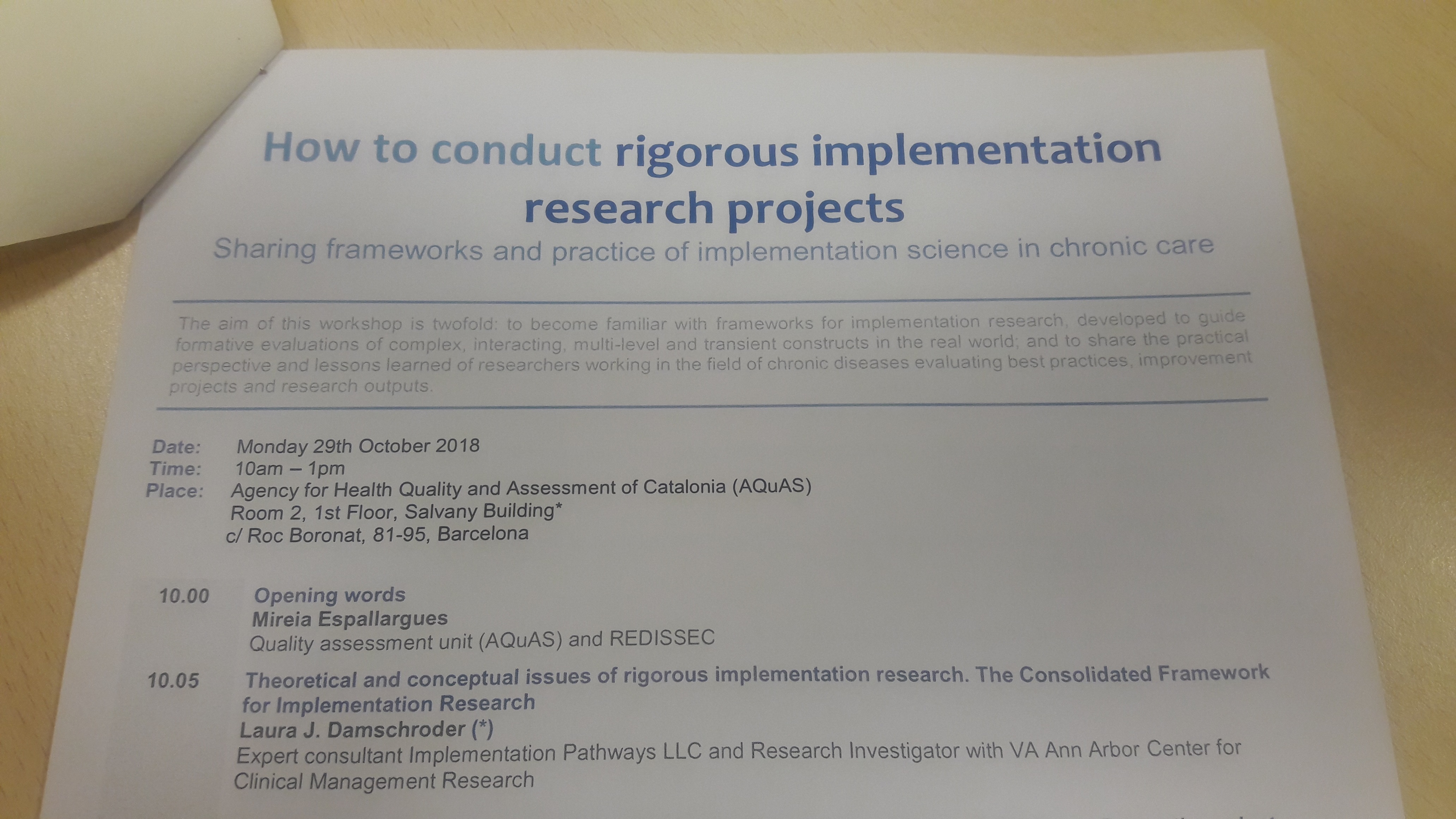
 

The workshop proceeded by looking at different examples of the implementation of good practices in the context of REDISSEC, the Health Services Research on Chronic Patients Network.

It all stems from the annual meeting of this network held in Madrid last week at the Instituto de Salud Carlos III, in which the idea of organising this workshop was put forward in order to bring some of the contents of the meeting closer to the Catalan context, with the participation of the AQuAS, the Hospital del Mar, and the Fundació Avedis Donabedian.

In terms of the AQuAS, three talks were given on projects in which implementation research is being done, with a different perspective in each case:

  • Quality standards in implementation by Vicky Serra-Sutton from the European project on dementia Act on Dementia Joint Action. The AQuAS team involved in this project was in fact given a mention this week at the Alzheimer Europe Conference which was held in Barcelona
  • The transfer of good practices and impact assessment by Elisa Poses-Ferrer from the European Project CHRODIS PLUS on chronicity
  • The assessment of projects for improvement in integrated care by Jillian Reynolds from the European project SUSTAIN on integrated care for older people.

Regarding the Hospital del Mar, we heard a talk by Maria Sala on the personalisation of screening for breast cancer and regarding the Fundació Avedis Donabedian, we heard a talk by Carola Orrego and Marta Ballester, who brought reflections on aspects of improvement and lessons learnt in implementation.

This workshop was a good opportunity for speakers and attendees to share experiences and knowledge.

Moving on to the second subject.

In terms of the new European HTA regulation, which is in its final stages of discussion in the European Parliament, Iñaki Imaz, from the Instituto de Salud Carlos III in Madrid gave a seminar which we were able to follow live at the AQuAS.

It was very interesting for many reasons. Situations were contextualised that justify the need for health technology assessment (HTA) as a starting point, which is always present in our context.

The emphasis was also placed on the complexity of assessment and the different possible scenarios (or levels). On the other hand, aspects being discussed regarding the proposal for legislation which would allow for, among other objectives, joint clinical assessment at a European level, were commented on in detail.

The seminar can be found on the following link:

Imaz I. The future of health technology assessment in Europe. Regarding the proposal for regulation passed by the European Parliament. Madrid: Agency for Health Technology Assessment. Instituto de Salud Carlos III, 30 November, 2018.

Talking about HTA in Europe, a lot has been done (more than 30 assessments available within the framework of EUnetHTA), there is work in progress and, above all, there is the desire for all to gain in terms of confidence, guarantees, transparency and the sustainability of health systems. What is especially sought after is to avoid duplicities and to share knowledge and methodologies.

We will keep track of all these subjects.

Implementation Science i nova regulació HTA: dos temes ben diferents

31 oct.

La implementació de millores, canvis en els processos, introducció de bones pràctiques en contextos determinats de salut i la nova regulació sobre avaluació de tecnologies sanitàries, respectivament, són temes presents a l’agenda d’AQuAS. Avui ho veurem a grans trets i, en properes ocasions, hi aprofundirem més des d’aquest espai.

Per aprendre sobre “implementation science” o “research implementation” vam fer un workshop a la seu d’AQuAS amb Laura J. Damschroeder, consultora experta en ciència de la implementació i investigadora als Estats Units.

De la seva ponència en destaquem la idea de construir coneixement col·lectiu i d’identificar barreres i facilitadors per a la implementació, el factor temps i el valor de l’avaluació.

És important també conèixer el marc teòric i conceptual de la implementació i els “bàsics” de la ciència de la implementació, útils per a qualsevol projecte en fase d’implementació, com també ho és el fet de dissenyar i seguir un pla d’acció adequat.

El workshop va continuar amb diferents exemples d’implementació de bones pràctiques en el context de la REDISSEC, la Red de Investigación en Servicios de Salud en Enfermedades Crónicas .

Tot ve del fet que la setmana passada es va fer a Madrid, a l’Instituto de Salud Carlos III, la reunió anual d’aquesta xarxa i es va plantejar la idea d’organitzar aquest workshop i apropar, d’aquesta manera, alguns continguts de la reunió al context català; amb participació d’AQuAS, de l’Hospital del Mar i de la Fundació Avedis Donabedian.

Pel que fa a AQuAS, es van presentar tres ponències sobre projectes on es fa recerca de la implementació, amb una perspectiva diferent en cada cas:

  • Estàndards de qualitat en la implementació per Vicky Serra-Sutton des del projecte europeu sobre demència Act on Dementia Joint Action. Justament, l’equip d’AQuAS implicat en aquest projecte ha tingut una menció aquesta setmana a l’Alzheimer Europe Conference que s’ha celebrat a Barcelona
  • Transferència de bones pràctiques i avaluació de l’impacte per Elisa Poses-Ferrer des del projecte europeu CHRODIS PLUS sobre cronicitat
  • Avaluació de projectes de millora de l’atenció integrada per Jillian Reynolds des del projecte europeu SUSTAIN sobre atenció integrada en persones grans

Pel que fa a l’Hospital del Mar, vam comptar amb la ponència de Maria Sala sobre la personalització del cribratge de càncer de mama i pel que fa a la Fundació Avedis Donabedian vam comptar amb les ponències de Carola Orrego i de Marta Ballester, que van aportar reflexions sobre aspectes de millora i lliçons apreses en implementació.

Aquest workshop va ser una bona oportunitat per a ponents i assistents a l’hora de compartir experiències i coneixements.

Canviem al segon tema.

Sobre la nova regulació Europea d’HTA que s’està acabant de perfilar en el Parlament Europeu, Iñaki Imaz de l’Instituto de Salud Carlos III de Madrid va fer un seminari que vam poder seguir en directe des d’AQuAS.

Va ser molt interessant per molts aspectes. Es van contextualitzar situacions que justifiquen la necessitat de l’avaluació de tecnologies sanitàries (HTA, per les inicials en anglès) com a punt de partida sempre present en el nostre context.

També es va posar èmfasi en la complexitat de l’avaluació i dels diferents escenaris (o nivells) possibles i es van comentar, amb detall, aspectes que s’estan discutint al voltant de la proposta de legislació que hauria de permetre, entre d’altres objectius, una avaluació clínica conjunta a nivell europeu.

El seminari es pot tornar a veure des del següent enllaç:

Imaz I. El futuro de la evaluación de tecnologías sanitarias en Europa. A propósito de la propuesta de regulación aprobada por el Parlamento Europeo. Madrid: Agencia de Evaluación de Tecnologías Sanitarias. Instituto de Salud Carlos III, 30 de noviembre de 2018.

Si parlem d’HTA a Europa, hi ha molta feina feta (en el marc d’EUnetHTA hi ha disponibles més de 30 avaluacions), feina en curs i, sobretot, la voluntat de guanyar tots plegats en termes de confiança, de garanties, de transparència i de sostenibilitat dels sistemes de salut. Especialment el que es busca és evitar duplicitats i compartir coneixement i metodologies.

Anirem seguint tots aquests temes.