Shall we go an extra mile? The IMIM and IDIBELL place the patient at the centre of research

24 gen.
Maite Solans Domènech

Research impact assessment studies show that to achieve more impact on society the participation of ‘people that can provide value’ is an important factor. What these studies show us is that making key actors participate in the long process of research can improve the efficacy of its application and its impact on society. In the conference which AQuAS organised on Participation in Research last April 4, Derek Stewart, very much involved in Patient and Public Involvement and Engagement at the NIHR Nottingham Biomedical Research Centre, told us that participation provides different perspectives to research. In addition, Derek Stewart explained that “while patients have the opportunity to configure the future and make sense of what is happening to them in their day to day, researchers have the opportunity to legitimate what they do and make their results visible.”

So what have we learnt from all this? Firstly, that there is diversity of participation in research with a wide range of ways of interaction that are inserted in the different levels of the research process. Secondly, that despite individual idiosyncrasies, a global and shared approach is needed to avoid contradictions and to take advantage of mutual learning. Thirdly, that a commitment is needed on the part of all the different institutions and the research community in order to favour participation in research and to have an impact on society. This is why a Work Group on Participation in Research has been created, (#SomRecerca). Under the initial coordination of AQuAS, different health research institutions have come together to promote actions, agents or strategies that facilitate participation and that foster more awareness of the research community. The principles that accompany this group are based on mutual support and the acceptance that diversity and different realities exist within each context.

The first step taken by this group has been to hold conferences in two institutions (IMIM and IDIBELL), last 22 and 23 of January, under the title Shall we go one step further? Placing the patient at the centre of research. These conferences have been a good opportunity to present experiences that were already on the go within the institution itself which place the patient at the centre of research.

The conferences have made the different experiences stemming from individual motivations worthwhile, of researchers or users themselves, and they have been inspirational as examples of where one can start. The patient has been placed at the centre of research in these experiences: to obtain resources, to generate ideas, to prioritise research or to be a part of the research team, among others.

And more specifically, actions have been proposed that help develop the participation of patients which provides value in research:

  • Informing patients of the research that is being carried out in institutions; that is, bringing research closer to citizens
  • Communicative skills of the researcher towards a non-scientific audience
  • Effective communication channels between patients and researchers, be they via an associative network or via other activities or means of communication such as conferences with patients, etc…
  • Support for all those involved in participation: of recruitment, of time, of resources, between researchers or with a guide.
  • Stable work groups that include the participation of different profiles (basic and clinical researchers, assistants, managers and patients) so as to identify needs, come up with ideas or make proposals, for example.

In short, the synergies between patients and researchers must be sought out in those cases where value can be provided. It is not always and easy path but one which makes a whole lot of sense.
Post written by Maite Solans Domènech.

Who talks about what at EUnetHTA?

3 maig
Marta Millaret

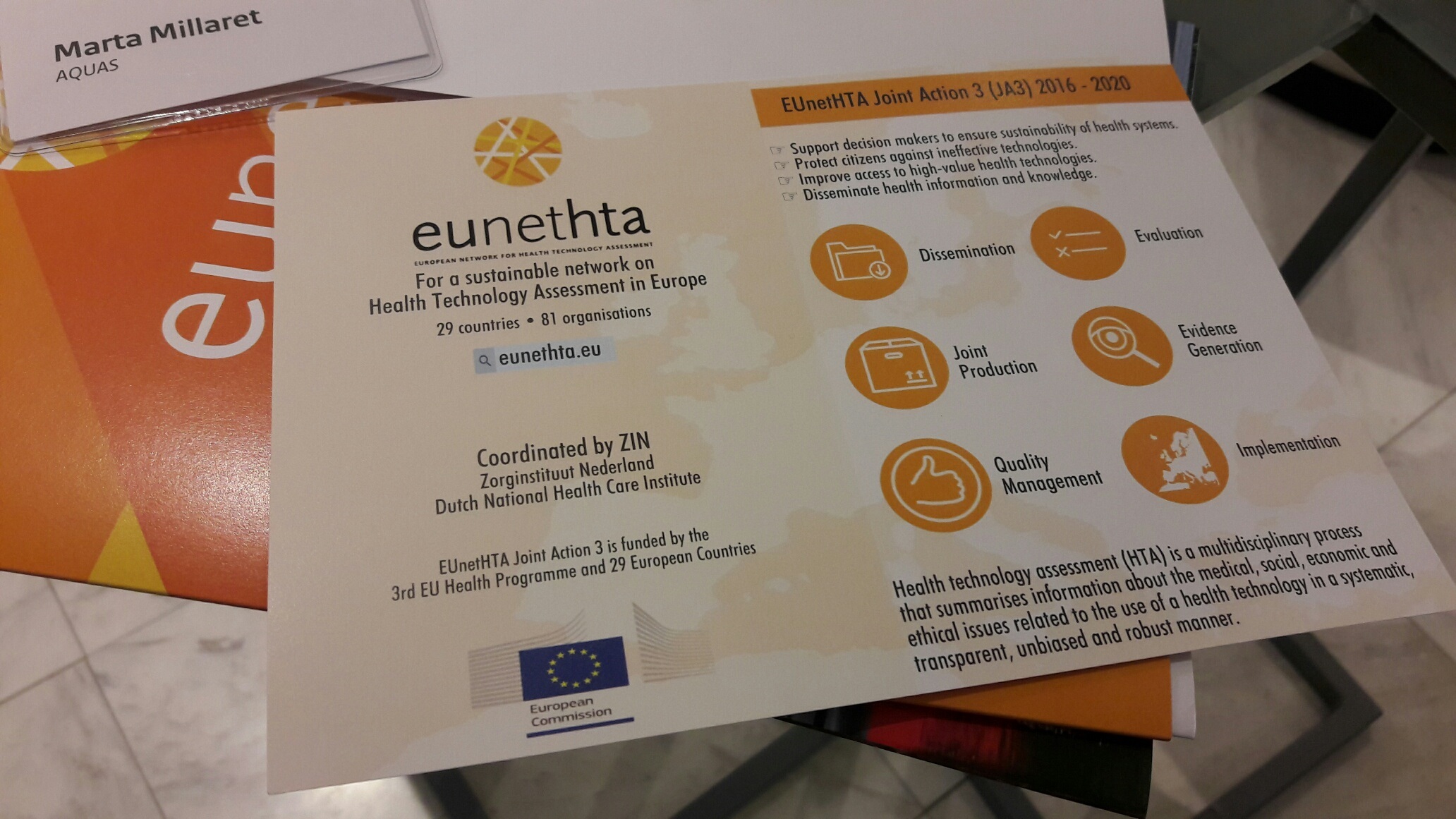
AQuAS is analysing the activities of dissemination of the EUnetHTA project, a European Joint Action comprised of 61 organisations from 29 countries and coordinated from the Zorginstituut Nederland in Holland. It is the European health technology assessment network.

Assessment, as Emmanuel Giménez talked about in this post,”can directly help in the practice, management and sustainability of different health systems” by providing the best available knowledge for taking decisions at different levels.

It is precisely on this subject that a proposal has recently been published regarding the regulation of drugs and health products within the framework of the European Commission and which is being debated and outlined for implementation.

The aim of the EUnetHTA project is to facilitate cooperation between different institutions in the field of health technology assessment to take advantage of expertise and useful knowledge to favour health systems which will consequently provide potential benefits for the health of citizens. It is about generating quality knowledge by using common methodologies in a systematic and transparent way and it is about doing this by working collaboratively and by avoiding duplicities.

AQuAS participates very actively in different work groups in the project (assessment, implementation, generation of evidence, dissemination) and today we are going to put the spotlight on the dissemination group, led by Iñaki Imaz of the Instituto de Salud Carlos III (Institute of Health Carlos III) in Madrid. This work group has the challenge of communicating more and better regarding what the EUnetTHA project is.

To do this, there are different strategies and one of these is the assessment of the dissemination itself, a task led by AQuAS. To this end, the different activities are being brought together and a first analysis has been carried out which will be repeated every four months with the idea of obtaining recommendations and specific actions.

In the first intake, almost a 100 activities have been included. 78% correspond to the activities in scientific meetings (workshops, presentations, oral communications and posters); 5% are articles in scientific publications with an impact factor in the Journal Citation Reports and the remainder (17%) are other publications, e-meetings and activity done in social networks.

This analysis will make it possible to look at who disseminates, what is disseminated and where it is disseminated as well as looking at the content and who the majority target audience is of these dissemination activities within the framework of the EUnetHTA project. The results of the first analysis will be presented at the next general assembly of the project in Cologne (Germany) at the end of the month.

We feel that it is interesting to find the way to involve all those participating in facilitating the dissemination of the project so as to achieve a more active communication of the EUnetHTA project. Involvement in dissemination means getting the people that work on a project to disseminate both their work and their project at the same time. In this way, everyone stands to gain.

Will we succeed in getting all participants more involved in the activities of dissemination? Will our assessment serve to improve things? That is to be seen.

Post written by Marta Millaret (@MartaMillaret).

Altmetrics: complementary metrics focused on the article

19 abr.
Ernest Abadal

The traditional system in assessing the quality of a scientific publication (a journal article, for example) has fundamentally been based on the calculation of the citations it generates. In an article published in Science (1995), Eugene Garfield (1925 – 2017) proposed a citation index as a system that would help authors find articles on a subject. It was a great innovation without doubt. Later, with the creation of the Institute for Scientific Information (today the Web of Science) and the Journal Citation Reports, this system became very prominent and centred its work on the assessment of journals because it helped authors decide in which journal to publish (based on the impact factor calculated for each one).It is a system that has been criticised from the humanities and social sciences and also because it does not focus on the article itself but instead gives the reference value to the journal in which it is published (and presupposes that an article should “inherit” the journal’s impact factor).

From 2010, people started talking about altmetrics, a set of indicators (for example, how often an article is shared, its re-dissemination, the comments it has generated, mentions (likes), etc…) that measure the presence of a publication in social and academic networks, which complement citation indexes considerably. Altmetrics, therefore, assess the repercussion of an article itself and not that of a journal as a whole (the way impact factors do, for example).

At present, several scientific editors have taken this information into consideration. One of the first examples was the journal PLOS, followed by Nature and others. Its use has also spread to data bases (e.g. Scopus) and to academic networks (e.g. ResearchGate). The altmetric data that accompany an article tend to have the sections that appear in figures 1 and 2, even though there can be small differences depending on the programme used (ImpactStory, PLUM, Article Level Metrics, altimetrics.com, etc…).

Figure 1.

Figure 1. Example of the altmetrics of an article in PLOS

And so we can see that it is not only the statistics of presence in social networks that are included (mentions, blogs, etc…) but also the use of data (visualisations and downloads) as well as the citations of an article (in Scopus, CrossRef, PubMed, GoogleScholar, etc…). We are talking about very complete quantitative information for the reader and also for the author of the article.

Figure 2. Example of the altmetrics of an article in Nature

In the case of Nature (figure 2) there is also a graphic representation in the form of a circle or “ring” in which each colour is a type of channel (twitter, blogs, facebook, wikipedia, etc…), where a contextualised percentage is given in relation to articles which are similar in age and it also indicates its precise presence in the general media (“news articles”) and scientific blogs.

Let us do a quick assessment of altmetrics. Their main strengths lie in the fact that they measure the impact of publications beyond academic circles, strictly speaking, that they can be applied to all types of documents (be it an article, a book or a doctoral thesis), that the results are immediate (there is no need to wait for the annual value of the impactor factor) and that they focus on the article (and not on the journal).

In terms of their weak points, it should be said that the indicators need to be collected very quickly (they are very volatile), that it is difficult to compare the indicators between each other (which is of more value, a retweet or a “like”?), that there is great difficulty in the normalisation and homogeneity when collecting data (which does not occur in the case of citations) and that different measuring tools produce different results (e.g. ImpactStory or Altmetrics).

Altmetrics, therefore, help to measure the impact of a specific publication in social networks. This is why we should define them as complementary metrics rather than alternative metrics. In contrast to the traditional impact factor – which is applied to a journal – altmetrics are centred on the article and this is a significant innovation. Despite them having some weak points they are in a consolidation phase and have long-term potential.

From a researcher’s perspective, it is clear that at present publishing an article in a journal is not enough and one needs to be fully involved in its dissemination in social networks (especially Twitter, blogs, etc…) and also in academic networks (Researchgate, Mendeley, etc…) so as to give visibility to the contents published. In this new scenario, altmetrics are fundamental because they are able to measure this impact in networks and offer authors (and readers) a general view of the dissemination of their publications.

Post by Ernest Abadal, Faculty of Library and Information Science, University of Barcelona.

Medical information in the press and the doctor-patient relationship

15 febr.
Gaietà Permanyer

For years, I have been under the impression of not having a clear idea of how information related to the complex world of medicine and health should be disseminated in the daily news media, both of the science that it is based on and of the difficulties and dilemmas in applying it in practice.

I have repeatedly refused offers, with only rare exceptions, to write texts on these subjects in newspapers or books of a non-professional nature: I had serious doubts of how to transmit this knowledge to the public at large. Looking back critically on these reservations I have had, I think they have been related to the paternalism inherent in the medical training received by the professionals of my generation: the fear that the public will make an incorrect interpretation and come to abhorrent conclusions of the facts disseminated, an audience with little knowledge on the theoretical foundations and subtleties of these facts, which are only accessible with proper professional training. Indeed, experience has shown me that these reservations were indeed justified.

However, at the same time, I have witnessed the growth of citizens’ autonomy, now widely acknowledged, and their right to take “informed decisions”. This position, which has come to define the 21st Century as “the patients’ century”, acknowledges their right to know relevant professional data so as to be able to take accurate decisions autonomously; it has an undeniable foundation but if we are to avoid that this leads to the proliferation of distorted facts it will require a rigorous preparation and an absence of spurious interests on the part of those divulging information. Ideally, these informants should contribute to “health literacy” in a way that is balanced, objective and unemotional.

The tension between these two conceptions of health information goes in parallel with that which exists between two extreme views of the doctor-patient relationship: the classical paternalistic one (“the doctor knows better than anyone what is best for a patient and their decision must be accepted”) and that of the “informed consumer” with autonomous decisions. The other extreme of this corresponds to an “imminent revolution” in which it would be the very well-informed patient, (basically as a result of the spread of refined computer technology) that would take the most important decisions concerning themselves.

Personally, like many others, I prefer a more balanced approach: that corresponding to the “interpretative” and “deliberative” models of the doctor-patient relationship, in which the experience and knowledge of the former interact with the latter respecting their autonomy.

I think that this dilemma runs parallel to the medical information found in daily news media: on the one hand, there is the social demand to inform citizens of current advances so they know their options or opportunities as “informed consumers”; on the other, there is the temptation to fuel the emotions (triumphalism or fear) of the reader who is untrained by offering them information which is largely uncritical, lacks rigour or is insufficient, with the risk of a biased, distorted or exaggerated interpretation. The more or less unreal notions that some informants may have on medical and health problems (common, alas, among many professionals) can be transmitted like this directly to the citizen and to their emotions and desires.

In the case of news related to medical advances and innovations, I would like citizens to know what expectations these novelties raise, maybe now within their reach, and the magnitude or relevance of the problem that can be lessened or resolved, and that this be done by using a rigorous and prudent terminology so that citizens can also create their own opinion on the solidity or temporariness of an innovation, and of the related uncertainties and limitations: not only of the benefits that they can provide them with but also of the undesired, uncomfortable or harmful side effects they might produce, and whether they are in anyway frequent or probable. In other words, I would not like the main aim of this information to be that of creating hope or fear in the reader, or give them the idea in a triumphal tone that in the wonderful world of science, the war against disease has claimed a new victory, especially at the hands of local researchers.

I have recently taken part in an analysis of the news published in the daily press in Catalonia on medical innovations.

Even though some well-documented news described in sufficient detail was found that could provide balanced information to the reader in this analysis, in many other cases the information was one-sided or not very thorough and was devoid of facts related to questionable aspects of the innovation and their risks. It resulted in a biased message which often tended to induce optimism in the reader rather than educate them in the knowledge of the pros and cons of the medical innovations.

At a time when there is a call for a user’s well-informed autonomy, I would be delighted if healthcare culture and the attitude of the news media did not amount to a paternalistic doctor-patient relationship. In this regard, there is no doubt that much still needs to be done.

Post written by Gaietà Permanyer Miralda. Emeritus physician. Unit of Epidemiology, Cardiology Service. Hospital Vall d’Hebron, Barcelona.