Committed to research assessment 100%

31 ag.

Since 2001, the AQuAS (Agency for Health Quality and Assessment of Catalonia) has been in charge of evaluating the proposals of research projects that are eligible to receive funding from the Fundació La Marató de TV3. It means prioritising the research with the most quality using a quantitative and qualitative methodology in a process that lasts months and that ends in a face-to-face meeting of international experts.

Group photograph of the final meeting with international experts in assessing the FMTV3 call on Diabetes. Barcelona, September 2016. From left to right and top to bottom: Gerald Tomking (Diabetes Institution of Ireland), Joan MV Pons (AQuAS), Johann Wojta (Medical University of Vienna), Stephan Zipfel (University of Tuebingen), Karlheinz Friedrich (University Hospital Jena), Maite Solans (AQuAS), Harold de Valk (University Medical Centre Utrecht), Hans-Georg Joost (German Institute of Human Nutrition), Juergen Eckel (German Diabetes Center), Ernest Vinyoles (external observer), Anna Monsó (external observer), Gabriel Capellà (external observer), Jaume Reventós (external observer), Bea Ortega (AQuAS), Esther Vizcaino (AQuAS), Núria Radó (AQuAS)


The assessment of research which is centred at the AQuAS considers three different stages in the cycle of research. The assessment of research proposals (avaluació ex-ante), assessment during research (ongoing assessment) and assessment once the research has been completed (avaluació ex-post). The AQuAS has a long track record and lengthy experience in all these stages of research.

The fact that one and the same institution does assessment of research and assessment of the health system is altogether exceptional and is one of the strong points of the AQuAS. The two types of assessment benefit each other mutually as a result of the knowledge that is generated.

Another area of research in which the AQuAS has been a pioneer is in assessing the impact of research. This year, the International School for Research Impact Assessment (ISRIA) will be held in Denmark (more information here).

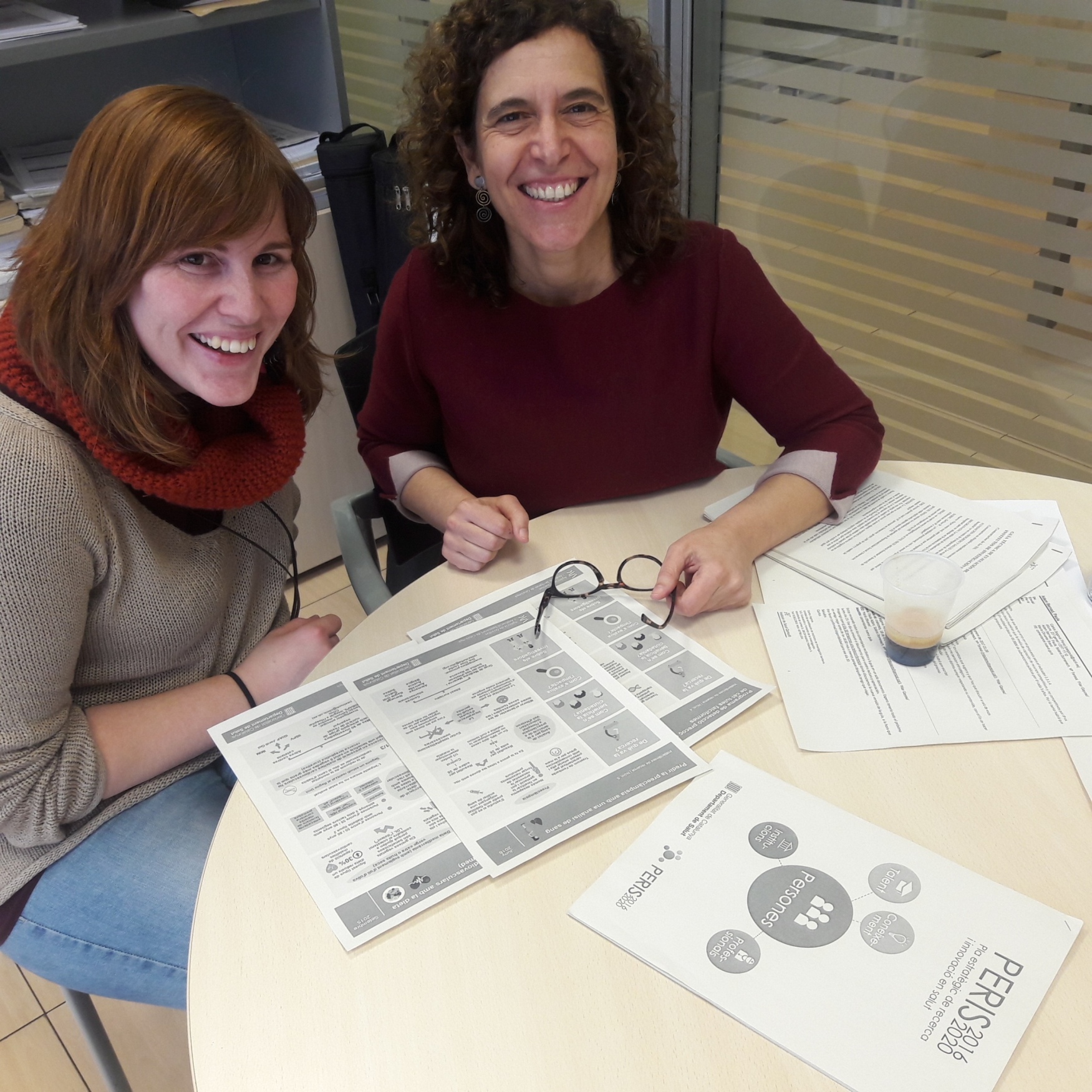
Since last year, the PERIS call is also assessed, which is an important new event and a strong boost for Catalan biomedical research. With regards to this call, it is worth highlighting the will and determination in placing people at the centre of research, and that we, in fact, right now find ourselves in a very good period because the analysis of data offers many opportunities in research.

Apart from all this there is a long-term task, which will take years, which has to do with the question of research and gender.

The article A global call for action to include gender in research impact assessment very quickly had a strong impact in social networks. It has been a year since we published a post recommending that it be read.

Almetrics evolution of this article: 220 (26/8/2016), 258 (31/8/2017).

The article heads the publications of this magazine in terms of impact.

Noteworthy facts:

Regarding the question of research and gender, we took the topic up again on this blog with another post as a call for reflection and to be aware of the reality that surrounds us, both within and beyond the area of research.

At AQuAS we ask ourselves how such a small team in number but huge in involvement manages to deal with the complex mechanism of comprehensive assessment of several research calls, research impact and also carry out research on the involvement of citizens in research, research in the media and the already mentioned question of research and gender.

In short, a lot of work done and a lot of work on the go at present with 100% involvement of the research team at the AQuAS and of many other collaborators and experts.

Post written by Marta Millaret (@MartaMillaret)
PERIS and people: research assessment by AQuAS

30 març
Núria Radó, Paula Adam

The first call of the Strategic Plan for Research and Innovation in Health 2016-2020 (PERIS in Catalan) for funding research and innovation, still pending resolution, prioritizes programmes which foster talent and employability and programmes of excellence in knowledge.

Accordingly, four actions have been initiated by competitive tendering to finance:

  1. The inclusion of scientists and technicians in national research groups
  2. The increase of nursing professionals in order to free up some of their workday so they can do research work
  3. Research projects aimed at primary care
  4. Major programmes focusing on four different subjects: personalised medicine, regenerative medicine, cooperative independent clinical research and cohort studies.

How are the PERIS calls assessed to determine which applications deserve funding?

The criteria for assessment are defined by the order of the requirements, forgive the repetition, and the requirements of each call. This is the instrument that sets out the rules to determine which projects or people are susceptible to receiving finance. Some will always be discarded and, depending on the specific criteria and resources available, others chosen which are considered worthy of funding.

Deciding which criteria to use and how they are assessed/rated/applied is a powerful science policymaking tool to design the research system it aspires to be: excellence, the subject, the discipline, the age of the applicants, the territoriality of the organisations or foreseeable impact are different variables to bear in mind when deciding who is worthy of being able to develop their research.

The Research Team at AQuAS has been commissioned to manage this process of assessment. This is why we accompanied the General Manager for Research and Innovation of the Health Department, Dr Andreu, in the public presentations he gave in different health research institutions linked to hospitals. We were impressed by the attendance at these informative sessions.

The assessment has been done by a panel of experts involving a total of 42 research professionals throughout Catalonia and Spain. It has required intense activity given that more than 490 applications of a very high level were received.

Looking back after having completed the assessment of the this first call, we feel, more than ever, that we made the right decision by putting people in the centre of the PERIS logo, large and circled by a prominent colour.

It is not only the plan itself which has been designed like this, to promote research with people at its centre, involving and motivating a great variety of professional profiles. PERIS has been a catalyst for mobilisation in the health system and in health research, even before the starting gun was fired, as seen in the packed informative presentations and in the involvement of the participants in the assessment panels, working deep into the night.

As can be expected, getting the staff at the Agency for Health Quality and Assessment of Catalonia (AQuAS) involved, has not been difficult either. We are eager to contribute to this strategic project by using a key tool for selection, accountability, continuous analysis and improvement of opportunities which is what assessment is all about.

Long life to PERIS!

Post written by Núria Radó (@nuriarado) and Paula Adam (@PaulaAdam4).

***Full information available here:

Analysis of research data in health: opportunities within reach

9 febr.
Xavier Serra-Picamal

The generation and storage of data is omnipresent nowadays. The costs have fallen drastically and the health sector is not alien to this. To illustrate this, it is worth having a look at the following graph created by the National Institutes of Health about the human genome, which shows the evolution of the cost of sequencing a genome:Cost per genome

As can be seen, since 2007, the cost of sequencing a genome has fallen dramatically. Having one’s own genome sequenced is now possible and in the future it may become commonplace. Bearing in mind that a copy of the human genome is made up of aproximately 3 million base pairs (3 million adeninines, thymines, citosines or guanines arranged sequentially in 23 chromosomes ) it is easy to infer that, also within this field, the quantity of data generated in the coming years will be massive.

This tendency is repeated in other areas of health care: among other, clinical history data in electronic format, medical imaging, primary care data or that of drug consumption are obtained and stored in registries, in general, structured and interlinked. The potential of this data for carrying out research in order to provide better health care is notable, in the way of faster and more accurate diagnoses, improved therapeutic approaches and a better management of the system.

To analyse the challenges and opportunities at a European level, a work session organised by the Directorate-General for Research and Innovation of the European Commission was held in Luxembourg with representatives from AQuAS. The points discussed have been gathered in the article Making sense of big data in health research: Towards an EU action plan, published in the Genome Medicine magazine and of open access. As explained in the article, using this information to provide better healthcare is a challenge but a great opportunity at the same time.

Making sense of big data in health research

Nevertheless, a big effort is required to transform this data into knowledge and specific actions. However much the costs of generating and storing data may drop, the management of information, its interpretation, and the generation of knowledge needs considerable investment and resources. This means having adequate information systems as well as the economic and human resources so that the data can be treated efficiently and the protection of individual rights guaranteed. In addition, the participation, commitment and effective communication of all the agents of the system is needed (including the scientific community, patients, citizens, the administration, and so on) to guarantee that this data is used efficiently, responsibly and that it promotes research which is efficient and of quality.

Catalonia, because of the size of its population, the fact that it has an integrated health system and the work done over many years, is well positioned to be able promote the reuse of health data for research. At an international level, some comparable projects exist and new projects exist with the goal of integrating and consolidating data from different sources, with some very ambitious and attractive programmes. The  PADRIS Programme, presented last 12 January, aims to centralise and make the data generated in health available to researchers in research centres in Catalonia and universities so as to provide better healthcare with a maximum guarantee in security and privacy. The work to be done is considerable. The resources needed too. The opportunities to provide better research and better healthcare are within reach.

Post written by Xavier Serra-Picamal, researcher at the Karolinska Institutet (Sweden).

* TERMCAT (the centre for terminology in the Catalan language) has recently dealt with the question of how to say data scientist in Catalan. The subject is very much a current issue!

In memory of professor Joan Rodés

12 gen.
Joan MV Pons
Joan MV Pons

With his passing away, Dr Joan Rodés (1938-2017) will be remembered by many people in person, and in many fields, for those who had the good fortune to know him as a doctor, researcher, manager and assessor (of politicians), as his was a life full to the brim. No matter which professional activity he took part in, and with the responsibilities he took on throughout his life, he left his mark and the accolades expressed these days are a clear demonstration of this.

To AQuAS (originally AATM), Joan Rodés has been an exceptional figure and I say this without any rhetoric whatsoever. When the Agency was created in 1994, he presided its scientific board of assessors and at the end of 1999, when the institution became known as Catalan Agency for Health Tecnology Assessment and Research (CAHTA), in Catalan Agència d’Avaluació de Tecnologia i Recerca Mèdiques (AATRM), he presided its Administrative Board, a position that he held till 2010. It was in that period (2000-2006) that, due to my responsabilities within the Agency as Managing Director, I was able to get to know this great personality more closely, very much a big strong fellow (in Catalan, a homenot) was Joan, as Josep Pla would say. At that time, we saw each other often, and I had frequent exchanges with him, aside from the more or less termly meetings of the Administrative Board. I did this in that minute office of the haematology services and later in that of the General Manager at the Hospital Clinic.

No matter what the position he occupied, he was always watchful -very much so- of events at the Agency, being a great facilitator of its duties. It was like this, without a doubt, because with Joan Rodés there was no need to convince him of the importance of informing well about decisions taken in the health services, using the most updated and precise knowledge that was available, not only that regarding the benefits and risks to health of medical interventions, but also in terms of its economic, ethical and social impact. For him and I quote his words literally from the AATRM Newsletter, 10 years of the Agency, of November 2004:

“critical assessment and continued learning are basic tools that need to be maintained and improved, not only by the Agency, in its everyday activity, but also by all the multiple actors and stakeholders in the health system (professionals, managers, politicians and citizens) that wish to continue sustaining this element of such importance for our social well-being”

I said this because of his role of facilitator as highest representative of the Agency giving constant support to the activities it carried out, but also because of his extensive experience and network of relationships that contributed to giving strength to many initiatives that were then being undertaken, especially in the field of research and its assessment. I was able to discuss this with him on many occasions at a later date, and I never once perceived an interventionist or managerial attitude; quite the opposite, always with a laissez-faire approach where each one had to do their assigned task (the technicians and managing director of the Agency, the scientific board and the administrative board) while facilitating that of others.

It has always been a great pleasure for me -a privilege better said- to have maintained contact at dinners and get-togethers, even during the last period in which his respiratory illness worsened, but he would still go to IDIBAPS from time to time despite this. I cannot end without saying that during those times when we would talk about any and everything (medicine, science, politics, society, the past, present and future) we had a really good laugh. Then as now that you have left us, you are and will very much be in my thoughts.

Post written by Joan MV Pons

agencia-2004-ca
Joan Rodés presiding an Administrative Board of AATRM in 2004

Gender equality in research, we all benefit

3 nov.
esther-vizcaino
Esther Vizcaino

Several month ago, we spoke about the publication of the article A global call for action to include gender in research impact assessment, in which the team of impact of research at AQuAS participated.

Investment in biomedical research has grown exponentially over recent years and consequently, governments, the industry, research centres and citizens expect to see a return on this investment translated into an increase in health benefits. Investing in research inappropriately can lead to economic and health losses. What’s more, this investment can also be wasted if it is not distributed equally in terms of gender.

That women are poorly represented in the field of health research is nothing new. By poorly represented we are referring to them as researchers as well as participants in research studies. Women receive less funding, appear less frequently than men as authors of publications in scientific journals and are awarded fewer scientific prizes. For example, of the 210 Nobel Prizes of physiology and medicine, there are only 12 women (5,7%).

Moreover, there is evidence that the differences in sex (biological) and of gender (sociocultural) are not included in a routine way in the design of research studies. This can mean that women find themselves at a disadvantage with regards to men as beneficiaries of research in terms of the health, economic and social impact associated with research. It has been demonstrated that incorporating the gender perspective stimulates innovation and excellence in research and technology.

Given the global and fragmented nature of research, we are faced with the inescapable need for all administrations, research institutions and assessment agencies to promote scientific policies that maximise the impact of research by means of gender equality.

article-pavel

Taking this necessity into account, researchers from 15 countries from 6 continents have made a “call for action” in the article to include the gender perspective in the assessment of the impact of research done with the aim of maximising its scientific, economic and social impact. Different recommendations are made in the article to all actors involved in research on how to include and reinforce gender analysis within the assessment of the impact of research.

In 2014, the United Nations launched a campaign, HeForShe, to fight against gender bias at a global level. This campaign wants to involve everyone, including men and boys, as defenders and agents of change to obtain gender equality and the rights of women.

Historically, gender equality has perhaps been mainly adopted as a subject of interest by women but including gender equality in all spheres is a subject for all.

Post written by Esther Vizcaino Garcia, AQuAS.

The “perfect” health system

20 oct.
Joan MV Pons
Joan MV Pons

Mark Britnell is an international expert in health systems having held several senior positions in the NHS and currently provides consulting services for several countries. With this wealth of experience, Britnell wrote a book in 2015 with the inspiring title of, In search of the perfect health care system (1). In it, Britnell examines the dilemmas facing governments, the global challenges such as demographic, epidemiological, technological and economic transitions, as well as the more specific cases facing each country.

A significant portion of the book, more than half, is dedicated to examining individual countries grouped by continent: the Asian region including Australia (with large countries from Japan, China and India, to small densely populated enclaves such as Singapore and Hong Kong) Africa and the Middle East (just three very different examples such as Qatar, Israel and South Africa), Europe (from Portugal to Russia via the Nordic countries, Germany, Italy, France and the English) and the Americas (from the north; Canada, USA and Mexico and the south, such as Brazil). Too bad that the section on the Iberian Peninsula only speaks of our western neighbours (the eastern side but a general walk through).

There is no questioning that Britnells’ knowledge has been acquired first hand, given his worldwide expertise in conferences and consultancy. As the author mentions, he is often asked which country has the best health care system? Since the WHO report, Health systems: Improving performance (2), published in 2000, several country rankings have been published according to the assessment of their health systems using a variety of methodologies and outcomes. The table below serves as an example.

pons-comparison-health-systems

Nowadays, rankings proliferate as can be seen in universities and research institutions/centres. The indicators may be different, but it seems that one may always end up finding the most favourable ranking for them. Catalan public universities are a good example, given that centre advertises their position – besides that of excellence in comparison to other universities which are not necessarily British –  in the ranking system which makes it stand out to a greater degree that other Catalan universities.

Britnell, getting back to our point, after so many rankings, lectures and consulting, make a proposal on what the best health system might be by taking the best areas from the different countries. If the world could have a perfect health system, it would have to possess the following characteristics:

–    Universal healthcare values (UK)
–    Primary health care (Israel)
–    Community services (Brazil)
–    Mental health and welfare (Australia)
–    Promoting health (Scandinavian countries)
–    Empowerment of patients and communities (certain African nations)
–    Research and development (USA)
–    Innovation and new ways of doing things (India)
–    IT and Communication technologies (Singapore)
–    The capacity of choice (France)
–    Funding (Switzerland)
–    Care for the elderly (Japan)

References

(1) Britnell M. In Search of the Perfect Health System. London (United Kingdom): Palgrave Macmillan Education; 2015.

(2) The World Health Report 2000. Health systems: improving performance. Geneva (Switzerland): World Health Organization (WHO); 2000.

(3) Where do you get the most for your health care dollar?. Bloomberg Visual Data; 2014.

(4) Davis K, Stremikis K, Squires D, Schoen C. 2014 Update. Mirror, mirror on the wall. How the performance of the U.S. Health Care System Compares Internationally. New York, NY (US): The Commonwealth Fund; 2014.

(5) Health outcomes and cost: A 166-country comparison. Intelligence Unit. The Economist; 2014.

Post written by Joan MV Pons.

Real Time Delphi relating to chronicity

2 juny
Monguet JM 2015
Josep Maria Monguet

The Real Time Delphi method, which implements the functionality of the Internet to make the Delphi Method more flexible, efficient and transparent, has been used by the Agency for Health Quality and Assessment of Catalonia (AQuAS as per the Catalan synonym) to identify the indicators for evaluating chronicity care and for the management of the areas of improvement in this field.

¿What is the Delphi method? It is a structured communication technique which is based on a panel of experts who answers questionnaires in two or more rounds. After each round, a facilitator provides a summary of what the experts have said in the previous round. Successive rounds are intended to reach a consensus on the subject. The Delphi method is applied to make predictions about the future and, in general, for any issue when a scientific approach is not possible. When the Delphi method is online (Real Time Delphi) the responses of the participants are calculated automatically and many variants of the method can be entered in a controlled way.

Health Consensus

The Health Consensus application that facilitates the participation of professionals through a methodology of online consensus developed by the company Onsanity from research done at the Universitat Politècnica de Catalunya (UPC) in Barcelona was used to identify the most appropriate indicators.

The work was carried out in the years 2013-2014, the first prototype of the system was applied twice, first in Catalonia, and a second version in the context of all the Spanish health system. The Health Consensus application for the selection of indicators allowed for the collecting of contributions from more than 800 health professionals, including clinical profiles of management and planning. An initial list of 215 indicators was progressively reduced through successive rounds of consensus until it was reduced to 18.

Not only did this experience allow the the identification of indicators, but it also showed various aspects that are interesting for research  and innovation:

  1. It is possible to pool the tacit knowledge of a fairly large group of professionals, putting together experiences and different points of view.
  2. The professionals underscore their perception that the contributions that are made, are highly valuable in the construction of the model subjected to consensus.
  3. The online system is accepted by the professionals who expressed a high satisfaction level during the participation process.

The experience was published: Monguet JM, Trejo A, Martí T, Espallargues M, Serra-Sutton V, Escarrabill J. Assessment of chronic health care through and Internet consensus tool. IGI Global; 2015.

Post written by Josep Mª Monguet (@JM_Monguet), UPC Professor.

Ioannidis and the industry: a persistent distortion

7 abr.

John PA IoannidisJoanMVPons is a scientist and professor originally from Greece, currently working at Stanford (Meta-research Innovation Center – METRICS) who is, undoubtedly, among the most prolific authors of medical scientific literature.

Some of his papers, alone or in collaboration, have had a great impact. Who does not remember the one entitled “Why most published research findings are false?”. Nowhere in his large output will you find trivialities, and he recently came to Barcelona to speak about defective research and even about the waste of resources this implies. But we will leave the latter topic for another occasion.

The paper by this author I want to comment on is the one written in collaboration entitled “Undue industry influences that distort healthcare research, strategy, expenditure and practice: a review” published in 2013 in European Journal of Clinical Investigation.

One might think that all has been already said about the (bad) influence of drug and health care products industries. There is even a literary body or genre in biomedical scientific publications exclusively devoted to this topic. And books abound, too. All that could be said has been said. Well, actually it hasn’t. Undue influence, such as biases, is far more subtle than we think. It is often hard to tell how, similarly to interest conflicts in biomedical research or in prescription practices, the one who does it refuses any influence, since science could not admit it, as its own deontology doesn’t. Fools!

What is interesting about this paper is its review nature, not only for the number of papers gathered, but because it provides a more integrated (re)view of the different elements upon which industry acts, or is allowed to act. It should be noted that the interests and profit of the drug and health care products industry are quite legitimate, but it clearly shows some specifics that put it aside from other manufacturing industries, and not just because its important investment in R+D+i. It is believed to be one of the most profitable industries, possibly due to its large margins, but also because human diseases and ailments are here to stay, even though their end –which both the poor and the rich want to delay– is ultimately inescapable.

Ever since I learned it, I am very fond of a quotation by George W Merck (1894-1957) who for 25 years chaired the drug company that bears his family’s name (1925-1950). As this visionary man said: “We try to remember that medicine is for the patient. We try never to forget that medicine is for the people. It is not for the profits. The profits follow, and if we have remembered that, they have never failed to appear. The better we have remembered it, the larger they have been.“ I wonder what he would think of it now.

Coming back to Ioannidis and his paper, there he follows the outline of how this (bad) influence acts, and the main elements –which changed with time– upon which it exerts its distorting effect, although not as an exclusive factor. Governments, as with other industries also regulated by them, play an essential role.

Evidence based medicine - Clinical practice guidelines - Medical practice

Post written by Joan MV Pons.

Animal (non-human) testing

18 febr.
Joan MV Pons
Joan MV Pons

It is striking that there are more data on the animals used in experimentation than on humans (patients or not) who take part in clinical trials. Certainly, in both cases, the regulations are stern and there are different organisms which ensure the safety of participants in experimentation.

Recently data on the experimental use of animals in Spain were published. Overall, the number of applications has been over 808,827 throughout 2014: 526,553 rodents (mostly mice), about 190,354 fish (more than a third were zebrafish) 44,169 birds and 23,881 rabbits, to name the most used animal species. It should be noted that a quarter of those, and despite being mostly mice, are genetically modified animals. The vast majority (75%) are used for what is called basic research and translational and applied research.

Informes anuales de la utilización de animales en la investigación y docencia

Is this too many or too few? What are the latest trends? Despite recent changes in the way we collect information, data show an increase over previous years, which does not seem to quite support the principles that should inspire animal testing, which were collected by the Royal Decree 53/2013, the so-called 3 Rs replacement, reduction and refinement.

Aside from quantity, quality also is important and there is a remarkable lag in  initiatives to improve data collection and reviews of experimental studies compared to human clinical research. We are referring to the CAMARADES (Collaborative approach to Meta-analysis and Review of Data in Experimental animal Estudies), which is essential before starting a new study, and the ARRIVE guidelines (Animal Research: Reporting In-Vivo Experiments) to improve the design and publication of animal experimentation, and ultimately, to reduce the risk of biases.

One might wonder, how many biomedical research funding agencies, in their peer review process, call or require the use of these guidelines when assessing projects involving animal experimentation? Surely we could also discuss the implementation of the guidelines CONSORT (Consolidated Standards of Reporting Trials) and PRISMA (Preferred Reporting Items for Systematic Reviews and Meta-analysis) in the case of clinical trials in humans.

It seems clear that the higher the risk of bias, the more overestimation of effects,  thus it is not surprising that the subsequent proposals for translating this into human experimentation end up being disappointing.

The field of neuroscience is full of such cases of failed transfer, usually for involving imperfect animal models, or less than careful study designs and too prone to bias.

A recent paper by Malcolm R. Macleod from the Centre for Clinical Brain Sciences, University of Edinburgh, published in PLoS Biology, insisted on those qualitative aspects often found in animal research. It also underlined that reporting the risk of bias is not related to the journal’s impact factor, which again emphasizes this measure as a poor indicator of the quality of research.

Post written by Joan MV Pons.

We need to speed up innovation in health

5 nov.

Manel BalcellsManel Balcells, Department of Health Commissioner at LEITAT Technology Centre

One of the challenges of any country relying on a knowledge economy is undoubtedly to look at innovation as a strategic element for the country’s growth and development, and to manage to turn innovation into economic value. That is to say, to return the benefits derived from investments conducted in basic and applied research, back to society.

However, any country prioritizes productive sectors which provide significant benefits, promoting the conditions that make the so called innovation – ecosystem possible, thus completing the value chain from research to market.

Back home in Catalonia, we are well aware of the detachment between the high level of biomedical research – leader in Europe with global significance (you can view the results of the centres in the report from the Central de Resultats) and the moderate degree of innovation reflected by European standards and published by the European Commission in the Regional Innovation Scoreboard. Continue reading