Preventing overdiagnosis 2018: Three key points to reduce overdiagnosis

8 nov.
Johanna Caro Mendivelso

This year, the annual Preventing Overdiagnosis conference was held in Copenhagen, co-sponsored by the World Health Organisation, where delegates from about 30 countries attended.

The space generated in this conference provides the opportunity to approach the subject of how health professionals, researchers and patients can implement solutions to problems related to overdiagnosis, overtreatment and overuse by using the evidence available.

Overall, some of the subjects discussed were the implementation of recommendations to “stop doing”, the challenge of dealing with excessive diagnosis in clinical visits, the impact of overdiagnosis, the fact of converting citizens into patients and the role of risk factors in excessive diagnosis.

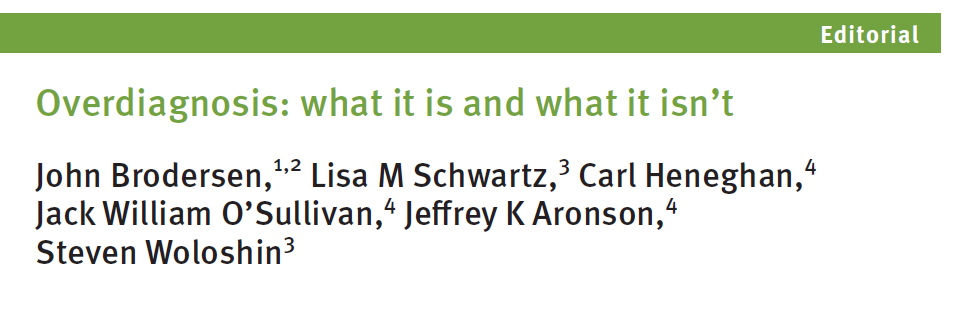
John Brodersen, professor of family medicine at the University of Copenhagen, started the conference by making a reflection on what is and what is not overdiagnosis. In general, overdiagnosis means turning people into patients unnecessarily by identifying problems that were never going to cause harm or by medicalising ordinary life through expanded definitions of diseases. This overdiagnosis can trigger a cascade of excessive treatments.
Later, Iona Heath, general practitioner and member of the Organising Committee of Preventing Overdiagnosis, asked the audience the question Why are we so afraid of normal? She reflected on why doctors are willing to rush into a diagnosis and pointed out that the task of defining “who is normal” is a challenge. Who should define who is normal and with what criteria?

Gisle Roksund, general practitioner in Norway stated that the general tendency in medicine is: “find it as soon as possible and do more”. Similarly, he pointed out that people are being labelled as ill with “pre” conditions when they are not. And he ended off by saying that life itself is a “pre-mortality” condition.

On his part, Paul Glasziou, general practitioner and professor at the Bond University in Australia, presented three key points to reduce overdiagnosis: reducing over-detection, over-definition and medicalisation. Juan Pablo Brito, endocrinologist and researcher at the Mayo Clinic, talked about a new term in his conference on diagnosis centred on the person: Extradiagnosis: when the diagnosis is not appropriate for the biology, context or preferences of a patient. The diagnosis centred on the patient is based on identifying the problem and carrying out actions to find the solution. That is, “reaching a conclusion together which makes intellectual, emotional and practical sense”.

In mental health, Allen Frances, psychiatrist in the United States, highlighted that overdiagnosis in psychiatry could be avoided if general practitioners had more time in their visits to get to know their patients better.

On the other hand, Steven Woloshin and Lisa Schartz, general internists and co-directors of the Center for Medicine and Media at The Dartmouth Institute, explained that some advertising campaigns could broaden the definition of diseases which can lead to an overdiagnosis and a medicalisation of life experiences. These reflections highlight the importance of having regulation related to these campaigns.

Lastly, the Preventing Overdiagnosis is a space which allows for the sharing of experiences, both theoretical and practical, of what is being done in the world with regards overdiagnosis and overtreatment.

From the AQuAS, and in collaboration with health professionals and scientific societies, the Essencial project in Catalonia tries to address these issues by contextualising them in our environment and by trying to implement recommendations that avoid low value practices and in consequence, an overuse.

Post written by Johanna Caro Mendivelso (@jmcaro103).

Low value clinical practices from the citizenry’s perspective

13 oct.

During the fifth edition of the international Preventing Overdiagnosis Congress, strategies for implementing solutions to avoid overdiagnosis and overuse were addressed based on the available scientific evidence.

In this year’s edition, which was held in Barcelona last year, apart from the involvement of professionals and organisations, patients had the opportunity to actively participate.

Experiences in different healthcare areas were shown in the use of best practices to communicate and to empower patients to achieve a better understanding of shared decisions.

Different world initiatives addressed the best practices to empower citizens in subjects related to low value practices, overdiagnosis and overtreatment. Experiences were shared and a debate was initiated on fundamental subjects such as the communication and participation of patients.

In recent years, the Essencial Project has studied the perspective of health professionals on low value practices, their causes and possible solutions so as to avoid them.

Essencial Project team: Cari Almazán, Johanna Caro, Liliana Arroyo and Hortènsia Aguado

For example, in a previous post, we explained the results of a survey we carried out with professionals in the field of primary care. The results of this survey highlighted the need to involve and empower the population more. Patients are also important decision makers in relation to their needs and in the demand for certain health services. Hence, the project must be accompanied by a communications strategy aimed not only at patients but also at citizens in general.

That is why we, from the Essencial Project, have been interested in finding out the opinion of patients in addition to the perspective of professionals. In the international Preventing Overdiagnosis 2017 Congress we participated explaining how an exploratory first approach was made to identify the beliefs, attitudes and perceptions of patients regarding the most important elements in consultations, low value practices and the essential components of an effective dialogue between professionals and patients. The end purpose of this was to understand the position of people before initiating possible interventions in the citizenry and to determine the most effective communicative tools and channels.

In Catalonia, AQuAS carried out the first exploratory qualitative study at the end of 2016 using a focus group of parents and children assigned to a primary care team. Low value practices in paediatrics are frequently associated with an over-diagnosis regarding antibiotics, bronchodilatadors, antipyretics or imaging tests, among others. These scenarios have been transferred to the debate with patients themselves. In total, seven women, mothers and grandmother of 14 children participated.

The first point of discussion was the most important elements in a consultation with health professionals and it was found that the treatment (29%) and information received (28%) are the most important elements received by professionals (representing approximately 60% of those mentioned). The relationship with the professional comes next (15%, often related to the degree of trust), followed by the feeling that their wishes or needs are met (12%), information requested (9%) and the diagnosis (5%).

The participants did not know the concept of low value practice but did recognise situations of an excessive prescription of medication or the request of unnecessary tests, especially in emergency services and private consultations.

Regarding communication, the participants said they appreciated that professionals communicate in a simple and direct manner, explaining the reasons for decisions. Similarly, that they felt it was important to receive printed information from professionals which they could peruse later at home. They also said they would like more informative sessions or community groups where these types of subjects could be explained to them and so gain more knowledge about these types of practices.

In our context, this is the first exploratory study done to identify low value practices and the communicative strategies of the citizenry, being the start of a series of studies on the population. Nonetheless, one of the limitations with which we find ourselves was that the participation was lower than expected. Although the term ‘low value practices’ is not known, participants identify situations in which they have experienced them.

Similarly, it is important to underline how patients value the treatment and information received as well as the professional-patient relationship. In the same way, patients recognise the need for a professional’s communication skills and the need for tools to support an effective communicative exchange.

Post written by Johanna Caro Mendivelso (@jmcaro103).

The value of collaboration and participation in the Essencial Conference 2017

4 maig

In the world of health, the involvement of professionals is necessary for a project to be successful and for it to reach health centres. On 21 April this year, the Conference for the implementation of the Essencial Project was held with the slogan “More is not always better: let’s avoid low value practices”.

When talking about the Essencial project, an initiative that identifies clinical practices of low value and promotes recommendations to avoid them, the collaboration between professionals becomes fundamental and even more so with reference to primary care, which is the gateway for patients to the health system.

For a conference devoted to this project, we wanted to have the active participation of health professionals and this did not seem easy in a conference where 750 attendees were expected.

How do we get them all to express themselves? How do we listen to their opinions? How do we use new technologies to meet these challenges?

Glyn Elwin, a doctor, researcher, Professor at the Dartmouth Institute for Health Policy and Clinical Practice in the United States and a real authority on the subject of shared decisions attended the conference.

At a later stage, a round table was held with speakers that spoke about the implementation of the Essencial project from the perspective of the project, of organisation, of primary care teams and of patients. Provision had been made for members of the audience to make their first contributions here in a round of questions open to the floor. Thus far, no difference to what happens in other scientific conferences.

But what was special about the approach of the 2017 Essencial conference?

We wanted to innovate and do things somewhat differently. A monologue was presented showing what the day to day of a primary care outpatient consultancy might be like. With the aim of reflecting on the communication between health professionals and patients, we highlighted the importance of communicative skills when explaining to patients why it might NOT be necessary to carry out a test or receive medication.

Using Kahoot (a tool for online voting) the attendees, in real time, were able to decide on the most important recommendations to include in the Essencial project. In this way, it was possible to vote and then make known the chosen recommendations during the conference in a process in which the professionals were the protagonists.

To end it all, the Prize for the most innovative idea to avoid low value practices in primary care was awarded as part of the conference’s programme. The prize consisted of a trip to this year’s Preventing Overdiagnosis Conference to be held in Canada in August. The winner was Mariam de la Poza of the primary care centre CAP Doctor Carles Ribas in Barcelona with a contribution on the recommendation “More antibiotics is not always the best: let’s avoid side effects, unnecessary costs and antimicrobial resistance”. Excitement right to the very end!

It goes without saying that organising a conference is complex and that there are many professionals taking part who do not always appear in the programmes. An expert team in communication and events organisation is crucial for the success of a conference of this type.

Post written by the Communication’s Unit at the AQuAS.

Why is difficult to reduce low value clinical practices in a Hospital?

15 des.
MaiteSolans
Maite Solans

Within the framework of the Programa de Millora de la Pràctica Clínica (Programme for improvement in Clinical Practice) of the Vall d’Hebron University Hospital – VHIR Institut de Recerca (VHIR Research Institute) and in collaboration with the Essencial project, work has been done to explore what barriers health professionals (hospital doctors and nurses) come up against in order to implement clinical recommendations aimed at reducing inadequate practices or those of low clinical value. A group of 15 health professionals (with medical or surgical specialities) collaborated in two discussion sessions to identify these barriers. The work done by Dimelza Osorio of the Vall d’Hebron University Hospital and by Liliana Arroyo of the University of Barcelona has been really outstanding.

When talking about inadequate practices or those of low clinical value, we are referring to inappropriate health interventions in certain circumstances, whether it be because the risks involved outweigh the benefits, because their efficiency is not proven or because there is not a clear cost-benefit correlation. These low value practices are present in everyday clinical practice and can lead to an over-diagnosis and/or over-treatment, meaning diagnosing or treating a clinical condition in which there are no notable health benefits for patients.

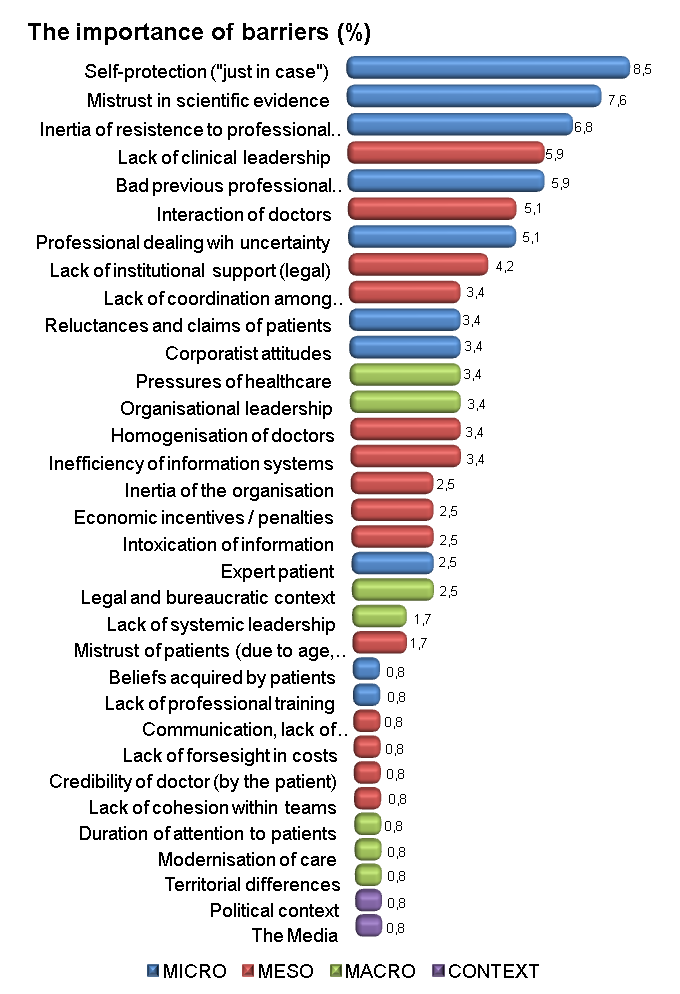
The barriers identified can be classified into four levels: micro, meso, macro and those of the context. At a first level (micro), those deriving from the characteristics of professionals themselves were identified, such as the tendency for self-protection in the face of claims or legal problems (defensive medicine), dealing with uncertainty or having had bad experiences previously; scepticism towards scientific evidence as a result of out-dated or contradictory information; other attitudes of professionals such as inertia or resistance to change; and the lack of training. All these constitute barriers. Patients’ characteristics were also identified, such as their reluctances and demands; the figure of the expert patient or beliefs acquired in the past.

At a second level (meso), barriers as a result of the interaction between professionals and patients were identified. Some barriers have to do with the relationship between professionals; that is to say, difficulties related to clinical leadership, the coordination between different professionals (or specialists), or the cohesion within teams. There are also barriers of organisational leadership such as a lack of institutional support in legal issues, the inertia of the organisation itself, economic incentives, wrongly applied penalties or the lack of foresight of certain costs. And then barriers of information flow, namely, the inefficiency of information systems such as the lack of operating capacity of e-mailing, or intoxication due to an excess of corporate information.

At a third level (macro), barriers are influenced by the structure and management characteristics of a hospital and the Catalan health system. The healthcare conditions stand out, such as the burden of healthcare, the duration of the attention given to patients, or how much technology is used in care, that is, greater access to facilities and tests. But also the design of the health system, such as in the lack of systemic leadership, or the lack of coordination between different levels of healthcare (primary care, hospital care, social healthcare, ….) . And then also the characteristics of the health system like territorial differences and the legal and bureaucratic context.

Lastly, certain external factors to the health system (the context) can also lead to low value clinical practices persisting. Although a lot less present in this case, the political context and the influence from the media are included.

The importance of each barrier is shown in the following graph:

barreres-en

Potential solutions were explored or proposed in the same session so as to eliminate these barriers; a series of solutions have been proposed mainly related to the creation of a leadership strategy and a series of clear options, which require rationlising processes and using available information properly.

Post written by Maite Solans (@SolansMaite).

Perspectives on Preventing Overdiagnosis

15 set.

Preventing Overdiagnosis Barcelona 2016We continue drawing inspiration from the Preventing Overdiagnosis Congress (in Twitter: #PODC2016), which is due to take place this coming week. There are many issues in play that we must take into consideration and we will try to demonstrate just some of those here.  Joan MV Pons in this post reflects on the public health measures implemented over the past centuries which have had a role in the history of overcoming poverty and increasing life expectancy after reading the book by Nobel Prize winning Economist Angus Deaton.

Without detracting from developments made over time, in this post Andreu Segura comments on the futility of medicine and of procedures with unrealistic expectations regarding the benefits. Segura mentions the report “To err is human” and the estimation made by Barbara Starfield concerning mortality caused by adverse side effects of medicine. At the same time, the author mentions the very specific case of prescribing preventive measures and how these have evolved over the years.

It is not a straightforward task, but thanks to this post by Cari Almazan, it is easy to understand exactly what is being referred to when we talk about overdiagnosis. Almazan takes us on a journey from the origins of the concept itself through to some current examples and discusses the challenges we face in the future in this area, which begins with a good communications strategy.

No es fácil pero gracias a este post de Cari Almazan resulta fácil entender qué significa y qué no significa sobrediagnóstico. Almazan propone un recorrido por los orígenes de este concepto pasando por algunos ejemplos actuales y planteando algunos retos de futuro en este ámbito, empezando por una buena estrategia de comunicación.

The concept of overdiagnosis is equivalent to diagnosing a disease that does not present symptoms throughout a person’s life and, meanwhile, the treatment and monitoring the patient is subject to in order to treat the disease can be more harmful and fail to produce any benefits.

The interest of working along the lines of diagnosing less can be seen on an individual and population-wide level. On an individual level, overdiagnosis is associated with the negative effects of unnecessary labels, such as the effects of radiation and false positives and false negatives as a result of unnecessary diagnostic tests and therapies (surgery or medication). On a population-wide level we are talking about the opportunity cost derived from wasting resources that might have been allocated to preventing and treating diseases.

That said, we can ask ourselves what the primary care professionals think. In this regard we find some interesting pointers in this post by Johanna Caro where we can see the principal results of a survey of GPs and paediatricians post by Johanna Caro Mendivelso where we can see the principal results of a survey of GPs and paediatricians. One of the most striking results of the survey is the fact that around 80% of physicians surveyed find themselves in the position of making a decision whether to request an unnecessary test or prescribe unnecessary treatment at least once the week.

The interest in the impact that this issue can have is growing significantly. For this reason, Preventig Overdiagnosis will be a brainstorming session which will enable us to design strategies and make decisions to address the fallout from overdiagnosis and overtreatment. We think that this new topic for debate is increasingly present in both our professional and personal lives.

johanna-caro-cari-almazan
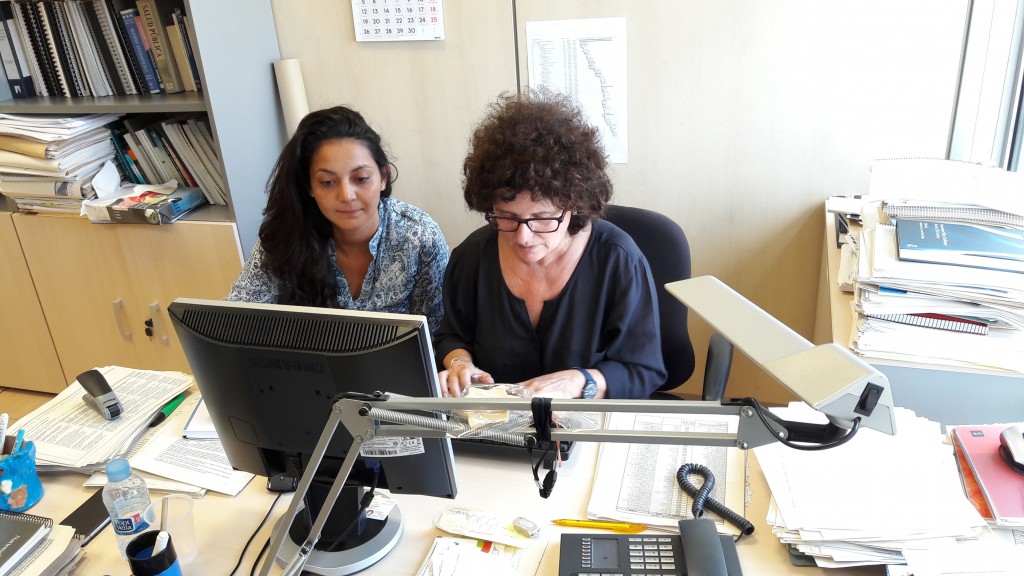
Johanna Caro Mendivelso and Cari Almazan, members of the Essencial Project team, participating in the Preventing Overdiagnosis.

Preventing Overdiagnosis: appointment in Barcelona

24 març

Next 15th April is the new deadline for submitting article abstracts for the Preventing Overdiagnosis Conference which will be held in Barcelona at the end of September 2016.

Who is this congress aimed at?

This congress is open to the whole society; for this reason, the congress is not only aiming at health care professionals, but also welcomes the participation of patients and all other citizens.

What do we understand by overdiagnosis?

Overdiagnosis is defined as the diagnosis of an illness which would not produce symptoms during a person’s life, but the treatment and follow-up, to which this person could be submitted, would not produce any benefit, and can even be harmful and generate costs.

Does overdiagnosing have consequences?

Yes, on an individual level, the consequences of overdiagnosing go from the negative effects of unnecessary labelling, damage as consequence of medical tests (radiation effects, false positive or false negative tests), unnecessary therapy (surgery, medication) and, on a more demographic level, one of the consequences of overdiagnosing refers to the opportunity cost, generated by a misuse of resources which could have been assigned to prevention and treatment of real illnesses.

What can we read on overdiagnosis?

We recommend the section “Too much medicine” of BMJ, the section “Less is more” of JAMA, the recommendations made by the Project Essencial and the book “Overdiagnosed. Making People Sick in the Pursuit of Health”.

Anything else?

Yes, indeed. We’ll be expecting you for the 4th edition of the International Preventing Overdiagnosis Conference, which will take place on 20th, 21st and 22nd September in Barcelona. Taking into account the congress program, it will be an ideal setting to share initiatives and work for the future.

If you want to read more on this subject, you can read this other blog post.

Post written by Cari Almazán (@AlmazanCari) and Marta Millaret (@MartaMillaret).

Preventing Overdiagnosis: una cita a Barcelona

24 març

BCN_1_còpia

El proper 15 d’abril és el nou termini per presentar resums de comunicacions per al Preventing Overdiagnosis Conference que se celebrarà a Barcelona a finals de setembre de 2016.

A qui va dirigit aquest congrés?

Aquest congrés està obert a tota la societat; per aquest motiu, el congrés no está dirigit només a professionals de la salut sinó que es convida a la participació a pacients i a tota la ciutadania.

Què entenem per sobrediagnòstic?

Sobrediagnòstic es defineix com el diagnòstic d’una malaltia que no ocasionarà símptomes al llarg de la vida d’una persona però que el tractament i el seguiment a què se sotmeti aquesta persona no li aportarà cap benefici però que sí que li podrà ocasianar danys i costos.

Té conseqüències sobrediagnosticar?

Sí, a nivell individual les conseqüències de sobrediagnosticar van des dels efectes negatius d’etiquetes innecessàries, danys en conseqüència de proves diagnòstiques (efectes de radiacions, falsos positius i falsos negatius), teràpies innecessàries (cirurgia, medicaments) i a un nivell més poblacional, una de les conseqüències de sobrediagnosticar fa referència al cost d’oportunitat ocasionat per un malbaratament de recursos que podrien haver estat dedicats a prevenir i a tractar altres malalties.

Què es pot llegir sobre sobrediagnòstic?

Recomanem la secció “Too much medicine” de BMJ, la secció “Less is more” del JAMA, les recomanacions que es fan des del Projecte Essencial i el llibre “Overdiagnosed. Making People Sick in the Pursuit of Health”.

Alguna cosa més?

Sí, i tant. Us esperem a la 4a edició de l’International Preventing Overdiagnosis Conference que tindrà lloc els dies 20, 21 i 22 de setembre a Barcelona. Tenint en compte el programa del congrés, serà un bon lloc on posar en comú iniciatives i seguir treballant.

Si voleu llegir més sobre aquest tema, podeu llegir aquest altre post.

Entrada elaborada per Cari Almazán (@AlmazanCari) i Marta Millaret (@MartaMillaret).

Shall we talk about overdiagnosis? Yes, in Barcelona next September…

17 març
carialmazan
Cari Almazan

Overdiagnosis is defined as the diagnosis of an illness which would not produce symptoms during a person’s life; it’s the result of the correct diagnosis of an illness whose treatment and follow-up do not produce any benefit, but on the other hand, could be harmful and generate costs. Overdiagnosis is neither the consequence of an erroneous diagnosis, nor of a false positive test.

The broadest definition of overdiagnosis refers to its consequences: negative effects of unnecessary labelling, damage as consequence of medical tests (radiation effects, false positive or false negative test results), unnecessary therapy (surgery, medication) and the opportunity cost, generated by a misuse of resources which could have been assigned to prevention and treatment of real illnesses.

Well-known examples of overdiagnosis are the screening programs for the detection in an early stage of cancers, which would never cause neither symptoms in nor the death of a patient, or ever increasingly sensitive diagnostic methods, detecting the smallest of abnormalities which would remain benign anyway (incidentalomes). Also the progressive reduction of diagnostic thresholds can eventually lead to invented disorders and to the fact that healthy and asymptomatic persons could be classified as sick while they are not, receiving treatments with higher risks than possible benefits.

Let’s go back in time. The concept of overdiagnosis has been described for the first time approximately 50 years ago, in relation to cancer screening, but the term doesn’t become popular until the year 2011 through the book “Overdiagnosed. Making People Sick in the Pursuit of Health”. At present, overdiagnosis is discussed in some sections of prestigious scientific publications such as the BMJ (Too much medicine) or the JAMA (Less is more), and is the subject of some specific congresses as now the Preventing Overdiagnosis Conferences. In our specific context, there are also initiatives, such as Choosing Wisely and the Essencial, who work out recommendations to avoid clinical practices of little value and include subjects related to overdiagnosis.

Preventing Overdiagnosis

Even with the knowledge presently available, overdiagnosis is still facing important challenges. A consensus on a formal definition is still missing, and under the umbrella of overdiagnosis, we still see a wide range of clinical situations gathered, requiring different approaches both from the scientific point of view, as well as from the perspective of necessary strategies to minimise the impact of overdiagnosis.

In order to meet these challenges, we need to deepen our knowledge of the methods used, in order to get an estimation of the frequency of overdiagnosis, as well as develop efficient communication strategies to avoid the confusion that situations of overdiagnosis can cause, both among patients as in society in general, the impact on the doctor-patient relationship (trust), or the potential jeopardy to patients who have already been diagnosed.

These challenges, together with the economic, social and ethical impact of overdiagnosis, its causes, facilitating elements and consequences, the new genomics tools and their possible impact on overdiagnosis, as well as matters related with overdiagnosis and aging, are some of the subjects which will be addressed during the 4th edition of the International Preventing Overdiagnosis Conference which will take place on the 20th, 21st and 22nd of September in Barcelona. You can read a previous post about it here.

The Agency for Health Quality and Assessment of Catalonia (AQuAS) is participating actively in the organisation of this international initiative, which gathers institutions like the Centre for Evidence Based Medicine from the Oxford University (UK), the Dartmouth Institute for Health Policy & Clinical Practice (USA), the Centre for Research in Evidence Practice of the Bond University (Australia), the Consumer Reports and the British Medical Journal (BMJ) and Public Library of Science (PLOS) groups.

submit abstracts

Important information: Until the 31st March [deadline extended to April 15th], abstracts can be submitted without any thematic restriction, as long as they’re related to overdiagnosis prevention. You can register now.

We’ll be expecting you there!!!

Post written by Cari Almazán (@AlmazanCari).

¿Hablamos de sobrediagnóstico? Sí, en Barcelona en septiembre…

17 març
carialmazan
Cari Almazan

El sobrediagnóstico se define como el diagnóstico de una enfermedad que no ocasionará síntomas a lo largo de la vida de una persona; es el resultado de diagnosticar correctamente una enfermedad en la que el tratamiento y el seguimiento no aportará ningún beneficio pero sí podrá ocasionar daños y costes. El sobrediagnóstico no es la consecuencia de un error diagnóstico ni de un falso positivo.

La definición más amplia de sobrediagnóstico se refiere a sus consecuencias: efectos negativos de etiquetas innecesarias, daños como consecuencia de pruebas diagnósticas (efectos de radiaciones, falsos positivos y falsos negativos), terapias innecesarias (cirugía, medicamentos) y el coste de oportunidad ocasionado por un derroche de recursos que podrían haber sido dedicados a prevenir y a tratar auténticas enfermedades.

Ejemplos conocidos de sobrediagnóstico son los programas de cribado que detectan cánceres en estadios precoces y que nunca ocasionarán síntomas ni la muerte del paciente, o pruebas diagnósticas cada vez más sensibles que identifican anormalidades tan mínimas que permanecerán benignas (incidentalomas). También la reducción progresiva de los umbrales diagnósticos puede llevar, incluso, a la invención de trastornos y a que personas sanas y asintomáticas sean clasificadas como enfermas cuando no lo son y recibir un tratamiento que les puede ocasionar más riesgos que beneficios.

Hagamos un poco de historia. El concepto de sobrediagnóstico fue descrito hace aproximadamente 50 años en relación con el cribado del cáncer, pero no es hasta el año 2011 que este término se populariza con el libro “Overdiagnosed. Making People Sick in the Pursuit of Health”. Actualmente, el sobrediagnóstico se discute en determinadas secciones de publicaciones científicas de prestigio como el BMJ (Too much medicine) o el JAMA (Less is more), y es objeto de congresos específicos como los Preventing Overdiagnosis Conferences. También hay iniciativas como el Choosing Wisely y el Essencial, en nuestro contexto, que elaboran recomendaciones para evitar prácticas clínicas de poco valor y que incorporan temas relativos al sobrediagnóstico.

Preventing OverdiagnosisA pesar del mayor conocimiento disponible, el sobrediagnóstico tiene retos a alcanzar. No se dispone aún de una definición formal consensuada, y bajo el paraguas del concepto de sobrediagnóstico se reúnen varias situaciones clínicas que requieren diferentes abordajes, tanto desde la perspectiva de la investigación como desde la perspectiva de las estrategias necesarias para minimizar el impacto del sobrediagnóstico.

Siguiendo con los retos, es necesario profundizar en el conocimiento de los métodos para estimar la frecuencia del sobrediagnóstico y también hay que desarrollar una estrategia efectiva de comunicación que evite la confusión que las situaciones de sobrediagnóstico pueden ocasionar, tanto entre pacientes como en la sociedad en general, el impacto en la relación médico-paciente (confianza), o el potencial perjuicio en los pacientes que ya tienen un diagnóstico.

Estos retos, junto con el impacto económico, social y ético del sobrediagnóstico, las causas, los elementos facilitadores y las consecuencias del sobrediagnóstico, las nuevas herramientas de la genómica y su posible impacto en el sobrediagnóstico y también cuestiones relacionadas con el sobrediagnóstico y el envejecimiento, son algunos de los temas que serán tratados en la 4ª edición del International Preventing Overdiagnosis Conference que tendrá lugar los días 20, 21 y 22 de septiembre en Barcelona, como anunciamos hace unos días en otro post.

L’Agència de Qualitat i Avaluació Sanitàries (AQuAS) participa activamente en la organización de esta iniciativa internacional que reúne a instituciones como el Center for Evidence Based Medicine de la Universidad de Oxford del Reino Unido, el Darmouth Institute for Health Policy & Clinical Practice de Estados Unidos, el Center for Research in Evidence Practice de la Bond University de Australia, el Consumer Reports y los grupos British Medical Journal (BMJ) y Public Library of Science (PLOS).

submit abstracts

Información útil: Hasta el próximo 31 de marzo [ampliado hasta el 15 de abril] se pueden presentar resúmenes de comunicaciones sin restricción temática siempre que guarden relación con la prevención del sobrediagnóstico. Os podeis registrar aquí.

Os esperamos !!!

Entrada elaborada por Cari Almazán (@AlmazanCari).

Parlem de sobrediagnòstic? Sí, a Barcelona aquest setembre…

17 març
carialmazan
Cari Almazan

El sobrediagnòstic es defineix com el diagnòstic d’una malaltia que no ocasionarà símptomes al llarg de la vida d’una persona; és el resultat de diagnosticar correctament una malaltia en què el tractament i el seguiment no aportarà cap benefici però sí que podrà ocasionar danys i costos. El sobrediagnòstic no és la conseqüència d’un error diagnòstic ni d’un fals positiu.

La definició més àmplia de sobrediagnòstic fa referència a les seves conseqüències: efectes negatius d’etiquetes innecessàries, danys com a conseqüència de proves diagnòstiques (efectes de radiacions, falsos positius i falsos negatius), teràpies innecessàries (cirurgia, medicaments) i el cost d’oportunitat ocasionat per un malbaratament de recursos que podrien haver estat dedicats a prevenir i a tractar autèntiques malalties.

Exemples prou coneguts de sobrediagnòstic són els programes de cribratge que detecten càncers en estadis precoços i que mai ocasionaran símptomes ni la mort del pacient, o proves diagnòstiques cada vegada més sensibles que identifiquen anormalitats tan mínimes que restaran benignes (incidentalomes). També la reducció progressiva dels llindars diagnòstics pot portar, fins i tot, a la invenció de trastorns i al fet que persones sanes i asimptomàtiques siguin classificades com a malaltes quan no ho són i a rebre un tractament que els pot ocasionar més riscos que beneficis.

Fem una mica d’història. El concepte de sobrediagnòstic va ser descrit fa aproximadament 50 anys en relació al cribratge del càncer, però no és fins a l’any 2011 que es popularitza aquest terme amb el llibre Overdiagnosed. Making People Sick in the Pursuit of Health. Actualment, el sobrediagnòstic es discuteix en determinades seccions de publicacions científiques de prestigi com el BMJ (Too much medicine) o el JAMA (Less is more), i és objecte de congressos específics com ara els Preventing Overdiagnosis Conferences. També hi ha iniciatives com el Choosing Wisely i l’Essencial, en el nostre context, que elaboren recomanacions per evitar pràctiques clíniques de poc valor i que incorporen temes relatius al sobrediagnòstic.

Tot i el major coneixement disponible, el sobrediagnòstic té reptes a assolir. No es disposa encara d’una definició formal consensuada i sota el paraigües del concepte de sobrediagnòstic s’apleguen diverses situacions clíniques que requereixen diferents abordatges tant des de la perspectiva de la recerca com des de la perspectiva de les estratègies necessàries per minimitzar l’impacte del sobrediagnòstic.

Seguint amb els reptes, cal aprofundir en el coneixement dels mètodes per estimar la freqüència del sobrediagnòstic i també cal desenvolupar una estratègia efectiva de comunicació que eviti la confusió que les situacions de sobrediagnòstic poden ocasionar tant entre pacients com en la societat en general, l’impacte en la relació metge-pacient (confiança), o el potencial perjudici en els pacients que ja tenen un diagnòstic.

Aquests reptes, juntament amb l’impacte econòmic, social i ètic del sobrediagnòstic, les causes, els elements facilitadors i les conseqüències del sobrediagnòstic, les noves eines de la genòmica i el seu posible impacte en el sobrediagnòstic i també qüestions relacionades amb el sobrediagnòstic i l’envelliment, són alguns dels temes que seran tractats en la 4a edició de l’International Preventing Overdiagnosis Conference que tindrà lloc els dies 20, 21 i 22 de setembre a Barcelona, tal com vam anunciar fa uns dies en un altre post.

L’Agència de Qualitat i Avaluació Sanitàries (AQuAS) participa activament en l’organització d’aquesta iniciativa internacional que reuneix institucions como el Center for Evidence Based Medicine de la Universitat d’Oxford del Regne Unit, el Darmouth Institute for Health Policy & Clinical Practice dels Estats Units, el Center for Research in Evidence Practice de la Bond University d’Austràlia, el Consumer Reports i els grups British Medical Journal (BMJ) i Public Library of Science (PLOS).

submit abstracts

Informació útil: Fins al proper 31 de març [termini ampliat fins al 15 d’abril] es podran presentar resums de comunicacions sense cap restricció temàtica sempre que guardin relació amb la prevenció del sobrediagnòstic. Us podeu registrar aquí.

Us hi esperem!!!

Entrada elaborada per Cari Almazán (@AlmazanCari).