Women and science: from photography 51 to the scissor graph. Have we progressed much at all?

28 abr.
Dolores Ruiz Muñoz

On 15 December 2015, the General Assembly of the United Nations declared 11 February as the day to celebrate the Dia International Day of Women and Girls in Science. With all the world days that we have to celebrate it is inevitable to ask ourselves whether this day was necessary, or not.

Today, from this platform, we would like to invite you to accompany us on this reflection.

When talking about the subject of discrimination against women in science, the typical question that is asked to highlight this discrimination is usually: How many women scientists do you know? Now, Marie Curie is usually one of the female scientists most mentioned here. It would seem we are doing well.

Let’s take this a little further: what happens if we pose the question about present day scientists? We might find ourselves in a context where we ourselves are women scientists, or we are all surrounded but women scientists, and think that finding several names would not be that difficult.

However, what about beyond our place of work? It seems as if we are now starting to have some difficulty. Outside of the circles where these women scientists operate it seems that people do not know much about women who do science and that the icon of Rosalind Franklin and her fotografia 51 remains relevant more than ever today.

Image of the Photograph 51 of the blog Centpeus of Daniel Close (@nielo40)

One reason to explain the invisibility of women in science is the fact that there were considerable barriers impeding women from gaining access to academic education for many years. Women were relegated in society to carrying out the role of reproduction, and it was almost impossible for them to get an academic education in equal terms to men, and it was, therefore, normal that later they did not stand out as scientists or let alone managed to become one.

Of course, even so, there have been women such as Nettie Maria Stevens, who have been able to leave their mark. This said, always from a position in the background of the history of science, and without receiving the clear acknowledgment that men in science have in their lifetimes.

And now what? Is the excuse of there being an academic ‘gap’ still true? This reasoning is no longer valid when we see that there are more women than men studying science degrees. Why are women today still absent in positions of responsibility in science? What is happening along the way? How is it possible that in Catalonia there are more women than men studying science but yet only 2 out of the 42 research centres have women as General Managers?

Image of the web Women in Science of the UNESCO

The situation today is known as the scissor graph. Women are left behind along the way in science. Even though the presence of women and men in recent years has tended to converge a little, the difference is still very visible and huge, especially in positions of greatest responsibility. This is a clear reflection of the glass ceiling which acts as an invisible barrier and which women come up against in the majority of fields in the labour market in their quest to attain positions of responsibility.

The Scissor graph (Mujeres y ciencia, CSIC)

The fact, however, that women have less and less presence in science goes beyond social injustice, unless of course there are some at this stage who still believe this happens because they are less capable, and not because of the social obstacles they encounter along the way which go far beyond the wage gap, a fact that has been more than demonstrated. All this signifies a clear loss of talent for science and for society; in short, for everyone.

Image of the report Women, gender, inequality and development

Source: Carme Poveda, Observatory on Women in Business and Economy, Chamber of Commerce of Barcelona

One could think that this may not be happening in the health sciences. In fact, it is one of the most feminised scientific sectors that we have. But is this so? Just thinking about what jobs are occupied by women in the health sciences makes it clear that this sector is not without this problem of, let’s call it defeminisation of power. In fact, the health sciences is one of the areas where the gap between women and men is very much a reality.

Just yesterday, the Ministry of Health launched a campaign aimed at the public in general to promote vaccination and immediately, a strong controversy was generated in the communications media. In the video it stands out that the only health professional in uniform who does not represent their reality is the nurse that appears with a cap and miniskirt. What happened? A possible explanation might be that the images were obtained from a free photo bank that clearly does not reflect the reality of our present day context.

For now, we will set aside writing about quotas according to sex, a concept that is never without controversy nor leaves anyone indifferent. But for the moment it seems that the International Day of Women and Children in Science may be necessary after all and especially of the Girl in Science as well because they are the scientists of the future who we hope will be able to close the gap in the pair of scissors.

We end this note with a very simple question: is there still someone who believes that we have already achieved parity?

Would you like to read more about the subject? Esther Vizcaino published Gender equality, we all win.

Post written by Dolores Ruiz-Muñoz.
Dona i ciència: de la fotografia 51 al gràfic de la tisora. Hem avançat gaire?

28 abr.
Dolores Ruiz-Muñoz

El 15 de desembre de 2015 l’Assemblea General de les Nacions Unides va declarar l’11 de febrer com a data per a commemorar el Dia Internacional de la Dona i la Nena en la Ciència. Amb tots els dies mundials que tenim per commemorar és inevitable pensar si aquest dia era necessari, o no.

Avui, des d’aquest espai, voldríem convidar-vos a acompanyar-nos en aquesta reflexió.

Quan es tracta del tema de la discriminació de les dones en la ciència, la pregunta típica que se sol fer habitualment per evidenciar aquesta discriminació és: quantes dones científiques coneixeu? I aquí, Marie Curie sol ser una de les científiques més mencionades. Semblaria que anem bé.

Anem una mica més enllà: què passa si la pregunta la fem sobre científiques actuals? Potser ens trobem en un context on nosaltres mateixes som científiques, o estem rodejades i rodejats de científiques, i trobar uns quants noms no ens seria tan difícil.

Però… i fora del nostre entorn de feina? Sembla que ja comencem a no anar tan bé. Fora dels cercles on aquestes dones científiques es mouen sembla que la ciutadania no coneix tant les dones que fan ciència i que la icona de la Rosalind Franklin i la seva fotografia 51 segueix avui tan actual com sempre.

Imatge de la fotografia 51 del blog Centpeus de Daniel Closa (@nielo40)

Una raó per explicar la invisibilitat de la dona en la ciència la trobem en el fet que durant molts anys hi ha hagut barreres importants perquè les dones accedissin a la formació acadèmica. Les dones estaven relegades a desenvolupar únicament un treball reproductiu dintre de la societat, era pràcticament impossible que accedissin a una formació acadèmica en igualtat de condicions que els homes i era, per tant, normal que després no destaquessin com a científiques o que ni tan sols arribessin a ser-ho.

Naturalment, tot i això, hi ha hagut dones com Nettie Maria Stevens, que han pogut deixar la seva empremta. Això sí, sempre des d’un segon pla de la història de la ciència, sense el reconeixement clar que han rebut els homes científics de la seva època.

I ara? Serveix encara l’excusa del gap o desfasament acadèmic? Aquest raonament ja no és vàlid si pensem que hi ha més dones que homes estudiant carreres de ciència. Per què les dones actualment segueixen estant absents dels llocs científics de responsabilitat? Què està passant pel camí? Com pot ser que a Catalunya hi hagi més dones que homes estudiant ciència i només 2 dels 42 centres de recerca catalans estiguin dirigits per dones?

Imatge de la web Women in Science de la UNESCO

El que passa actualment es coneix com el gràfic de la tisora. Les dones es van quedant pel camí en la carrera científica. Tot i que en els últims anys la presència entre dones i homes ha tendit a convergir una mica, la diferència encara és clara i enorme, sobretot en els llocs de més responsabilitat i això és un clar reflex del sostre de cristall (o sostre de vidre), com una barrera invisible, que les dones es troben en la majoria dels àmbits del mercat laboral per arribar a llocs de responsabilitat.

Gràfic de la tisora (Mujeres y ciencia, CSIC)

Però el resultat que les dones vagin poc a poc abandonant la seva presència en la ciència va més enllà d’una qüestió d’injustícia social. A no ser que a hores d’ara encara algú pensi que ho fan per ser menys competents, i no pels entrebancs socials que van trobant-se pel camí, molt més enllà de la més que demostrada bretxa salarial, això suposa una pèrdua de talent clara per la ciència, per la societat; en definitiva, per a tothom.

Imatge de l’informe Dones, desigualtat de gèneres i desenvolupament.

Font: Carme Poveda; Observatori Dona Empresa i Economia, de la Cambra de Comerç de Barcelona.

Tal vegada això no passi a les ciències de la salut, es podria pensar. De fet, és un dels àmbits científics més feminitzats que coneixem. Segur? Només pensant en quins són els llocs que ocupen les dones en les ciències de la salut  ja queda clar que aquest àmbit no està exempt d’aquesta, diguem-ne, desfeminització del poder. De fet, les ciències de la salut és un dels àmbits on la bretxa entre dones i homes és més que present.

Ahir mateix el Ministerio de salud va iniciar una campanya dirigida a la població general per promoure la vacunació i immediatament es va generar una forta polèmica en els mitjans de comunicació. En el vídeo destaca que l’únic professional de la salut amb un uniforme que no representa la seva realitat és el de la infermera que apareix amb còfia i minifaldilla. Què va passar? Potser l’explicació la trobaríem en el fet que s’han usat imatges d’un banc d’imatges gratuït que clarament no reflecteix la realitat del nostre context actual.

Ens reservem per a una altra ocasió escriure sobre les quotes per sexe, un concepte que no està mai lliure de polèmica ni sol deixar indiferent. Però de moment sembla que potser el Dia Internacional de la Dona i la Nena en la Ciència no està de més i, sobretot, no està de més que també sigui de la Nena en la Ciència perquè elles seran les científiques del futur que esperem que aconsegueixin tancar la tisora.

Tanquem aquest apunt amb una pregunta ben senzilla: encara hi ha algú que pensi que ja hem arribat a la paritat?

Voleu llegir més sobre el tema? Esther Vizcaino va publicar Igualtat de gènere, hi guanyem tots.

Entrada elaborada per Dolores Ruiz-Muñoz, dona i científica.

«Miss» Stevens and the Y chromosome

26 maig

Mercè PiquerasNettie Maria Stevens (1861-1912) belongs to “the other half of science”: the half that is made up of women who have often been forgotten by history. The glowing obituary which appeared in the Science journal refers to her as Miss Stevens, even though she held a Ph.D. and the centre where she worked (Bryn Mawr College) had offered her a research professorship. Stevens was a researcher in several fields of biology, but her most prominent work was performed in the determination of the chromosomal basis of sex.
After completing her teaching studies at Westfield Normal School (now Westfield State University) in Massachusetts, Stevens worked as a teacher and librarian. However, one of her professors, a disciple of the great naturalist Louis Agassiz, awakened her interest in biology. In 1896, when Stevens was 35, she began studying at Stanford University (California), a modern institution that admitted women and allowed students to choose their own courses. In addition, enrolment was much cheaper than in the universities of New England, where she lived. She graduated in 1899 and published her first article, based on research from her Ph.D., which described two new species of protozoa and changes in the chromosomes during cell division.

In 1900, Stevens moved to Bryn Mawr College, Pennsylvania, which was renowned for its research into cytology. Thomas H. Morgan, a prominent researcher in genetics, evolution and embryology (Nobel Prize in Physiology or Medicine, 1933) directed her doctoral thesis. While preparing her thesis, Stevens received grants for stays in Germany (University of Würzburg) and Italy (Anton Dohrn Naples Zoological Station). Upon completing her Ph.D., she remained at Bryn Mawr College to lecture and continue her research.

The hypothesis that sex could be determined by one chromosome that was different from all the others – then called the “accessory chromosome” – had already been suggested in 1902 by Clarence E. McClung (1870-1946), but it was Nettie Stevens who proved it with her experiments. The first article on the accessory chromosome, published in 1905, was a careful cytological study with 241 drawings made by Stevens herself of what she observed through the microscope. The article proved clearly that all eggs tested from the mealworm beetle Tenebrio molitor, had 10 chromosomes of equal size, while the spermatozoa could contain a set just like that of the eggs, in other words, 10 chromosomes of the same size – or 9 chromosomes of equal size and one smaller chromosome (see figure 186 and 187). In the first case (all the spermatozoa of equal size) always produce females, while in the other (with one smaller) produced males. In addition, somatic (non-reproductive) cells from males always possessed the smaller chromosome.

Some of Stevens’ illustrations

Stevens - figura 1

At the same time Stevens was performing this work, Edmund B. Wilson (1856-1939), who was working independently, described a similar dimorphism in insect spermatozoa. There was no rivalry between both scientists nor did either scientist claim priority of their discoveries. However, many texts attribute the discovery solely to Wilson, despite the fact that he himself stated in the article in Science outlining his observations: “… one of the chromosomes in the male is much smaller than the corresponding one in the female (which is in agreement with the observations of Stevens on the beetle Tenebrio)”.

Unfortunately, Nettie Maria Stevens’ career as a scientist was short-lived. She died in 1912 at the age of 51 from breast cancer.

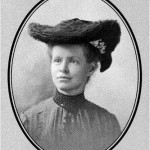
Nettie Maria Stevens

Bibliography

Studies in spermatogenesis with special reference to the “accessory chromosome.” Article by Nettie M. Stevens, 1905, which describes the study that confirmed that sex was determined by a chromosome which, was different in males. Available from the Project Gutenberg.

Nettie Maria Stevens (1861-1912): Her life and contributions to cytogenetics.
Marilyn Bailey Ogilvie & Clifford J. Choquette.
Proceedings of the American Philosophical Society, 1981, 125:292-311

Post writen by Mercè Piqueras (@lectoracorrent), biologist, science writer, science editor, and translator.