«The Poverty Hypothesis» versus «The Capacity Hypothesis»

16 abr.

Jordi VarelaJordi Varela, Editor of the blog “Advances in Clinical Management

The socioeconomic status influences the consumption of goods and services in each community in a very obvious way, a phenomenon which logically includes hospitalisation rates. But in what sense does poverty or wealth determine hospital utilisation? And what role does the accessibility to the number of installed beds in the community play in hospitalisation rates?

To try to answer these two questions I will examine two projects, an English one and an American one that emphasise two different hypothesis, the first one being based on the influence of poverty and the second one, on the installed capacity.

Continue reading

Towards a characterisation of the social impact of biomedical research centres in Catalonia: are we going in the right direction?

9 abr.

Paula AdamPaula Adam, Head of Research Assessment AQuAS

While growing, the overall number of agents who are interested in evaluating the impact of research conducted in the R & D organizations meet a common concern: The need to define a set of indicators of results or impacts that are comparable and internationally accepted. In 2009 a Canadian panel of experts carried out one of the proposals with a global scope, using a set of indicators accompanied by a theoretical model and an appeal to the global community in helping advance the improvement and refinement. Since then, others have reported similar interests. However, we’re not yet aware of any successful wide-ranging initiatives. In literature the points of view favouring a mixed vision of quantitative metric indicators combined with qualitative approaches prevails. Continue reading

Implementing and evaluating the Essencial’s recommendations impact

2 abr.

carialmazanCari Almazán, Head of Essencial  Project

Essencial (Essential), in our context, is a pioneering project. Introduced in March 2013, it was the first initiative in Catalonia and Spain created with the objective of identifying and making the necessary recommendations for the avoidance of little value clinical practice. This objective is not confined to solely generate a periodic list of recommendations. Essencial also aims to promote real change in clinical practice. To achieve this, complementary strategies to implement the recommendations and measure their impact have been developed.

What is meant by little value clinical practices?

It’s clear that, apart from clinical practices with proven effectiveness, other clinical practices take place, some of low value and some that do not provide any substantial value whatsoever. When talking about clinical practice of little value, we mean health interventions that are inappropriate in certain circumstances, either because they are ineffective or because there is no scientific evidence of effectiveness, either because the risks outweigh the benefits or there are alternatives that are more cost-effective. The consequences of inappropriate practice are increased overdiagnosis and overtreatment, as mentioned in the recent medical article Update on medical overuse, published in JAMA. Continue reading

The lessons we learned from Cy Frank

26 març

Cy FrankCyril Frank, or Cy, as he liked to be called, was a visionary with a transforming vocation who accomplished a lot for the wellbeing and health of the residents in Alberta and Canada. Surgeon by profession, he was always interested by the challenges about the quality of services and health systems, very similar to those of AQuAS. He was a leader in his home country and he will be always remembered by people in Alberta and Canada, as demonstrated by the long list of messages, memories, thoughts, stories and notes of condolence that are published every day on the University of Calgary’s notice board. Where he was a professor. Stresses the obituary that the journalist André Picard wrote in The Globe and Mail explaining the variety of ‘hats’ that led Cy Frank over his life. Continue reading

In favour of the variability

19 març

Joan EscarrabillJoan Escarrabill. Director Chronic Care Program at Hospital Clínic Barcelona

John Wennberg explained to us how difficult it is to justify the variability in clinical practice. The health care that people receive, is more determined by where they live (zip code) than by their overall health. This variability is influenced more by local clinical practice (the features and character of each place, i.e. zip code) than the prevalence of disease or patient preferences. Furthermore, in places with greater health services and activity, the satisfaction, quality and the survival rates are often worse. As this variability (chaotic, according to Wennberg) is not explained by sanitary reasons, it also constitutes an element that leads to greater health inequalities.

There are many examples. The «Observatori de Teràpies Respiratòries a Domicili» analyzes annually the performance of these home treatments. There are paradoxes related to the number of treatments. In Catalonia there are over 65,000 people who receive treatment with continuous positive airway pressure (CPAP) in order to treat sleep apnoea. On the other hand there are just over 2,000 people who need home mechanical ventilation. There is less variability in the patient group treated with CPAP (the difference is 2.5 times between the territory with the lowest and the highest prevalence) than in the group of patients using ventilators (the difference is 22 times). The home oxygen therapies’ variability maps show the differences in use of these treatments among different districts of Barcelona. Continue reading

The reuse of data: a transforming element of social and economic reality

12 març

AGA2Anna García-Altés, Head of the Catalan Health System Observatory

The information generated through the contact between citizens and the administration is of great importance, ranging from registrations of birth to registrations in the education system; employment; transport; housing and utilities; the development of economic activities; tax payments; health system; the judiciary system, and even death certifications. This information is essential for the development of the responsibilities that are attributed to the Administration but becomes an invaluable asset for secondary uses.

The current economic situation has highlighted the ever present need to base public policy on assessments to ensure that its objectives are met and, therefore, that an efficient public resources allocation is performed. Data availability is the element that facilitates the evaluation culture implementation in the administration. Data analysis in each are provides information on the policy effectiveness and efficiency and tremendously improves planning. Continue reading

More participation, better policies?

5 març

Elena TorrenteElena Torrente, Coordinator of digital health. DKV Servicios

«For us [the Athenians legislators], the debate is not a stepping stone towards action, but the first step essential to taking any wise decision.» – Pericles

I read this quote in the book «És la política, idiotes!» by Professor of Political Science Quim Brugué where he firmly defends politics and the need for collective decisions in politics. Right now when political disaffection prevails, this is an interesting book to say the least that points to an issue that for me is paramount: Intelligence is always collective.

Nowadays, in the era of social networks where we can share knowledge and contribute ideas, interesting debate has never been so easy. But, how about in the area of public policy? Is collective intelligence taken into consideration when they design it? Does it make sense to do it? Continue reading

The VISC+ project is an opportunity to improve the quality of health care

26 febr.

Argimon JMJosep Maria Argimon, AQuAS Director

VISC+ is a project under the Big Data, the new observational research methodology that makes use of the high availability of data arising from the mass digitization of the modern society activities, added to the analytical potential of current technology. The European Union is generally allocating and in particular in health area, both for the added value it can bring to the public services development and for the revitalization in the field of entrepreneurship. For example, between 2016 and 2020 the EU will invest 500 million Euros to Big Data (in health, energy and manufacturing related projects), while private companies will contribute 2,000 million Euros.

Similarly, the European Institute of Innovation and Technology’s KIC Health Initiative (communities of knowledge and innovation) has one of its nodes in Barcelona, and AQuAS is one of its associate members. KIC Health has a budget of 2,100 million for the coming years and counts with the participation of public and private sector, this being a requirement of the initiative. This space between public initiative and innovative company is where the aforementioned methodology should find its most prolific field, being one of the strategic lines, along with others such as cancer or aging issues. Continue reading

Preference sensitive health care: the causes of variations

19 febr.

Jordi VarelaJordi Varela. Editor of the blog «Advances in Clinical Management«

There is a case-mix part (25% according to Wennberg) such as inguinal hernia, cataracts, metrorrhagia or knee osteoarthritis, for which modern medicine has an effective surgical response, although in the application of the technique there is often a margin for the doctor’s interpretation, another margin for the subjectivity of the patient, such as pain perception or adaptation to the lack of visual acuity, as well as a very important factor: the decision of the patient himself. There are men who prefer to wear a brace to hernia surgery and women who prefer to live with their uterus, provided that the degree of the discomfort and metrorrhagy allows them to.

After this introduction, let’s see the Variations in Health Care, the good, the bad and the inexplicable report by John Appleby and his collaborators, published by King’s Fund in 2011, which states that variations in hospitalization rates are pervasive and persistent, and even affect common interventions known to be effective such as hip replacement for advanced osteoarthritis cases.

Distribution rates of hip replacement in England 2009/10

Note that although adjusted for age and sex, the rate of hospitalization for hip replacement (with lighter blue line) in the graphic, are observed in 18 PCT (Primary Care Trust) that show a value of 60 interventions per 100,000 inhabitants per year, while at the other extreme, there are 20 showing a rate of 140. That is, citizens of the latter communities have a 2.3 times higher probability of being operated on for prosthetic hip replacement than the citizens of the former. The same report shows that these regional differences are extended to other elective procedures such as knee, cholecystectomies or coronary angioplasty.

Whichever way you look, this type of variation in the use of health care resources for procedures seemingly well identified and standardized, is universal, and this is seen when comparisons between systems (countries) are being made, but don’t disappear when, as in the English case, intra-communities and intersystem analysis are being made. If I may, I’ll next show a Spanish example from the Variaciones de la Práctica Médica (VPM) initiative that has the support of all autonomous regions. I have in hand the final report of the VPM research project: Variations in the use of knee arthroplasty in the National Health System, from which I have chosen this graph:


I think in the above graph it should be noted that, excluding outliers health areas (in light blue), there are Spanish territories where inhabitants have a probability of knee prosthesis intervention 6.4 times higher than inhabitants from the areas with the lowest rates. And this occurs in a health system that is considered one of the most fair and accessible in the world.

Where is the problem? What explains these extraordinary variations?

To answer these questions, there’s nothing better that to resort to a 1977 investigation led by a young Wennberg. The following table, published in Tracking Medicine by the same author (Oxford University Press 2010), there is a summary of the results of this work. It’s the comparison of two small communities: Middlebury in Vermont vs. Randolph in New Hampshire. As seen in the table, the two communities have the same socioeconomic characteristics, the same prevalence of chronic diseases, and the same doctor accessibility. However, the Middlebury citizens are hospitalized 67% more than those of Randolph, and undergo surgery 63% more.

This work is a benchmark for questions about the causes of variations in the use of health resources. According to Wennberg, if when demographic, socioeconomic and accessibility factors have been adjusted, such overwhelming differences still remain, one must draw the attention of the variations towards the medical practice and the availability of healthcare resources provided by doctors in each area.

The Centre for Innovation in Health Management in Catalonia: present and future

12 febr.

Montse MoaharraMontse Moharra. OIGS AQuAS

The Catalan health system is the result of a remarkable historical reality that favours the consolidation of a system characterized by public funding, multiple provision and integration of all resources in a network of public use, which makes it a reference and innovation source in management.

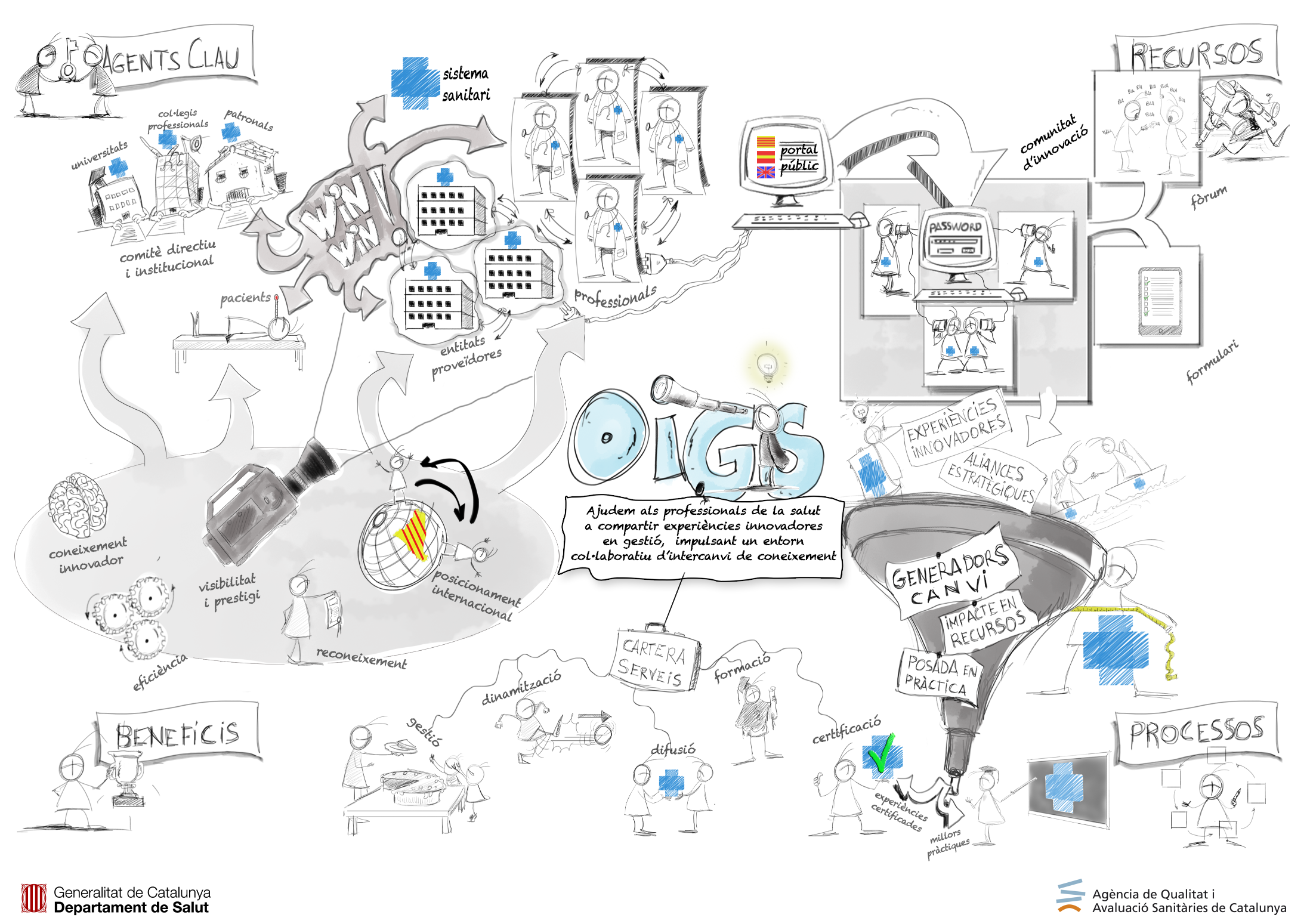
In this context, in 2012 the Observatori d’Innovació en Gestió de la Sanitat in Catalonia (OIGS) (The Centre for Innovation in Health Management in Catalonia) was created with the aim of collecting and giving value to the knowledge generated by innovative initiatives: innovative experiences, strategic partnerships and best practices. Currently, OIGS includes a total of 181 experiences, of which 56% are related to the management of healthcare and strategic processes, 14% with chronic patients, 14% with TIC and 7% drug related.

OIGS also offers an innovation learning space through a public portal and a community of innovation that facilitates the interaction between over 400 professional users who are already sharing their experiences.
workshop

How can an innovative experience be registered?

One has to register with the innovation community and fill in a form with the experience data. The form content is reviewed by the OIGS and the experience is published on the website if it meets the established criteria: having been implemented within an organization, generating a change, having had an impact on resource optimization and being expansible to other organizations or systems.

When the experience is published, the willing organizations may present at any time, also through the innovation community, the self-assessment of the experience. OIGS reviews and evaluates the presented self-assessment and those experiences that exceed this evaluation, obtain a quality certificate issued by AQuAS. Thus, so far 19 experiences have been certified.

Identifying the best practices in health management

Starting from the process of reviewing management innovative experiments, identifying commonalities and required by CatSalut, so far three potentially scalable experiences throughout the healthcare system have been identified: the suitability of prescribing in primary and community care; the online preoperative and the online dermatology. However, this is an ongoing process that ought to facilitate identifying new best practices.

OIGS in the future

In the near future, OIGS aims to encourage the participation of professionals and organizations that are important to system innovation; to create knowledge networks through participation in research and innovation projects at European level and organizing specific thematic workshops. The innovation community will facilitate identifying experiences that can be part of potential interest groups and that will be able to respond to the specific challenges related to European funding such as innovative public procurement.