Integrated care: what is the main underlying idea?

9 juny

This past 23rd, 24th and 25th May, 2016, Barcelona hosted ICIC16 – The 16th International Conference on Integrated Care where 1,000 attendees from over 50 countries around the globe enjoyed an active and busy agenda.

The experience involved 92 speakers and over 23 hours, which was also possible to follow via streaming. All in all, a challenge which the organizers were successful in delivering. You can read or re-read the Twitter comments from here: #ICIC16.
ICIC - AQUAS
Gabi Barbaglia, Vicky Serra-Sutton, Laia Domingo, Mireia Espallargues, Marina Ordóñez, Montse Moharra

The International Conference on Integrated Care (ICIC) has become a must for professionals who provide care for people and managers working in the fields of health and social services, among others.

Different languages to express the same message: integrated care represents the path we need to follow in order to meet the challenges of our aging populations.

How can we do it? Integrated care proposes the integration of services as a response to the fragmentation of care practice, especially in the biomedical system. The coordination of professionals and institutions aims to improve the experience of patients’ who receive care, as well as their families and to improve their quality of life related to health. This becomes especially key when identifying patients with complex needs.

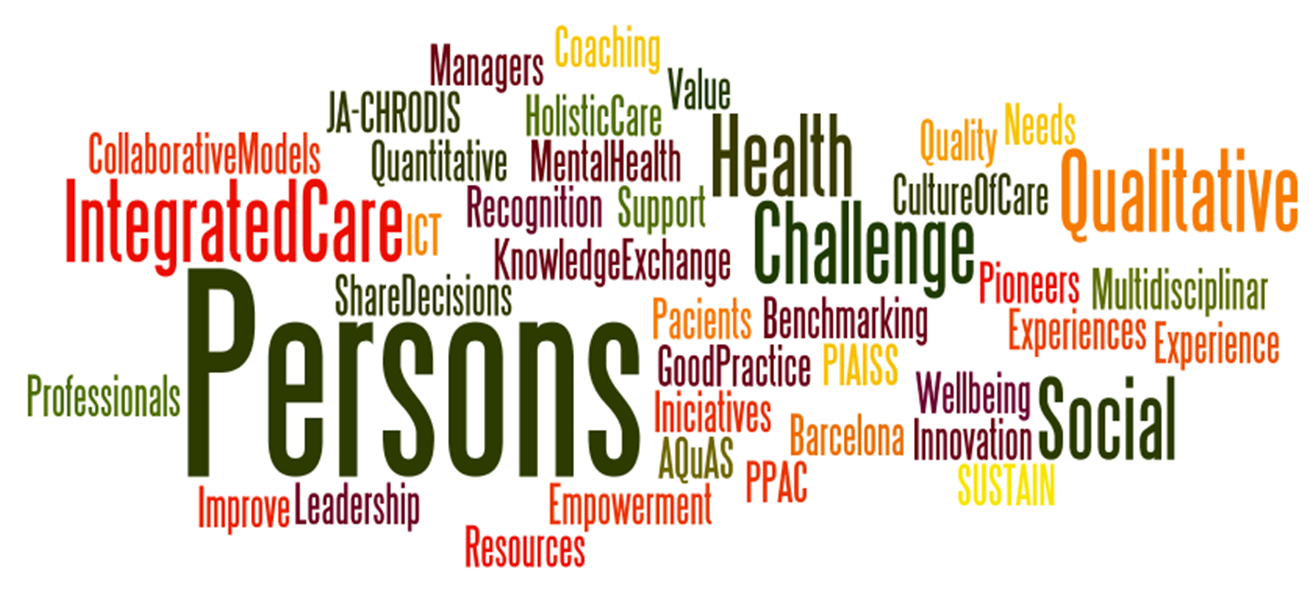
The main topics covered during the ICIC conference referred to people-centred care within the perspective of those treated and in the coordination, integration and, collaboration of services, professionals and systems (health, social, education, justice, corporate, etc.). In this regard, there were a variety of experiences presented from around the world of collaborative approaches that promote a multidisciplinary and integrated style.
ICIC-cloud-persons

The conference speakers emphasized the value of primary care and community health as being core to providing care to the community as well as the leadership of professionals from the areas of nursing, social work, the field of mental health and other disciplines and profiles.

Following this main topic, several presentations focused on different organizational models of collaborative care which report findings that endorse the adoption of strategies from the bottom up, in other words, strategies that would enable the initiatives proposed by health professionals to reach planners and administrators who, in turn, can provide the support and recognition.

It is important to highlight that there is an ever-increasing recognition of the importance of social determinants of health and looking to the community for the role it might play in shaping these determinants.

One highlight of the conference was the talk Changing culture and measuring what matters given by Alonzo L. Plough in which the speaker summarized the report: Building a National Culture of Health: background, action, framework, measures and next steps.

Don Reding from National Voices, gave an inspirational presentation with Putting what matters most to patients and communities at the heart of health and social care design.

Another outstanding presentation was that given by Professor Deirdre Heenan from the University of Ulster: Integrated care in Northern Ireland: meeting the challenge of mental health.

***You can read more about the ICIC 2016 conference by clicking on the following link:

http://lhalliances.org.uk/international-conference-on-integrated-care/

http://blog.hospitalclinic.org/2016/05/catalunya-acull-la-16-conferencia-internacional-sobre-atencio-integrada/

http://gestioclinicavarela.blogspot.com.es/2016/05/a-proposit-de-la-16th-international.html

That’s not all. Next year’s conference will be held in Dublin (land of innovators!) with the following themes:

ICIC #ICIC17 Dublin

Let’s come back to Barcelona for a while. For some time now, the Agency for Health Quality and Assessment of Catalonia (AQuAS as per the Catalan synonym) has been working on an assessment of integrated care, by way of example with the Evaluation of collaborative social and health care models.

It is also noteworthy the recent publication of the specialised report in the Social Work Magazine (Revista de Treball Social), titled: Integrated social and health care: points to reflect upon, which we believe to be a good cross-section of opinions and a good starting point.

Another iniciative in AQuAS is the SUSTAIN project -funded by Horizon2020, an opportunity for professionals to work jointly with their peers in other countries in an effort to define a roadmap and establish synergies in the field of Integrated care in Europe, a project of great interest for Catalonia.

Finally, it is vital not to lose sight of another key issue which is equality in the access to and outcomes from services, and this implies regular analysis of variations  in care which have not been justified.

A further helpful instrument for incorporating the opinions of those who receive care and the professionals involved is that of shared decisions. This involves a line of work which incorporates available evidence in a specific area or department of care, the preferences of patients when faced with the different health intervention options, and the essential information for improving the knowledge of all those involved (professionals, patients and their families and environment).

Post written by Vicky Serra-Sutton, Gabi Barbaglia (@gabibarblagia), Laia Domingo, Marta Millaret (@MartaMillaret) and Mireia Espallargues.


The Great Escape

21 gen.
Joan MV Pons, Head of Evaluation AQuAS
Joan MV Pons

A few days ago, Anna Garcia-Altés in a previous post referred to the Nobel Prize in Economics, which Alfred Nobel never granted – that was awarded in 2015 to Angus Deaton and his work on inequality. This is not the subject that I wish to talk about today but another that also features in the recent book from this Nobel proze winner which is titled “The Great Escape” (The Great Escape). Yes, just like the movie, set in a German camp for prisoners of war starring Steve McQueen and recalling a real fact of World War II. Unlike reality, the book predicts a better ending. For Deaton, the greatest escape in human history was in overcoming poverty and ageing.

For centuries, those who did not die at a young age could face years of misery. Beginning in period called the Enlightenment, with its scientific revolution and subsequent later industrial revolution, some people in certain countries began to escape this meagre fate.

Meanwhile, germ theories founded in the late nineteenth century surpassed the paradigm of the miasma theory in explaining contagious diseases. The key was and still is scientific knowledge and its dissemination. This point in history marks the extraordinary increase in life expectancy, initially for the better-off and then for the rest of the population.

This higher life expectancy, manifested especially in the developed countries, is largely due to the remarkable reduction in infant mortality and, more recently, to the epidemiological transition to chronic non-contagious diseases, the improvement in life expectancy in adulthood (increased life expectancy ≥ 50 years from 1950), but without a substantial improvement in longevity. Deaton shows us all this with data and graphics.

To illustrate it, Deaton mentions the progress in combating smallpox with a vaccination of smallpox (initially using matter from infected people and later the much safer vaccine Edward Jenner introduced in 1799). The public health measures introduced in the last few hundred years, including sanitation, water supply, nutrition and better hygiene, have led to a significant reduction in infant mortality.

Here, it was due to not only the knowledge but also the determination of the authorities in improving the conditions of the population. The improvement in life expectancy in adulthood is explained largely by reducing cardiovascular mortality through diagnostic and therapeutic advances in this field.

As mentioned before, we witnessed not only increased life expectancy but also a significant increase in the world population, an authentic explosion starting in the second half of the twentieth century. Malthusian alarms re-emerged but they were fortunately overcome by improvements in agricultural productivity, without excluding initiatives – for better or worse – for controlling the birth rate in developing countries; again, examples of scientific knowledge and its dissemination.

Deaton is very critical about the operating methods in which help flows from developed countries to developing countries. From the times of imperialism and colonization where (natural) resources were moved from poor countries to rich ones (Nineteenth century) and since the end of World War II we’ve also seen a flow of resources from developed countries to developing countries.

This external help, whether from governmental or NGO sources and despite the illusion that might it create if it continues as usual, may end up doing more harm than good. There’s no shortage of examples in the book of wasted resources by governments and corrupt politicians, granting donations or grants to countries (government to government) without these ever reaching the people. Not to mention situations where these grants are part of the geopolitics of the former colonies or contemporary powers.

Contrary to what an engineered hydraulic vision (communicating vessels) may show, we must invest in projects and programs that promote conditions for economic development to make external aid unnecessary, as is the reality in Africa, where paradoxically, the more external help yields the least growth in GDP per capita.

Health aid, without underestimating its achievements (vaccination campaigns, infrastructure construction, drugs against HIV / AIDS, mosquito nets), continues to be in most cases, vertical health programs with a very specific focus. This contrasts with the horizontal programs aimed at strengthening local health care systems, especially a good network of primary and community care.

Often foreign aid and the development of local capacity are not aligned; on the contrary, often one damages the other. Rich countries’ subsidies to their agriculture – consider the famous European PAC – is detrimental to farmers in poor countries where most of the workforce still works the land. There are more effective ways to help.

(It notes that another Nobel laureate in economics, Robert Fogel (1926-2013), had already written about the great escape in “The Escape from Hunger and Premature Death, 1700-2100” (2004), Deaton and had revised appointment. Thank Anna Garcia-Altés to call me about this)

La gran evasió

21 gen.
 Joan MV Pons Joan MV Pons, responsable Avaluació AQuAS
Joan MV Pons

Fa pocs dies, l’Anna Garcia-Altés feia referència al Premi Nobel d’economia -que Alfred Nobel mai va instituir- 2015 Angus Deaton i els seus treballs sobre la desigualtat. No és sobre aquest tema que voldria parlar, sinó d’un altre que també surt en el darrer llibre del nou Nobel i que porta per títol “La gran evasió” (The great escape), sí, com la pel·lícula ambientada en un camp alemany de presoners de guerra que protagonitza Steve McQueen i que rememora un fet real de la segona guerra mundial. Contrari a la realitat, el llibre augura un millor final.. Per a Deaton, la més gran escapada en la història humana és la superació de la pobresa i, com dir-ho, l’envelliment de la mort.

Per segles i segles, qui no moria en els primers anys de vida podia enfrontar-se a anys de misèria. És a partir d’aquest període anomenat de la Il·lustració, amb la revolució científica i la revolució industrial subsegüent que alguns humans en alguns països van començar a escapar d’aquest destí.

Entremig hi ha la teoria dels gèrmens fonamentada a finals del segle XIX i que superava el paradigma de la teoria miasmàtica per explicar les malalties contagioses. La clau estava, segueix estant, en el coneixement científic i la seva difusió. D’aquí prové l’extraordinari augment de l’esperança de vida, primer en els més benestants i, seguidament, a la resta de la població.

Aquesta més alta esperança de vida, manifestada especialment en els països desenvolupats, ha estat deguda en gran part a la marcada reducció en la mortalitat infantil i, més darrerament, amb la transició epidemiològica cap a malalties cròniques no contagioses, a la millora en l’esperança de vida a l’edat adulta (augment de l’esperança de vida en ≥ 50 anys a partir de 1950), sense que la longevitat hagi millorat substancialment. Tot això ho mostra Deaton amb dades i gràfics.

Per exemplificar-ho, Deaton fa esment del progrés per combatre la verola, amb la inoculació de la verola (a partir de material de persones infectades) primer i la vacuna molt més segura que Edward Jenner va introduir després (1799). Han estat les mesures de salut pública de les darreres centúries, entre aquestes el sanejament, el subministrament d’aigua potable, la nutrició i una millor higiene, les que han donat lloc a la important reducció en la mortalitat infantil.

Aquí no sols ha estat el coneixement, sinó també la determinació dels poders públics de millorar les condicions de la població. La millora en l’esperança de vida a l’edat adulta s’explica en bona part per la reducció de la mortalitat cardiovascular pels avenços diagnòstics i terapèutics en aquest camp.

No sols, com dèiem, ha augmentat l’esperança de vida, sinó que també hi ha hagut un important increment de la població mundial, una autèntica explosió a partir de la segona meitat del segle XX. Alarmes malthusianes sorgiren de nou que, afortunadament, foren superades per les millores en la productivitat agrícola, sense excloure’s iniciatives -amb millor o pitjor intenció- pel control de la natalitat en els països en vies de desenvolupament. De nou coneixement (científic) i difusió del mateix.

On Deaton és molt crític és en la manera com operen les ajudes que flueixen dels països desenvolupats als països en vies de desenvolupament. Dels temps de l’imperialisme i colonització on els recursos (naturals) anaven dels països pobres als rics (segle XIX), s’ha passat des del final de la segona guerra mundial a un flux de recursos dels països desenvolupats a països en vies de desenvolupament.

Aquesta ajuda externa, siguin fonts governamentals o d’ONG, malgrat la il·lusió que pugui despertar, si se segueix donant com fins ara, acaba fent més mal que bé. En el llibre no falten exemples del malbaratament de recursos per governs i polítics corruptes, atorgant-se les donacions o ajudes a països (govern a govern) i sense arribar a la gent. No diguem quan aquestes ajudes formen part de la geopolítica de les antigues colònies o dels poders contemporanis.

Contrari al que anomena una visió hidràulica (de vasos comunicants) i enginyeril, cal invertir en projectes i programes que afavoreixin les condicions pel desenvolupament econòmic per així fer que l’ajuda sigui innecessària, doncs no deixa de ser paradoxal a l’Àfrica que, quan més ajuda externa menys creix el PIB per càpita.

L’ajuda sanitària, sense menystenir els seus èxits (campanyes de vacunació, construcció d’infraestructures, fàrmacs contra el VIH/Sida, mosquiteres), no deixen de ser en la majoria de casos programes de salut verticals amb un focus ben específic. Això contrasta amb els programes horitzontals adreçats a reforçar els sistemes locals d’atenció sanitària, en especial, una bona xarxa d’atenció primària i comunitària.

Sovint l’ajuda exterior i el desenvolupament de la capacitat local no estan alineades, sinó que una perjudica a l’altra. Els subsidis dels països rics a la seva agricultura –pensem en la famosa política agrària comuna (PAC) europea – perjudica als pagesos dels països pobres on la major part de la població activa treballa la terra. Hi ha formes més efectives d’ajudar.

(Cal dir que un altre llorejat amb el Nobel d’economia, Robert Fogel (1926-2013), ja havia escrit sobre la gran escapada a “The Escape from Hunger and Premature Death, 1700-2100” (2004), text que Deaton cita i que havia revisat. Agraeixo a l’Anna Garcia-Altés que em cridés l’atenció sobre això)

Social networks and health, an opportunity that still has far to go

8 oct.

Josep Vidal AlaballJosep Vidal Alaball, Family Doctor. EAP Artés (ICS)

Whatever the field, social networks open a range of opportunities. Their features has been changing many people’s lives for many years, starting with the closest relationships to organizations, companies and brands around us and yes, even the medical staff.

In the health field, I’m not quite sure whether the social networks should be used to improve the relationship and interaction with patients, as this aspect should be dealt with in everyday consultations. What is certain is that social networks can be used to enable patients to consult doctors or reinforce aspects that sometimes can not be completely covered during a medical consultation. A good example is the use of inhalers. Sometimes, it can be easier for a professional to recommend patients a video showing how people with respiratory diseases use it, instead of briefly and superficially teaching the correct technique during the consultation. Continue reading

Public health care budget. A ten-year overview (part 2)

1 oct.

Joan-PonsJoan MV Pons, Head of Evaluation AQuAS

If in the previous post we examined the public health care budget evolution in the last decade (2005-2015) and we compared its distribution by major service lines, in this second part we will look at diseases (health problems) as described by the WHO International Classification of Diaseases (ICD) where they categorize conditions by the affected organs (apparatus or systems) or by origin (in the graphic: pressupost = budget)

Sense títol Continue reading

Public health care budget. A ten-year overview (part 1)

24 set.

Joan-PonsJoan MV Pons, Head of Evaluation AQuAS

In 2007, a high interest health economics research article was published and promoted by the Department of Health1. The study broadcasted the public health care budget for 2005, not only for the 17 categories of the International Classification of Diseases (ICD), but also by the type of assistance and mainline services. There is no doubt that the work provided a reference point for health planning and management and offered an unexpected surprise as, until recently2, the newer data of this kind and obtained using a similar methodology was not being made public. I admit that it has been a personal interest of the Minister to see the data presented in this manner.

And in this interval, 2005-2015, what do the numbers say, more exactly, the euros? First, let’s have a look at the overall graphics and then at its sections.

Sense títol

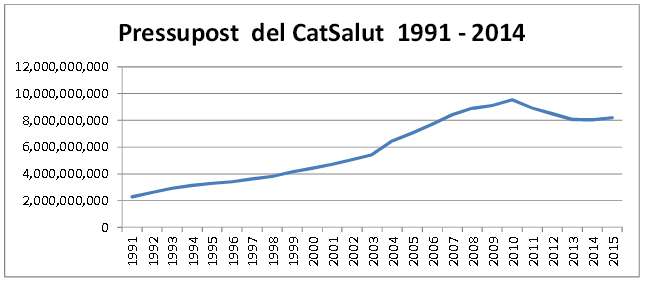
Let’s start by mentioning that the harsh cuts timeframe was in 2011-2013 when CatSalut’s budget had to be reduced by 1.5 billion Euros compared to 2010, the year when this expenditure (or investment for some and certainly a source of health and financial benefits for many people) reached its peak. Worthy of mentioning is that between 2003-2010, CatSalut’s budget growth far exceeded the GDP growth, but this was a very common trend before the crisis. We will not go along with littleness, by asking whether, despite the reduction in public spending, the budget for social policies (health, education, welfare and family) of the Catalan government has increased in percentage within Catalonian budgets (71.2% in 2015). Accurately, the 2005 health budget represented 40% of the Catalan public budget and in 2015 we have the same percentage, but the amounts are very different. Here we could apply the phrase attributed to both Mark Twain and Benjamin Disraeli regarding the three types of lies: lies, damned lies and statistics.

If we continue down the broad lines of services, we have to study them with graphics such as the following (pressupost = budget):

Sense títol

If we examine the budget distribution among major areas or major lines (functional classification) we notice striking things worthy of mentioning. The first, undoubtedly, is the reduction in pharmacy spending that has reached stratospheric levels in the mid of the last decade, (almost 24% of all health care budget). Plenty of measures with regards to the quality of prescribing have been implemented, from the most effective in price levels and generic to the more educational (professional) and motivating (management by objectives). It’s clear that for many years, the local and foreign pharmaceutical industry, existed in a cloud due to the lack of a genuine public pharmacy policy in this country. For this reason, those covenants that demanded returns of profits with which research networks (ISCIII) were financed and, amusingly, funds for activities aimed at rational drug use that the Ministry distributed among nationalities and regions, emerged.

Therefore the pharmacy spending goes down (as the return of the pharmaceutical industry to research and rational use), but the more particular pharmacy, the high technology pharmacy (biotechnology, whether medicine of recombinant origin or monoclonal antibodies) as is the MHDA (ambulatory drugs dispensed at the hospitals), continues to rise with an absolute increase of 61.6% between 2005 and 2015 (from M€390.29 to M€630.93). A more thorough analysis of the changes in pharmaceuticals expenditure, whether in a hospital or for distribution to outpatients, would force us to examine in more detail the different types of drugs and their use.

We can also notice an increase in spending on health care, both primary and specialized, as the latter grows much more to represent more than half (58%) of public insurance spending. The trend of focusing on hospitals and unrestrained specialized care also comes from afar. We may say, although without the data, that there is an incipient turnaround in recent years, of a slight decrease in specialized care and slight increase in primary care. The growing need for attention to chronic disease and for integration of social services (health and social care), the two sides of the same coin, should go on shifting this situation.

1 Gisbert R, Brosa M, Bohigas L. Distribución del presupuesto sanitario público de Catalunya del año 2005 entre las 17 categorías CIE-9-MC. Gac Sanit 2007;21:124-31.

2 Pressupost del Departament de Salut per a l’any 2015

Results Centre. Primary Care Setting. 2014 Data.

13 ag.

AGA2Anna García-Altés, Head of the Catalan Health System Observatory

This report presents the results of all SISCAT primary care teams (PCT) for 2014. This year, the structure of the report is slightly different from previous years. It deals with fewer topics but in a more concrete, in-depth manner. A special effort has been made to include indicators of nursing care evaluations, an area little discussed up until now in the Results Centre reports, and other new indicators from records that so far have not been analyzed in the reports. Some examples of these indicators are: the percentage of diabetic patients with related treatment diagnoses or the A&E MBDS indicators. However, the tables with the values ​​of all indicators centre by centre -the distinguishing feature of the Results Centre- remain. As in previous years, all reports include innovative experiences that provide good care results, included in the Observatori d’Innovació en Gestió de la Sanitat in Catalonia as well as the experts’ opinion. Continue reading

Can unnecessary hospitalizations be avoided?

18 juny

Jordi VarelaJordi Varela, Editor of the blog “Advances in Clinical Management

It is said that the best savings in health is in avoidable hospitalisation that doesn’t occur, especially since the use of a hospital bed is the most expensive health resource of all the health offers, but also because if one person, let’s imagine an elderly one with several chronic conditions, can avoid being admitted in hospital, his/her health will suffer less compromising situations. For this reason, all health systems are very active in trying to launch all kinds of measures to reduce the admission of chronic and frail patients.

Dr. Sara Purdy, family physician and Senior Consultant at the University of Bristol, published under the auspices of the King’s Fund, in late 2010, an analysis of what actions reduce the unnecessary hospital admissions and which ones do not. The work of Dr. Purdy is focused only on organisational actions such as home hospitalisation or case management, and, in contrast, does not include strictly clinical factors such as the impact of a new drug for asthma conditions.

Continue reading