How we adapt medical language to improve communication with patients

12 jul.
Montse Moharra

What is special about the recommendations for patients and the Essencial project, one of the projects of the Agency for Health Quality and Assessment of Catalonia (AQuAS)?

There is a greater and greater demand to have access to clear and more readily understandable information in health by patients. There is a growing need, therefore, to provide this within a comprehensible format which includes the need to ensure that the medical message a patient receives is effective. This will in turn facilitate the conversation between both parts and will improve a patient’s understanding of their diseases, treatment options or possible side effects and will most likely also have an impact on empowering patients to be more actively involved in taking decisions related to their treatment.


The use of medical terminology is one of the factors, among others, which impedes an effective communication between professionals in health and patients. This could be due to a low level of understanding in health which we call “literacy” or perhaps as a result of the complexity of the specialised medical terminology itself which stems from a wide range of clinical specialities. These use specific terminology and we often find terms used in other fields of expertise such as pharmacy or biology.

It is most likely too that one of the reasons why medical information is not successfully transmitted is due to the amount of terminology found in a text which may not easily be understandable to the patient. Moreover, with the progress of medicine itself new terminology is constantly being introduced – some is modified and some terms are discarded. Therefore, the variation in terminology and the use of overlong sentences, the density of unexplained terminology, the use of acronyms, symbols or abbreviations are some of the barriers that complicate understanding.

The Essencial project, which has been drawing up recommendations to avoid unnecessary clinical practices for five years, started to adapt information for patients in 2014 and at present there are a total of twenty-two recommendations for patients available in Catalan and Spanish. These are a clear example of how medical terminology is adapted so that clinical recommendations can better be understood by patients and reach them effectively. For this reason, a process is followed to adapt the language to make a text easier to read and this also applies to its content, format and graphic images thus ensuring that documents for patients meet minimum reading requirements. The communication group of the Patient Advisory Council that designed the format of the documents and regularly validates the content also participates in this process.
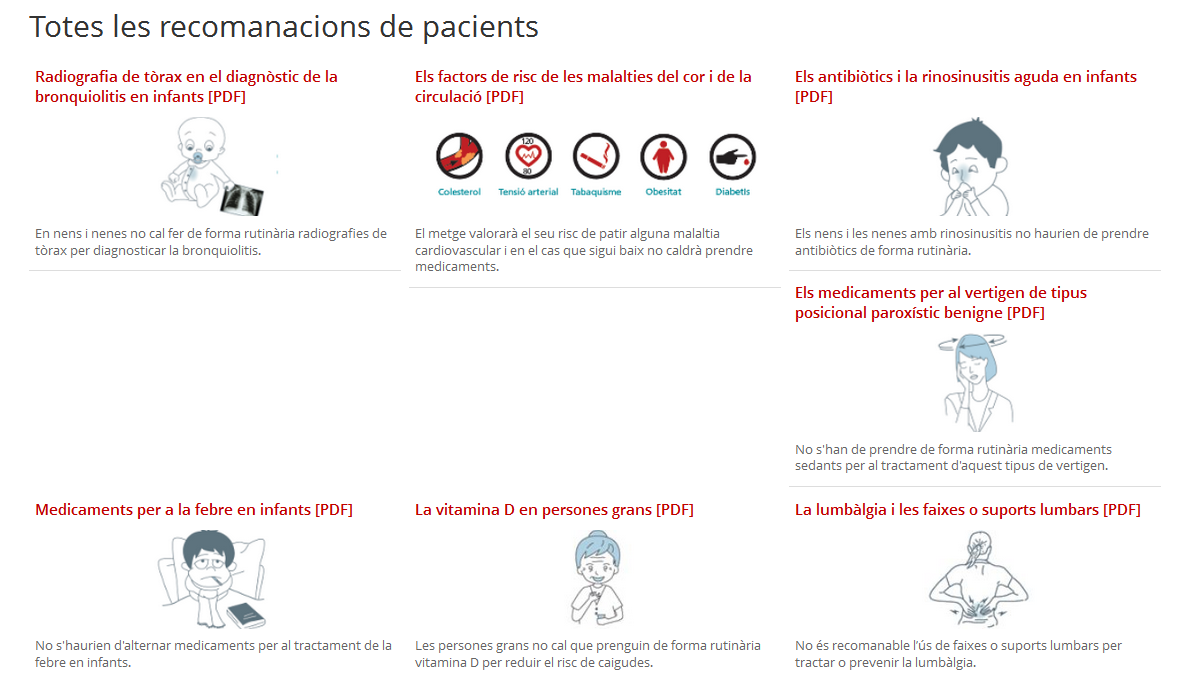
The ultimate aim, therefore, is to make medical language more accessible to patients so that the message is effective bearing in mind the linguistic, cognitive and cultural barriers that may impede the information from being understood adequately.

Post written by Montse Moharra.
Cómo adaptamos el lenguaje médico para mejorar la comunicación con el paciente

12 jul.
Montse Moharra

¿Que tienen de especial las recomendaciones para pacientes del proyecto Essencial, uno de los proyectos de la Agencia de Calidad y Evaluación Sanitarias de Cataluña (AQuAS)?

Cada vez más hay una demanda creciente para tener acceso a la información en salud de forma más clara y comprensible para los pacientes y por este motivo se incrementa la necesidad de proporcionar esta información en un formato comprensible y asegurar que el mensaje médico que recibe el paciente sea válido. Ésto, además, facilitará el diálogo entre ambas partes y mejorará que los pacientes puedan entender mejor su enfermedad, las opciones de tratamiento, los posibles efectos secundarios y seguramente habrá también un impacto en el empoderamiento del paciente para tomar parte más activa en la toma de decisiones de su proceso terapéutico.

El uso de terminología médica es uno de los factores, entre otros, que impiden una buena comunicación entre el profesional de la salud y el paciente, puede ser causa de un bajo nivel de comprensión en salud, lo que llamamos “alfabetitzación” o por la propia complejidad de la terminología médica especializada, con un amplio abanico  de diferentes especialidades clínicas que se expresan a través de una terminología específica y donde encontramos frecuentemente otros términos que se utilizan en otros conocimientos como farmacia o biología.

Sin embargo, seguramente uno de los motivos por los que la información médica no se comunica con éxito es justamente la avalancha terminológica que se concentra en un mismo texto con una semántica poco transparente para el paciente. Además, la propia evolución de la medicina constantemente incorpora nueva terminología, se modifica otra y se abandona el uso de algunos otros términos. Por tanto, la variación terminológica, junto con el uso de frases demasiado largas, concentración de terminología no explicada, el uso de siglas, los símbolos, las abreviaturas son algunas de las barreras que dificultan la comprensión.

El proyecto Essencial que elabora recomendaciones para evitar las prácticas clínicas innecesarias desde hace 5 años, empezó a adaptar la información para los pacientes en el año 2014 y actualmente hay un total de 22 recomendaciones para pacientes disponibles en catalán y castellano. De hecho, son un ejemplo claro de cómo se adapta la terminología médica para que la recomendación clínia se entienda mejor y llegue a los pacientes. Por este motivo se sigue un proceso de adaptación lingüística que hace que el texto sea más fácil de leer, del mismo modo que se adapta el contenido, la forma y la imagen gráfica. Este formato hace que las fichas para pacientes cumplan con unos requisitos mínimos de lectura. El proceso cuenta con la participación del grupo de comunicación del Consejo Consultivo de Pacientes que diseñaron el formato de las fichas y validan regularmente su contenido.

La finalidad final es acercar el lenguaje médico a los pacientes para que de este modo el mensaje sea válido considerando las barreras lingüísticas, cognitivas y culturales que pueden provocar incomprensión de la información.

Entrada elaborada por Montse Moharra.

Com adaptem el llenguatge mèdic per millorar la comunicació amb el pacient

12 jul.
Montse Moharra

Què tenen d’especial les recomanacions per a pacients del projecte Essencial, un dels projectes de l’Agència de Qualitat i Avaluació Sanitàries de Catalunya (AQuAS)?

Cada vegada més hi ha una demanda creixent per tenir accés a la informació en salut de manera més clara i entenedora per part dels pacients i per tant s’incrementa la necessitat de proporcionar-la amb un format comprensible i assegurar que el missatge mèdic que rep el pacient sigui vàlid. Això, a més, també facilitarà el diàleg entre ambdues parts i millorarà el fet que els pacients puguin entendre millor la seva malaltia, les opcions de tractament, els possibles efectes secundaris i segurament també tindrà un impacte en l’apoderament del pacient per prendre part més activa en la presa de decisions del seu procés terapèutic.

L’ús de la terminologia mèdica és un dels factors, entre d’altres, que impedeix una bona comunicació entre el professional de la salut i el pacient, pot ser a causa d’un nivell baix de comprensió en salut, el que anomenem “alfabetització” o bé també per la mateixa complexitat de la terminologia mèdica especialitzada, la qual compta amb un ampli ventall de diferents especialitats clíniques que s’expressen a través d’una terminologia específica i on sovint trobem altres termes que s’utilitzen en altres coneixements com la farmàcia o la biologia.

Segurament també, però, un dels motius pels quals la informació mèdica no es comunica amb èxit és justament l’allau terminològica que es concentra en una mateix text amb una semàntica poc transparent per al pacient. A més, per la pròpia evolució de la medicina, constantment s’incorpora nova terminologia, se’n modifica d’altra i també s’abandona l’ús d’alguns altres termes. Per tant, la variació terminològica, així com també l’ús de frases massa llargues, concentració de terminologia no explicada, l’ús de les sigles, els símbols, les abreviatures són algunes de les barreres que dificulten la comprensió.

El projecte Essencial que elabora recomanacions per evitar les pràctiques clíniques innecessàries des de fa 5 anys, va començar a adaptar la informació per als pacients l’any 2014 i actualment hi ha un total de vint-i-dos recomanacions per a pacients disponibles en català i castellà. De fet, són un exemple clar de com s’adapta la terminologia mèdica per tal que la recomanació clínica s’entengui millor i arribi als pacients. Per això se segueix un procés d’adaptació lingüística que fa que el text sigui més fàcil de llegir, així com també s’adapta el contingut, la forma i la imatge gràfica. Aquest format fa que les fitxes per a pacients compleixen uns requisits mínims de lectura. El procés compta també amb la participació del grup de comunicació del Consell Consultiu de Pacients que van dissenyar el format de les fitxes i validen regularment el seu contingut.

La finalitat final és, doncs, apropar el llenguatge mèdic als pacients per tal que el missatge sigui vàlid considerant les barreres lingüístiques, cognitives i culturals que poden provocar incomprensió de la informació.

Entrada elaborada per Montse Moharra.

The XPatient congress in search of current and innovative proposals in the area of patient experience

5 jul.

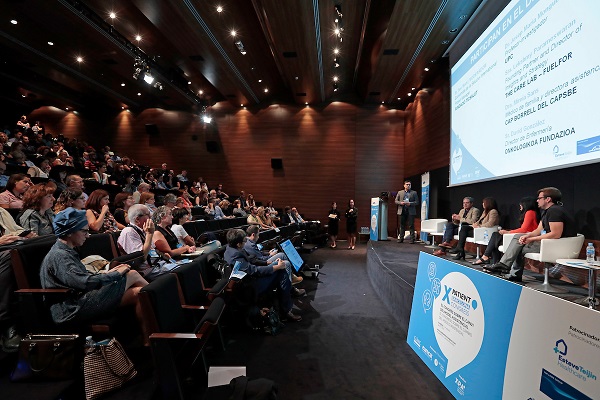
The XPatient Barcelona congress, which this year holds its 3rd edition on September 20 in the CaixaForum Barcelona, concerns itself with innovative initiatives taking place in several contexts: in patient and caregiver empowerment, in the co-creation of healthcare with patients and in technology at the service of users. This has been done via a call for participation, or Call4Projects, which was open till last 25 June and received 73 projects, a figure considered a success in participation.

This event, organised by the technological centre Eurecat and the Hospital Clínic, together with the help of the XPA Barcelona community of practice (Patient Experience) – of which AQuAS has been a member since its beginning – has become the main meeting point in Catalonia for patients, family members and healthcare professionals as well as the different actors involved in healthcare. This is where they present and debate on the best initiatives for improving the quality of life of people and users, an area where technology plays a key role as facilitator of new models of healthcare.

Felip Miralles

In the words of the head eHealth at Eurecat, Felip Miralles, “we want an XPatient Barcelona congress which is increasingly more active, interactive and participative and which consolidates itself as ambassador for the best initiatives, methods and technologies having a focus and impact on improving patient experience.”


Joan Escarrabill

Joan Escarrabill, physician at the Hospital Clínic, points out that “the starting point to assess patient experience is to not make any assumptions” and stresses that “there are many strategies to identify the needs of patients and their caregivers which are not covered.”

The proposals selected from the participative process, Call4Projects, will be presented during the congress in September either in a speech or in the exhibition space at the event.

Post written by Eurecat (@Eurecat_news), Centre Tecnològic de Catalunya.

El congreso XPatient en búsqueda de propuestas actuales e innovadoras en el ámbito de la experiencia del paciente

5 jul.

El congreso XPatient Barcelona, que este año celebrará su tercera edición el 20 de septiembre en CaixaForum Barcelona, trabaja con iniciativas innovadoras que se estén llevando a cabo en los ámbitos del empoderamiento del paciente y del cuidador, la cocreación asistencial con pacientes y la tecnología al servicio del usuario, a través de una llamada a la participación, o Call4Projects, que estuvo abierta hasta el pasado 25 de junio y obtuvo 73 proyectos, cifra que se considera un éxito de participación de la convocatoria.

Este evento, organizado por el centro tecnológico Eurecat y el Hospital Clínic de Barcelona, con el impulso de la comunidad de práctica XPA Barcelona (Experiencia del Paciente) -de la que AQuAS forma parte como miembro desde su inicio- se ha convertido en principal punto de encuentro entre pacientes, familiares y profesionales sanitarios para exponer y debatir las mejores iniciativas en la mejora de la calidad de vida de las personas usuarias y de los diferentes actores implicados en la asistencia sanitaria, un ámbito donde la tecnología juega un papel clave como facilitador de nuevos modelos asistenciales.

Felip Miralles

En palabras del responsable de la unidad de eHealth de Eurecat, Felip Miralles, “queremos un congreso XPatient Barcelona cada vez más vivo, interactivo y participativo, que se consolide también como altavoz de las mejores iniciativas, métodos y tecnologías que tengan foco e impacto en la mejora de la experiencia del paciente”.


Joan Escarrabill

Joan Escarrabill, médico del Hospital Clínic de Barcelona, remarca que “el punto de partida para evaluar la experiencia del paciente es no hacer suposiciones” y subraya que “hay muchas estrategias para identificar las necesidades no cubiertas de los pacientes y de sus cuidadores”.

Las propuestas seleccionadas a partir del proceso participativo Call4Projects se presentarán durante el congreso de septiembre, ya sea como ponencia o bien en el espacio expositivo del evento.

Entrada elaborada por Eurecat (@Eurecat_news), Centre Tecnològic de Catalunya.

El congrés XPatient a la recerca de propostes actuals i innovadores en l’àmbit de l’experiència del pacient

5 jul.

El congrés XPatient Barcelona, que enguany celebrarà la seva tercera edició el 20 de setembre al CaixaForum Barcelona, treballa amb iniciatives innovadores que s’estiguin duent a terme en els àmbits de l’apoderament del pacient i del cuidador, la cocreació assistencial amb pacients i la tecnologia al servei de l’usuari, mitjançant una crida a la participació, o Call4Projects, que va estar oberta fins al passat 25 de juny i va obtenir 73 projectes, xifra que es considera un èxit participatiu de la convocatòria.

Aquest esdeveniment, organitzat pel centre tecnològic Eurecat i l’Hospital Clínic, amb l’impuls de la comunitat de pràctica XPA Barcelona (Experiència del Pacient) -de la qual AQuAS forma part com a membre des del seu inici- s’ha convertit en el principal punt de trobada a Catalunya entre pacients, familiars i professionals sanitaris per exposar i debatre les millors iniciatives en la millora de la qualitat de vida de les persones usuàries i dels diferents actors implicats en l’assistència sanitària, un àmbit on la tecnologia juga un paper clau com a facilitador de nous models assistencials.

Felip Miralles

En paraules del cap de la unitat d’eHealth d’Eurecat, Felip Miralles, “volem un congrés XPatient Barcelona cada cop més viu, interactiu i participatiu, que es consolidi també en altaveu de les millors iniciatives, mètodes i tecnologies que tinguin focus i impacte en la millora de l’experiència del pacient”.


Joan Escarrabill

Joan Escarrabill, metge de l’Hospital Clínic, remarca que “el punt de partida per avaluar l’experiència del pacient és no fer suposicions” i subratlla que “hi ha moltes estratègies per identificar les necessitats no cobertes dels pacients i dels seus cuidadors”.

Les propostes seleccionades a partir del procés participatiu Call4Projects es presentaran durant el congrés de setembre, ja sigui com a ponència o a l’espai expositiu de l’acte.

Entrada elaborada per Eurecat (@Eurecat_news), Centre Tecnològic de Catalunya.

“Me sube la melatonina”

28 juny
Joan MV Pons

Well, let’s say that in Juan Luis Guerra’s merengue song (1990), it was bilirubin that was on the rise:

Me sube la bilirrubina
¡Ay! Me sube la bilirrubina
Cuando te miro y no me miras
¡Ay! Cuando te miro y no me miras
Y no lo quita la aspirina
¡No! Ni un suero con penicilina
Es un amor que contamina
¡Ay! Me sube la bilirrubina

It is evident that it is something difficult to treat, but who cares, it could also have been serotonin, dopamine or noradrenaline. After all, love alters everything and things would rhyme just the same. Whatever the case, if there is one thing that should best be avoided, it is a rise in bilirubin, because one can end up jaundiced or, as they said in the past, with an excess of bile.

What is true is that melatonin starts increasing in all of us when it begins to get dark, before going to sleep, following a circadian rhythm set by our hypothalamic biological clock. The pineal gland, where Descartes thought there was a connection between the mind and the body, where he placed the soul, segregates this hormone that induces sleep and thus, works better when restful sleep eludes us, that is, when there is a delay in the onset of sleep.

New physiological actions of this hormone are discovered every day which means that it almost acquires the quality of a “miraculous molecule” due to its ubiquity and the number of activities in which it takes part (antioxidant, neuro-protector, anti-cancerous, immunomodulation, etc..).

Melatonin, which is mostly obtained synthetically, is marketed as a drug (prolonged-release tablets of 2 mg) and as a nutritional or dietary supplement (doses of less than 2 mg). This difference, we are talking about 0.02 mg, is in itself a little surprising and even more so bearing in mind that there is only one drug with melatonin but on the other hand, there are numerous supplements that contain melatonin (on its own or in combination with other products). The requirements, in one case or another, are very different. While there are countries in which melatonin is marketed on its own or as dietary supplements, in others it is only found as a drug which requires a doctor’s prescription, and in Europe both situations exist. In Spain, a medical prescription is needed but it is not a publicly funded drug and as a supplement, as mentioned before, there is a wide range of products.

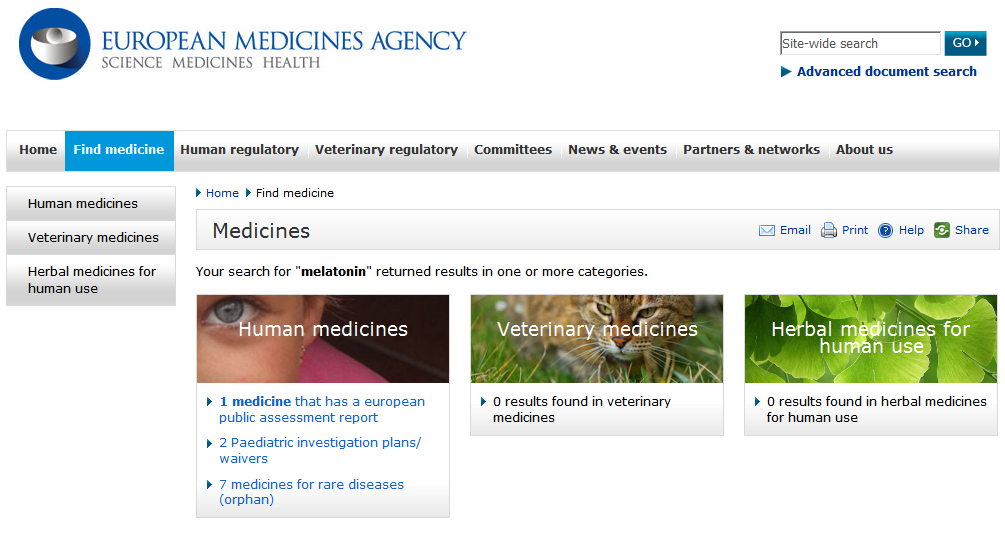
As a drug, it is authorised by the European Medicines Agency (EMA) in people aged 55 or over and in treating primary insomnia for a limited period of time. The EMA considers that melatonin is effective albeit with a small effect size in a small fraction of the population but with a more favourable safety profile than other hypnotic drugs.

It is known that as one gets older the secretion of this hormone decreases and yet all clinical practice guidelines or recommendations in the approach to insomnia primarily advise sleep hygiene measures followed psychological interventions. Nevertheless, the data of pharmacological consumption shows an increase in prescriptions of hypnotic drugs and sedatives, especially those derived or related to benzodiazepines.

The EMA has asked for more studies on melatonin at a paediatric level despite the fact that there is data which seems favourable in children with an attention-deficit hyperactivity disorder or with autistic spectrum disorder where sleep hygiene and psychological interventions have failed.

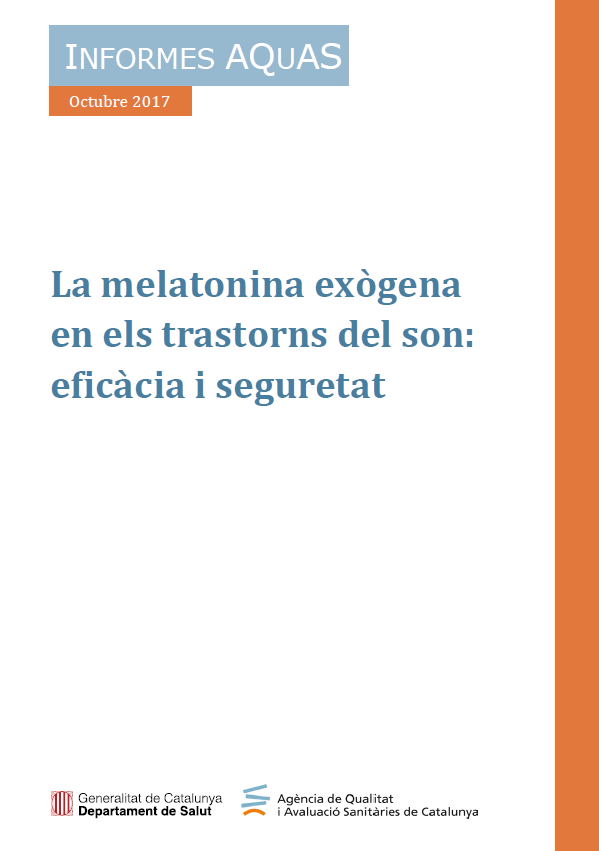
The report “Exogenous melatonin in the treatment of sleep disorders: efficacy and safety” drawn up by the AQuAS talks of these and other related subjects, mentioning the wide range of para-pharmaceutical products that contain melatonin.


As a dietary supplement or a drug, there are unequal demands by regulatory agencies in Europe (food safety, drugs) in terms of its authorisation for marketing. It is a known fact that the variability in the quality of a product, its formulation, dosage and combinations in supplements and so on, in part explain the heterogeneity between studies observed in some meta-analyses, also contained in the report.

Post written by Joan MV Pons.

“Me sube la melatonina”

28 juny
Joan MV Pons

Bueno, digamos que en la canción era la bilirrubina lo que subía, como cantaba Juan Luís Guerra en su merengue (1990):

Me sube la bilirrubina
¡Ay! Me sube la bilirrubina
Cuando te miro y no me miras
¡Ay! Cuando te miro y no me miras
Y no lo quita la aspirina
¡No! Ni un suero con penicilina
Es un amor que contamina
¡Ay! Me sube la bilirrubina

Ya se ve que es algo difícil de tratar, pero da igual, también podría haber sido la serotonina, la dopamina o la noradrenalina, pues el enamoramiento todo lo altera y rimaría igual. De todas formas, si hay algo que es mejor que no suba es la bilirrubina, pues uno puede acabar ictérico.

Lo cierto es que a todos nos empieza a subir la melatonina cuando empieza la oscuridad, antes de ir a dormir, siguiendo el ritmo circadiario que marca el reloj biológico hipotalámico. La glándula pineal, donde Descartes creía que estaba la conexión entre mente y cuerpo, donde él ubicaba el alma, segrega esta hormona que induce el sueño y, por tanto, funciona mejor en los insomnios de conciliación, es decir, retraso en el inicio del sueño.

Cada día, se descubren nuevas acciones fisiológicas de esta hormona que hace que casi adquiera la cualidad de “molécula milagrosa” por su ubicuidad y número de actividades en las que participa (antioxidante, neuroprotectora, anticáncer, inmunomoduladora, etc.).

La melatonina, que se obtiene mayoritariamente de forma sintética, está comercializada como medicamento (comprimidos de liberación prolongada de 2 mgr) y como suplemento nutricional o alimentario (dosis inferiores a 2 mgr). Esta diferente consideración, que va de 0.02 mgr, ya resulta un poco chocante, más si tenemos en cuenta que solo hay un fármaco con melatonina y, por el contrario, son numerosísimos los suplementos que tienen melatonina (sola o en combinación con otros productos). Los requisitos, en uno y otro caso, son bien desiguales, pero mientras que hay países donde la melatonina está comercializada solo como suplemento dietético, en otros solo se encuentra como fármaco que requiere receta, y en Europa se puede encontrar de las dos formas. En España hace falta receta médica pero no es un medicamento financiado públicamente y como suplemento, como decíamos, hay muchos productos.

Como medicamento, está autorizada por la European Medicines Agency (EMA), en mayores de de 55 años y para el tratamiento del insomnio primario durante un período limitado de tiempo. La EMA considera que la melatonina es eficaç con un tamaño de efecto pequeño, en una fracción pequeña de la población y con un perfil de seguridad más favorable que el de otros hipnóticos.

Se sabe que con la edad la secreción de esta hormona disminuye, pero todas las guías de práctica clínica o recomendaciones para el abordaje del insomnio recomiendan en primer lugar las medidas de higiene del sueño, seguidas o acompañadas de intervenciones psicológicas. Los datos de consumo farmacológico muestran, sin embargo, un incremento de las recetas de medicamentos hipnóticos y sedantes, especialmente de aquellos derivados o relacionados con las benzodiazepinas.

La EMA ha exigido más estudios a nivel pediátrico de la melatonina a pesar que hay datos que parecen favorables en niños con trastorno por déficit de atención/hiperactividad y trastorno de espectro autista y, siempre y cuando, la higiene del sueño y las intervenciones psicológicas hayan fracasado.

El informe “La melatonina exógena en los trastornos del sueño: eficacia y seguridad” elaborado por AQuAS se refiere a estos y a otros temas relacionados, recogiendo la multiplicidad de productos de parafarmacia que contienen melatonina.

Ser un suplemento alimentario o un medicamento implica una desigual exigencia por lo que refiere a su autorización de comercialización por parte de las agencias reguladoras (de seguridad alimentaria, de medicamentos) en Europa. Es conocida la variabilidad en la calidad del producto, formulación, dosis y combinaciones de los suplemento y esto, en parte, explica la heterogeneidad entre estudios observada en algunas metanálisis que también se recogen en este informe.

Entrada elaborada por Joan MV Pons.

“Me sube la melatonina”

28 juny
Joan MV Pons

Bé, diguem que a la cançó era la bilirubina el que pujava, com cantava Juan Luís Guerra en el seu merengue (1990):

Me sube la bilirrubina
¡Ay! Me sube la bilirrubina
Cuando te miro y no me miras
¡Ay! Cuando te miro y no me miras
Y no lo quita la aspirina
¡No! Ni un suero con penicilina
Es un amor que contamina
¡Ay! Me sube la bilirrubina

Ja es veu que és quelcom difícil de tractar, però tant se val, també podria haver estat la serotonina, la dopamina o la noradrenalina, doncs l’enamorament tot ho altera i rimaria igual. De totes maneres, si hi ha alguna cosa que és millor que no pugi és la bilirubina, doncs hom pot acabar ictèric o, com deien abans, amb la fel sobreeixida.

El que és cert és que a tots ens comença a pujar la melatonina quan s’inicia al foscor, abans d’anar a dormir, seguint el ritme circadiari que marca el rellotge biològic hipotalàmic. La glàndula pineal, on Descartes creia que hi havia la connexió entre ment i cos, on ell ubicava l’ànima, segrega aquesta hormona que indueix el son i, per tant, funciona millor en els insomnis de conciliació, és a dir, retard en l’inici del son.

Cada dia, es descobreixen noves accions fisiològiques d’aquesta hormona que fa que quasi adquireixi la qualitat de “molècula miraculosa” per la seva ubiqüitat i nombre d’activitats en les quals participa (antioxidant, neuroprotectora, anticàncer, immunomoduladora, etc.).

La melatonina, que s’obté majoritàriament de forma sintètica, està comercialitzada com a medicament (comprimits d’alliberament perllongat de 2 mgr)  i com a suplement nutricional o alimentari (dosis inferiors a 2 mgr). Aquesta diferent consideració, que va de 0.02 mgr, ja resulta un xic xocant, més tenint en compte que sols hi ha un fàrmac amb melatonina i, pel contrari, són nombrosíssims els suplements que tenen melatonina (sola o amb combinació amb altres productes). Els requisits, en un cas o en l’altre, són ben desiguals, però mentre que hi ha països on la melatonina està comercialitzada sols com a suplement dietètic, en d’altres sols es troba com a fàrmac que necessitant recepta, i a Europa es pot trobar d’ambdues maneres. A Espanya cal recepta mèdica però no és un medicament finançat públicament i com a suplement, com dèiem, hi ha molts productes.

Com a medicament, està autoritzat per l’’European Medicines Agency (EMA), en majors de 55 anys i per al tractament de l’insomni primari durant un període limitat de temps. L’EMA considera que la melatonina és eficaç amb una grandària d’efecte petit, en una fracció petita de la població i amb un perfil de seguretat més favorable que d’altres hipnòtics.

Se sap que amb l’edat la secreció d’aquesta hormona disminueix, però totes les guies de pràctica clínica o recomanacions per a l’abordatge de l’insomni aconsellen primerament les mesures d’higiene del son, seguides o acompanyades d’intervencions psicològiques. Les dades de consum farmacològic mostren, tanmateix, un increment de les receptes de medicaments hipnòtics i sedants, especialment d’aquells derivats o relacionats amb les benzodiazepines.

L’EMA ha exigit més estudis a nivell pediàtric de la melatonina malgrat que hi ha dades que semblen favorables en nens amb trastorn per dèficit d’atenció/hiperactivitat i trastorn d’espectre autista i, sempre i quan, la higiene del son i les intervencions psicològiques hagin fracassat.

L’informe “La melatonina exògena en els trastorns del son: eficàcia i seguretat” elaborat per l’AQuAS parla d’aquests i altres temes relacionats, recollint la multiplicitat de productes de parafarmàcia que contenen melatonina.

Ser un suplement alimentari o un medicament implica una desigual exigència pel que fa a la seva autorització de comercialització per part de les agències reguladores (de seguretat alimentària, de medicaments) a Europa. És coneguda la variabilitat en la qualitat del producte, formulació, dosis i combinacions dels suplements i això, en part, explica l’heterogeneïtat entre estudis observada en algunes metanàlisis que també es recullen en l’informe.

Entrada elaborada per Joan MV Pons.

Taking another step forward: Can we measure the participation in research of the agents of the system?

21 juny

In recent years, the idea that the participation of the actors in research is a key element in research to transform and generate impact in society has been insisted on repeatedly. For those who are still a little unsure of this statement, studies in the assessment of the impact of research demonstrate the idea. They emphasise the participation of professionals, patients and the remainder of the actors of the system throughout the entire process of research during which the effectiveness of research in reaching society is improved.

Hence, the AQuAS, in collaboration with the Fundación Bancaria “a Caixa”, considered it necessary for the systems of assessment to be involved too if we want research to have a greater impact. With this objective, and a great contribution from Maite Solans and Paula Adam, the first monographic on Responsible Research of the SARIS (Assessment System of Research in Health) was presented. As a result of reviewing the existing international literature, 47 indicators were identified that measure the activities and participation of the actors in research institutions.

The indicators identified cover a large part of the research ‘process’, and they have been grouped in six aspects  – training, governance, resources, activity, dissemination, and primary results. This allows us to see how the different actors in the system can be involved during the entire process of research (planning, execution and translation).

Figure 1. Aspects in the process of research

However, we need to be cautious! On the one hand, the proposed indicators can be useful to stimulate and open up the reflection on how to monitor the activities carried out in research institutions in relation to the participation of the actors of the system. On the other hand, it must be pointed out that an indicator must be used responsibly by taking into consideration their context, incentives and the distortions that a measure can provoke. Experts in measures and indicators in science know very well that the research fabric and the research system change their behaviour according to what is being measured, ‘you get what you measure’, said Cyril Frank, chairman of the panel on the impact of research in health of the Canadian Academy of Health Sciences (CAHS).

Referring to participation in research, the question of measure is even more complex because it is still in its infancy. As Derek Stewart said, director of Patient Involvement of Nottingham Biomedical Research Centre and speaker at the SARIS session where this monographic was presented:

One of the greatest challenges of measures is that ‘inputs’ are often measured – the number of people that participate, the number of groups that have been called or who have been talked to or the number of studies in which patients participate. It is about carrying out actions that add value, that help provide knowledge for solutions for patients”

Derek Stewart’s reflections during the preparation of his conference can be found on his blog ‘Making a difference’.

Indicators should help to answer specific questions based on each situation and need, and this is why it is essential to assess their relevance and feasibility within their context. The concept of relevance refers to the proximity of an indicator to a need and specific question that we pose; for example, what is the real value of the participation which an indicator measures? The concept of feasibility refers to how easily available and affordable data is when constructing an indicator.

As can be seen in Figure 1, among the indicators found in the literature there is a large number that are relevant, which was to be expected because they are recommended by very prestigious entities. Nevertheless, their feasibility in our environment is low in the majority of cases which means that although we have identified several indicators with limitations, none are fully recommendable.

Figure 3. Feasibility vs Relevance of the 47 indicators

Therefore, bearing in mind the context of research in Catalonia, at AQuAS we have catalogued the indicators as follows:

  • 27 indicators as not recommendable for use
  • 20 indicators with limitations
  • No indicator as being fully recommendable

Our findings allowed us to learn a valuable lesson: before defining indicators or measuring the participation in research, we must first explore what is done in our environment and so by first analysing what is feasible we can then decide what the most relevant actions are.

The success of assessment systems depends on the acceptance of their processes and results among those in charge of taking decisions and the research communities which are being assessed. The challenge, thus, is to understand what is done in practice in our environment based on the guide which the indicators in the international literature have provided us with.

Let us continue!

Post written by Ion Arrizabalaga.

(Post published jointly in the AQuAS blog and the blog of CaixaCiència)