10 years of Catalonian Register of Arthroplasty (RACat)

26 nov.

Olga Martínez-Laia DomingoOlga Martinez and Laia Domingo. Evaluation Area, AQuAS

The Catalonian Register of Arthroplasties (RACat) was set in motion in 2005 as an initiative of the Catalan Health Service (CatSalut), the Catalan Society of Orthopaedic and Traumatology Surgery (SCCOT) and AQuAS (at the time, the Agency for Information, Evaluation and Quality in Health).

Thus, a population register designed to assess the hip and knee arthroplasty effectiveness and safety, was born offering insights into the hospitalizations variability, the procedures and models used for arthroplasty, the survival of the implanted prosthesis and implants traceability and creating indicators for assessing the quality of health care (performance and benchmarking).

Different international previous experiences pointed to the fact that the existence of arthroplasty registers has contributed to reducing variability and improving the effectiveness, safety and quality of arthroplasty1. This fact, coupled with the growing need to respond to several research and clinical management questions highlighted the need to set the RACat in motion. Continue reading

COMSalut (Community and Health: Primary and Community Care)

19 nov.

Andreu SeguraAndreu Segura, Secretary of Catalan Public Health Interdepartmental Plan

Soon we will celebrate thirty years from the first international conference on health promotion held in Ottawa. Some of its most popular recommendations are the appeal of reorienting health services and the need for individuals and communities to take control of their own health determinants -they have taken responsibility.

Both proposals are at the root of the COMSalut project and its most direct antecedents, such as the Interdepartmental Plan of Public Health (Pla Interdepartamental de Salut Pública – PINSAP), one of the innovations of Catalonia Public Health law of 2009, which emphasized the impact that various sectors of society and public administration have on health and, consequently, recognized them as key elements of health policies and, therefore, the health plan. A health plan that, with respect to the health system, promotes the development of organizational formulas and the funding of the services most consistent with the community dimension and the cooperation between providers, such as territorial pacts for managed care groups (MCG) from CatSalut. Continue reading

The need of bioinformatics within the health system

12 nov.

AnaRipollAna Ripoll, President of the Bioinformatics Barcelona Association – BIB

We live in a society that is able to generate massive amounts of data in seconds. In fact, it has been estimated that in two days we generate as much data as we did since the birth of civilization to the completion of the Human Genome Project in 2003. The health system is no exception in the age of large data, now that the available data come from a variety of sources, such as electronic health records, laboratories, medical imaging systems and medical notes. In addition to these more traditional sources, we can add the data generated by the patient through electronic monitoring devices in real time, mobile applications, social networks or patients’ forums. Currently these data are scattered, disconnected, in various formats, and even in some cases without digitizing, and thus it’s difficult to process and to analyze. Extracting the valuable information all this data contained in the health system will help increase biomedical knowledge so we can advance towards a personalized, participatory, predictive and preventive medicine. Continue reading

We need to speed up innovation in health

5 nov.

Manel BalcellsManel Balcells, Department of Health Commissioner at LEITAT Technology Centre

One of the challenges of any country relying on a knowledge economy is undoubtedly to look at innovation as a strategic element for the country’s growth and development, and to manage to turn innovation into economic value. That is to say, to return the benefits derived from investments conducted in basic and applied research, back to society.

However, any country prioritizes productive sectors which provide significant benefits, promoting the conditions that make the so called innovation – ecosystem possible, thus completing the value chain from research to market.

Back home in Catalonia, we are well aware of the detachment between the high level of biomedical research – leader in Europe with global significance (you can view the results of the centres in the report from the Central de Resultats) and the moderate degree of innovation reflected by European standards and published by the European Commission in the Regional Innovation Scoreboard. Continue reading

21 experiences receive the certificate at the Third Edition of Centre for Innovation in Health Management in Catalonia (OIGS)

29 oct.

Sense títol

Montse Moharra (@mmoharra), Dolors Benítez and Anna García-Altés (@annagaal)

Students at the Pompeu Fabra University can respond to the challenges arising from the  OIGS (Centre for Innovation in Health Management in Catalonia) innovation community

Over 600 health professionals met in Barcelona on Monday September 21st during the Third Edition of the Centre for Innovation in Health Management in Catalonia (OIGS), which was attended by the Minister of Health, Boi Ruiz. During the ceremony, 21 innovative experiences received the quality certificate.

The Minister welcomed the involvement of health professionals in “responding to our major concern, which is to improve healthcare» and gave «thanks to the people who believed that the best way to change things is do it from within.” It also found that OIGS is a project of «an extraordinary dimension» and that its current numbers (189 experiences and more than 500 users) denote its consolidation. He also stressed that in times of budgetary constraints, they are undertaking pioneering improvements in the health system to help improve the health care for citizens. Continue reading

Angus Deaton: the Nobel laureate concerned about health inequalities

22 oct.

Sense títolAnna García-Altés, @annagaal, Head of the Catalan Health System Observatory

Last week, on Monday, we found out that the Swedish Royal Academy of Sciences awarded the Nobel Prize in Economics to Angus Deaton a 69 years old Scottish laureate. 

Dr. Deaton, qualified in mathematics, did his PhD at Cambridge University, but has developed his academic career at Princeton University. The committee granted him the award for his work in consumption analysis, poverty and welfare and their applications in microeconomics, macroeconomics and development economics, which has influenced both the politics (and policy-makers) and the scientific community.

deaton A

One of his main achievements has been the development of a system used to estimate the demand for various goods, which is currently the standard tool for measuring the effects of the economic policy, in order to build price indices and to compare the welfare levels of different countries and different timeframes. He also undertook various studies linking consumption and income whilst his most recent work is assessing welfare and poverty mainly -but not exclusively- in the developing countries. In addition to his research subjects, Dr. Deaton’s work is also remarkable for the breadth of methodological approaches used, from theoretical models to the use of econometric methods, mainly household surveys (which is one of his areas of expertise); his knowledge of the data quality commonly available and his careful construction of accurate measurement results. Continue reading

Ideally, professionals could prescribe app’s and websites with trustworthy and quality content

15 oct.

mireia sansMireia Sans (MS in the text), family physician and director of the Unitat de Gestió Hospitalet Nord of Institut Català de la Salut, in an interview made by Anna García-Altés (AGA in the text), discusses the advantages of the new technologies for the health care world and advocates the importance of digital identity.

AGA: What it is meant by digital identity?

MS: It is the set of information that exposes us on the Internet, whether we’re talking about personal data, images, records, news, reviews… All this provides our description to digital level. It’s important to not try to invent a false identity but rather to emphasize the virtues-values​​-knowledge-skills you have and wish to publicize.

AGA: Is it necessary for health professionals to have a well presented digital identity? What are the benefits?

MS: Yes, it’s fundamental. Working on this identity is the first step towards a successful and proactive management of our digital reputation, which reflects what we do, what we teach and say about ourselves and also what others say about us. Continue reading

Social networks and health, an opportunity that still has far to go

8 oct.

Josep Vidal AlaballJosep Vidal Alaball, Family Doctor. EAP Artés (ICS)

Whatever the field, social networks open a range of opportunities. Their features has been changing many people’s lives for many years, starting with the closest relationships to organizations, companies and brands around us and yes, even the medical staff.

In the health field, I’m not quite sure whether the social networks should be used to improve the relationship and interaction with patients, as this aspect should be dealt with in everyday consultations. What is certain is that social networks can be used to enable patients to consult doctors or reinforce aspects that sometimes can not be completely covered during a medical consultation. A good example is the use of inhalers. Sometimes, it can be easier for a professional to recommend patients a video showing how people with respiratory diseases use it, instead of briefly and superficially teaching the correct technique during the consultation. Continue reading

Public health care budget. A ten-year overview (part 2)

1 oct.

Joan-PonsJoan MV Pons, Head of Evaluation AQuAS

If in the previous post we examined the public health care budget evolution in the last decade (2005-2015) and we compared its distribution by major service lines, in this second part we will look at diseases (health problems) as described by the WHO International Classification of Diaseases (ICD) where they categorize conditions by the affected organs (apparatus or systems) or by origin (in the graphic: pressupost = budget)

Sense títol Continue reading

Public health care budget. A ten-year overview (part 1)

24 set.

Joan-PonsJoan MV Pons, Head of Evaluation AQuAS

In 2007, a high interest health economics research article was published and promoted by the Department of Health1. The study broadcasted the public health care budget for 2005, not only for the 17 categories of the International Classification of Diseases (ICD), but also by the type of assistance and mainline services. There is no doubt that the work provided a reference point for health planning and management and offered an unexpected surprise as, until recently2, the newer data of this kind and obtained using a similar methodology was not being made public. I admit that it has been a personal interest of the Minister to see the data presented in this manner.

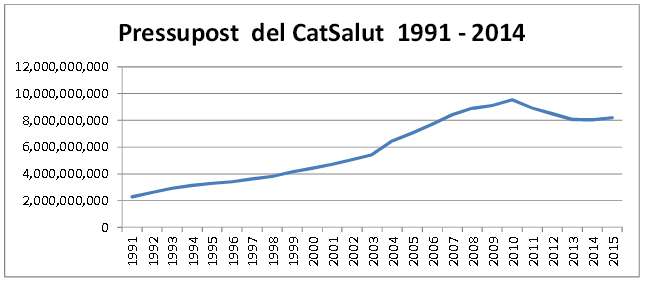
And in this interval, 2005-2015, what do the numbers say, more exactly, the euros? First, let’s have a look at the overall graphics and then at its sections.
Sense títol

Let’s start by mentioning that the harsh cuts timeframe was in 2011-2013 when CatSalut’s budget had to be reduced by 1.5 billion Euros compared to 2010, the year when this expenditure (or investment for some and certainly a source of health and financial benefits for many people) reached its peak. Worthy of mentioning is that between 2003-2010, CatSalut’s budget growth far exceeded the GDP growth, but this was a very common trend before the crisis. We will not go along with littleness, by asking whether, despite the reduction in public spending, the budget for social policies (health, education, welfare and family) of the Catalan government has increased in percentage within Catalonian budgets (71.2% in 2015). Accurately, the 2005 health budget represented 40% of the Catalan public budget and in 2015 we have the same percentage, but the amounts are very different. Here we could apply the phrase attributed to both Mark Twain and Benjamin Disraeli regarding the three types of lies: lies, damned lies and statistics.

If we continue down the broad lines of services, we have to study them with graphics such as the following (pressupost = budget):

Sense títol

If we examine the budget distribution among major areas or major lines (functional classification) we notice striking things worthy of mentioning. The first, undoubtedly, is the reduction in pharmacy spending that has reached stratospheric levels in the mid of the last decade, (almost 24% of all health care budget). Plenty of measures with regards to the quality of prescribing have been implemented, from the most effective in price levels and generic to the more educational (professional) and motivating (management by objectives). It’s clear that for many years, the local and foreign pharmaceutical industry, existed in a cloud due to the lack of a genuine public pharmacy policy in this country. For this reason, those covenants that demanded returns of profits with which research networks (ISCIII) were financed and, amusingly, funds for activities aimed at rational drug use that the Ministry distributed among nationalities and regions, emerged.

Therefore the pharmacy spending goes down (as the return of the pharmaceutical industry to research and rational use), but the more particular pharmacy, the high technology pharmacy (biotechnology, whether medicine of recombinant origin or monoclonal antibodies) as is the MHDA (ambulatory drugs dispensed at the hospitals), continues to rise with an absolute increase of 61.6% between 2005 and 2015 (from M€390.29 to M€630.93). A more thorough analysis of the changes in pharmaceuticals expenditure, whether in a hospital or for distribution to outpatients, would force us to examine in more detail the different types of drugs and their use.

We can also notice an increase in spending on health care, both primary and specialized, as the latter grows much more to represent more than half (58%) of public insurance spending. The trend of focusing on hospitals and unrestrained specialized care also comes from afar. We may say, although without the data, that there is an incipient turnaround in recent years, of a slight decrease in specialized care and slight increase in primary care. The growing need for attention to chronic disease and for integration of social services (health and social care), the two sides of the same coin, should go on shifting this situation.

1 Gisbert R, Brosa M, Bohigas L. Distribución del presupuesto sanitario público de Catalunya del año 2005 entre las 17 categorías CIE-9-MC. Gac Sanit 2007;21:124-31.

2 Pressupost del Departament de Salut per a l’any 2015