Health data: Do we give citizens what they want?

24 nov.
central-de-resultats-qualitatiu
Dolores Ruiz-Muñoz, Anna García-Altés and Hortènsia Aguado

The right to receive advice with regards to the information available on the network is reflected in the Carta de drets i deures de la ciutadania en relació a la salut i l’atenció sanitària (Citizens Bill of Rights and Duties relating to health and healthcare), updated in 2015. In particular, it specifies that a person has the right to obtain accurate and reliable recommendations from health professionals in terms of the available health information on the network (web pages, applications, etc…).

It is a fact that, from different professional sectors, we are more and more frequently identifying citizens as a key group to take into consideration when communicating the outcomes of our work, including the health sector. The different actors involved in disseminating health information resulting from the Catalan health system activity are no exception. When we publish our data we do it more and more in a way that is not only aimed at informing health professionals on the one hand but also at being accountable to citizens as end users.

But have we really asked citizens what information they want to obtain from us?

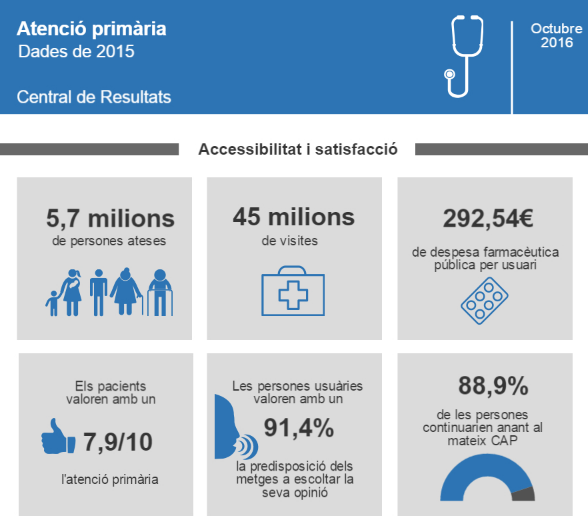
From the Results Centre of the Catalan Health System Observatory we publish a series of reports annually with quantitative indicators that aim to measure, assess and disseminate the results obtained in the different areas of the public health system. Up to the present, to disseminate this information beyond the comfort zone of the health sector, we have published a series of infographics with the information that we have considered to be most relevant for citizens, making the effort to create a user friendly format.
infografia-atencio-primaria


During the first semester of 2016, we spent time reflecting on our labour and we realised that we did not in fact know whether what we were publishing for citizens really reached or interested them. We did not even know what it was that citizens wanted to receive from us. To answer these questions we carried out a qualitative study of Catalan citizens to find out what their needs for health information were, but not limiting ourselves to that produced by the Results Centre.

We created three discussion groups and invited citizens randomly selected from Registre Central d’Assegurats del CatSalut (CatSalut’s Central Registry of the Insured) to freely express what they felt their necessities for health information were. What we discovered was that the population is not interested in receiving health information in a general or systematic way but rather only wants health information when they have a specific personal need and which is directly related to what is affecting them at a given time. They are not interested, therefore, in receiving health information about the population as a whole nor of how the health system works. They state that this information is necessary but feel it is health professionals who need to have it and know how to manage it. In this way, they place their trust in the health system by dissociating themselves from this type of information.

Furthermore, they consider it of interest that the information be made available on the networks but state that, whether they actively search for it on the internet or not, what they need is to be able to contrast the information at a later stage with their primary care physician or specialist, and that it be this professional who discerns what the best information available is for each occasion. What is more, they clearly identify this professional as being the person who needs to know the health information produced systematically by the Catalan health system.

We presented the results of this study at a recent congress, to be exact, the XXXIV Congress of the Spanish Society for the Quality of Healthcare and the XXI Congress of the Andalusian Society for the Quality of Healthcare, generating a very interesting posterior debate regarding these results. One of the attendees at the congress stated their concern for the fact that citizens were not interested in receiving general health information. The debate centred on how we could educate the population into showing an interest in this information and on how to make it reach them. We believe that the key underlying question here is whether this need be done at all.

The public at large have an overwhelming amount of information at their disposal on an infinite number of different subjects on a daily basis. It seems clear that when a person has a specific need regarding their state of health they consult a professional in whom they trust. It is obvious that to us, as healthcare professionals, we will always feel that the information we produce is of such interest as to make others want to know about it, but it is also probable that our enthusiasm makes us biased when interpreting reality. We should perhaps ask ourselves whether we need to make the effort to provide the public with information they say they do not need nor interests them, and whether we are prepared to accept their decision and respect it.

Post written by Dolores Ruiz-Muñoz, Anna García-Altés and Hortènsia Aguado.
Datos de salud: ¿Ofrecemos a la ciudadanía lo que quiere?

24 nov.

central-de-resultats-qualitatiuEn la Carta de derechos y deberes de la ciudadanía en relación con la salud y la atención sanitaria, actualizada en 2015, se recoge el derecho a recibir asesoramiento relativo a la información disponible en la red y, en concreto, se especifica que la persona tiene derecho a obtener recomendaciones veraces y fiables por parte de los profesionales sanitarios en relación con la información sanitaria disponible en la red (páginas web, aplicaciones, etc.).

Cada vez más, desde los diferentes sectores profesionales, identificamos a la ciudadanía como un grupo clave que hay que tener en cuenta a la hora de hacer llegar el resultado final de nuestro trabajo, incluido el sector sanitario. Los servicios implicados en dar a conocer la información sanitaria que se desprende del sistema sanitario catalán no somos una excepción y cuando publicamos nuestros datos lo hacemos, cada vez más, con la idea de no solo informar a los profesionales sanitarios, sino también rendir cuentas a la ciudadanía en última instancia.

Pero, ¿realmente hemos preguntado a la ciudadanía qué información quiere recibir de nosotros?

Desde la Central de Resultados del Observatorio del Sistema de Salud de Cataluña publicamos anualmente una serie de informes con indicadores cuantitativos que pretenden medir, evaluar y difundir los resultados alcanzados en los diferentes ámbitos del sistema sanitario público. Hasta ahora, para difundir esta información más allá del territorio de confort que nos supone el sector sanitario, hemos publicado una serie de infografías con la información que hemos considerado que sería más relevante para la ciudadanía, esforzándonos para que el formato fuera amigable.

infografia-atencio-primaria

Durante el primer semestre de 2016 hicimos un ejercicio de reflexión y nos dimos cuenta de que realmente no sabíamos si lo que publicábamos para la ciudadanía realmente les llegaba y les interesaba, y ni siquiera sabíamos qué era lo que la ciudadanía quería recibir de nosotros. Para contestar a estas preguntas hemos llevado a cabo un estudio cualitativo para conocer las necesidades de información sanitaria de la ciudadanía en Cataluña, sin restringirnos a los productos de la Central de Resultados.

Hemos hecho 3 grupos de discusión donde hemos invitado a ciudadanos elegidos al azar del Registro Central de Asegurados del CatSalut y donde ellos han podido expresar libremente qué necesidades de información sanitaria tienen. El resultado que hemos obtenido es que a la ciudadanía no le interesa recibir información sanitaria de forma general y sistemática, solo le interesa la información sanitaria cuando tiene una necesidad personal clara y esta está directamente relacionada con lo que a la persona le esté sucediendo en ese momento concreto. No le interesa, por tanto, recibir información de salud poblacional o del funcionamiento del sistema sanitario. Manifiesta que esta información es necesaria pero entiende que son los profesionales sanitarios los que la deben conocer y saber gestionar, confiando en el sistema sanitario y desvinculándose de este tipo de información.

Consideran, además, que es interesante que la información esté accesible en las redes pero manifiestan que, busquen o no activamente en Internet, lo que necesitan es que esta información la puedan contrastar después con su médico de atención primaria o especialista y que sea este profesional quien identifique la mejor información disponible en cada momento. Es más, reconocen claramente que es este profesional quien debe conocer la información sanitaria que el sistema sanitario catalán produce sistemáticamente.

Hemos presentado recientemente los resultados de este estudio en un congreso, concretamente en el XXXIV Congreso de la Sociedad Española de Calidad Asistencial y XXI Congreso de la Sociedad Andaluza de Calidad Asistencial, generando un debate posterior muy interesante en torno a sus resultados. Una de las personas presentes en el congreso manifestaba su preocupación por el hecho de que la ciudadanía no estuviera interesada en recibir información general de salud. El debate se centraba en cómo podíamos educar a la población para que esta información le interesara y le llegara. Creemos que la cuestión realmente importante detrás de todo esto es si hay que hacerlo.

La ciudadanía tiene al alcance una cantidad de información desbordante sobre un número infinito de temas diferentes cada día. Parece claro que cuando una persona tiene una necesidad concreta sobre su estado de salud consulta a un profesional en quien confía. Es evidente que a nosotros, como profesionales sanitarios, siempre nos parecerá que la información que producimos es lo suficientemente interesante para que los demás la quieran conocer pero también es probable que nuestro entusiasmo nos sesgue a la hora de interpretar la realidad. Tal vez deberíamos preguntarnos si tenemos que esforzarnos para facilitar a la ciudadanía información que dice que no necesita y que no le interesa, y si estamos preparados para aceptar su decisión y respetarla.

Entrada elaborada por Dolores Ruiz-Muñoz, Anna García-Altés (@annagaal) y Hortènsia Aguado.

Dades de salut: oferim a la ciutadania el que vol?

24 nov.
central-de-resultats-qualitatiu
Dolores Ruiz-Muñoz, Anna García-Altés i Hortènsia Aguado

A la Carta de drets i deures de la ciutadania en relació a la salut i l’atenció sanitària, actualitzada l’any 2015, es recull el dret a rebre assessorament relatiu a la informació disponible a la xarxa i, en concret, s’especifica que la persona té dret a obtenir recomanacions veraces i fiables per part dels professionals sanitaris en relació amb la informació sanitària disponible a la xarxa (pàgines web, aplicacions, etc.).

Cada vegada més, des dels diferents sectors professionals, identifiquem a la ciutadania com un grup clau que cal tenir en compte a l’hora de fer arribar el resultat final de la nostra feina, inclòs el sector sanitari. Els serveis implicats en donar a conèixer la informació sanitària que es desprèn del sistema sanitari català no som una excepció i quan publiquem les nostres dades ho fem, cada vegada més, amb la idea de no només informar als professionals sanitaris, sinó també de retre comptes a la ciutadania en última instància.

Però,  realment li hem preguntat mai a la ciutadania quina informació vol rebre de nosaltres?

Des de la Central de Resultats de l’Observatori del Sistema de Salut de Catalunya publiquem anualment una sèrie d’informes amb indicadors quantitatius que pretenen mesurar, avaluar i difondre els resultats assolits en els diferents àmbits del sistema sanitari públic. Fins ara, per difondre aquesta informació més enllà del territori de confort que ens suposa el sector sanitari, hem publicat una sèrie d’infografies amb la informació que hem considerat que seria més rellevant per a la ciutadania fent un esforç perquè el format fos amigable.

infografia-atencio-primaria


Durant el primer semestre del 2016 vam fer un exercici de reflexió i ens vam adonar que realment no sabíem si el que publicàvem per a la ciutadania realment els arribava i els interessava, i ni tan sols sabíem què era el que la ciutadania volia rebre de nosaltres. Per contestar aquestes preguntes hem dut a terme un estudi qualitatiu per conèixer les necessitats d’informació sanitària de la ciutadania a Catalunya, sense restringir-nos als productes de la Central de Resultats.

Hem fet 3 grups de discussió on hem convidat ciutadans triats a l’atzar del Registre Central d’Assegurats del CatSalut i on ells han pogut expressar lliurement quines necessitats d’informació sanitària tenen. El resultat que hem obtingut és que a la ciutadania no els interessa rebre informació sanitària de manera general i sistemàtica, només els interessa la informació sanitària quan tenen una necessitat personal clara i aquesta està directament relacionada a allò que a la persona li estigui succeint en aquell moment concret. No els interessa, per tant, rebre informació de salut poblacional o del funcionament del sistema sanitari. Manifesten que aquesta informació és necessària però entenen que són els professionals sanitaris els que l’han de conèixer i saber gestionar-la, confiant en el sistema sanitari i desvinculant-se d’aquest tipus d’informació.

Consideren, a més, que és interessant que la informació estigui accessible a les xarxes però manifesten que, busquin o no activament a Internet, el que necessiten és que aquesta informació la puguin contrastar després amb el seu metge d’atenció primària o especialista i que sigui aquest professional qui destriï la millor informació disponible en cada moment. Encara més, identifiquen clarament que és aquest professional qui ha de conèixer la informació sanitària que sistemàticament el sistema sanitari català produeix.

Els resultats d’aquest estudi els hem presentat recentment en un congrés, concretament al XXXIV Congreso de la Sociedad Española de Calidad Asistencial i XXI Congreso de la Sociedad Andaluza de Calidad Asistencial, generant un debat posterior molt interessant entorn als seus resultats. Una de les persones presents en el congrés manifestava la seva preocupació pel fet que la ciutadania no estigués interessada en rebre informació general de salut. El debat es centrava en com podíem educar la població per a què aquesta informació els interessés i els arribés. Creiem que la qüestió realment important darrera de tot això és si cal fer-ho.

La ciutadania té a l’abast una quantitat d’informació desbordant sobre un número infinit de temes diferents cada dia. Sembla clar que quan una persona té una necessitat concreta sobre el seu estat de salut consulta un professional en qui confia. És evident que a nosaltres, com a professionals sanitaris, sempre ens semblarà que la informació que produïm és prou interessant perquè els altres la vulguin conèixer però també és probable que el nostre entusiasme ens esbiaixi a l’hora d’interpretar la realitat. Tal vegada hauríem de preguntar-nos si hem de fer esforços per fer arribar a la ciutadania informació que diu que no necessita i que no li interessa, i si estem preparats per acceptar la seva decisió i respectar-la.

Entrada elaborada per Dolores Ruiz-Muñoz, Anna García-Altés (@annagaal) i Hortènsia Aguado.

Post de verano sobre sobrediagnóstico y sobretratamiento

19 ag.

prat verd floritEl congreso Preventig Overdiagnosis es un congreso abierto a toda la sociedad que quiere fomentar el debate y la reflexión sobre temas controvertidos muy actuales con la mirada puesta en la mejora de la atención sanitaria y en hacer pedagogía entre los profesionales y toda la ciudadanía sobre el hecho que, a veces, hacer más no siempre implica hacer aquello que más puede beneficiar un paciente.

Esto nos hace recordar el post del 2012 en el blog Gestión Clínica y Sanitaria donde se usaba el concepto de Mies van der Rohe “menos es más” aplicado a calidad asistencial y exceso de asistencia o sobreuso, y se aportaba una recopilación de las iniciativas existentes en aquel momento en esta líniea.

Tambien recordamos que en el blog Farmacia de Atención Primaria se publicaron dos posts en el 2014 sobre esta temática: un post que llevaba por título: “Más vale prevenir (el sobrediagnóstico) que curar (el sobretratamiento)” y una entrevista a Margaret McCartney de la Universidad de Glasgow.

Está claro que cualquier intervención médica (preventiva, diagnóstica y terapéutica) conlleva sus riesgos y el reto es saber valorar ésto con sabiduría. Como apuntaba Joan MV Pons en este post, a veces, no hacer nada es la acción más correcta. El autor hace un recorrido brillante que va desde la cita de Voltaire “el arte de la medicina está en entretener al paciente mientras la naturaleza cura la enfermedad” hasta la cuestión de los incentivos que pueden modular conductas, pasando por la “medicina defensiva”, algunas expectativas de algunos pacientes que prefieren salir de la consulta con la prescripción de algún fármaco, la solicitud para hacerse alguna prueba médica o la derivación a un especialista, sin olvidar la importancia de la comunicación médico-paciente (impossible no hacer hincapié aquí en el post de Carme Carrion) y el tiempo que esta comunicación requiere.

La tendencia humana de “hacer” y “actuar” se puede contraponer a los perjuicios y efectos adversos de este hacer y actuar y, si nos encontramos en el contexto médico, de lo que estamos hablando es de someter a una persona a pruebas médicas o a un tratamiento. ¿Con algún beneficio?

Seguimos inspirándonos en el congreso Preventing Overdiagnosis.

CEBM - Barcelona - Thirsty

[Para ver las colaboraciones AQUAS en el congreso Preventing Overdiagnosis que se celebrará en Barcelona el próximo mes de septiembre, no os perdáis este enlace]

Post d’estiu sobre sobrediagnòstic i sobretractament

19 ag.

prat verd floritEl congrés Preventig Overdiagnosis és un congrès obert a tota la societat que vol fomentar el debat i la reflexió al voltant de temes controvertits ben actuals amb la mirada posada a millorar l’atenció sanitària i a fer pedagogia entre els professionals i tota la ciutadania sobre el fet que, a vegades, fer més no sempre implica fer allò que més pot beneficiar un pacient.

Això ens fa recordar el post del 2012 al blog Gestión Clínica y Sanitaria on s’usava el concepte de Mies van der Rohe “menys és més” referit a qualitat assistencial i excès d’assistència o sobreús, i es feia un recull de les iniciatives existents en aquell moment en aquesta línia.

També recordem que en el blog Farmacia de Atención Primaria es van publicar dos posts al 2014 sobre aquesta temàtica: un post que portava per títol “Más vale prevenir (el sobrediagnóstico) que curar (el sobretratamiento)” i una entrevista a Margaret McCartney de la Universitat de Glasgow.

Està clar que qualsevol intervenció mèdica (preventiva, diagnòstica i terapèutica) comporta els seus riscos i el repte és saber valorar-los amb saviesa. Com apuntava Joan MV Pons en aquest post, a vegades, no fer res és l’acció més correcta. L’autor fa un recorregut brillant que va des de la cita de Voltaire “l’art de la medicina està en entretenir al pacient mentre la naturalesa cura la malaltia” fins a la qüestió dels incentius que poden modular conductes, passant per la “medicina defensiva”, algunes de les expectatives d’alguns pacients que prefereixen sortir de la consulta amb la prescripció d’algun fàrmac, la sol·licitud de fer-se una prova o la derivació a un especialista, sense oblidar la importància de la comunicació metge-pacient (impossible no esmentar aquí el post de Carme Carrion) i el temps que aquesta comunicació requereix.

La tendència humana de “fer” i “d’actuar” es pot contraposar als perjudicis i efectes adversos d’aquest fer i actuar i, si ens trobem en el context mèdic, del que estem parlant és de sotmetre a una persona a proves mèdiques o a un tractament. Amb algun benefici?

Seguim inspirant-nos en el congrés Preventing Overdiagnosis.

CEBM - Barcelona - Thirsty

[Si voleu veure quines col·laboracions AQUAS hi haurà al congrés Preventing Overdiagnosis que se celebrarà a Barcelona el proper mes de setembre, no us perdeu aquest enllaç]

Post de verano sobre el congreso internacional Preventing Overdiagnosis

12 ag.

Preventing OverdiagnosisReducir las situaciones de sobrediagnóstico y de sobretratamiento para mejorar la práctica clínica es el tema del congreso Preventing Overdiagnosis.

Como ha dicho Ray Moynihan en el blog Cochrane Community: “for anyone who currently doesn’t have overdiagnosis and overtreatment on their radar, it might be time you did”.

El congreso Preventing Overdiagnosis de este año viene cargado de temes controvertidos y ha registrado un aumento de un 30% en el número de resúmenes presentados.

Las participaciones de los profesionales de la Agència de Qualitat i Avaluació Sanitàries de Catalunya (AQuAS) en este congreso las encontramos desde la conferencia inaugural hasta la participación en varias mesas redondas, ponencias, comunicaciones orales y pósters.

Colaboraciones AQuAS en la agenda del Preventing Overdiagnosis de 2016:

PRIMER DíA: Martes 20 de septiembre de 2016

08:45-09:00. Dedeu T. Introduction. [conferencia inaugural]

10.30-11.00 Room 131. García-Altés A. Overuse and Economic consequences of overdiagnosis. [chair]

10.30-11.00 Room 134. Marinelli M. Análisis de coste efectividad y de los daños causados por sobrediagnósticos de un programa de cribado de aneurismos de aorta abdominal.

12.40-13.30 Room 111/112 Colls C. Evaluation of the main factors related to hip fracture in people over 64

SEGUNDO DÍA: Miércoles 21 de septiembre de 2016

12:15-12.45 Room 111/112 Vivanco RM. Dyslipidemia, statin use  and lipid profile in epilepsy patients and general population: EPIVASMAR-REGICOR comparative study

12:45-13:30 Room 130. Pons JMV. Ageing and overdiagnosis, dediagnosis and deprescribing [Chair]

12:45-13:30 Room 130. Ageing and overdiagnosis, dediagnosis and deprescribing. Caro J. Impact of ESSENCIAL recommendations in primary care

15:30-17:15 Room 129. Widening disease definitions that cause overdiagnosis. Colls C. Actors and factors influencing treatment with drugs for attention deficit and hyperactivity disorder (ADHD)

15:30-17:15 Room 130. Interventions to mitigate overdiagnosis and overtreatment. Obach M. QPI tool: an intervention in primary care to enhance prescription quality

TERCER DÍA: Jueves 22 de septiembre de 2016

09:00-10:30 Room 111/112. Moving from Evidence to Action. Almazan C. How to avoid unnecessary interventions in primary care.

11:00-12:30. Room 134. Marinelli M. Atlas de variaciones de la práctica clínica: ¿una herramienta para identificar posible sobre o infra-tratamiento? El caso de las artroplastias en Catalunya.

12:30-13:30 Room 111/112. Caro J. Drivers for low-value practices in primary care setting: a qualitative study

***

Podeis acceder al programa entero del congreso y seguir el hashtag del congreso en Twitter: #PODC2016.

Si estais de vacaciones, desde el blog AQUAS os deseamos unas felices vacaciones.

vacances2016

Post d’estiu sobre el congrés internacional Preventing Overdiagnosis

12 ag.

Preventing Overdiagnosis Barcelona 2016

Reduir les situacions de sobrediagnòstic i de sobretractament per millorar la pràctica clínica és el tema del congrés Preventing Overdiagnosis.

Tal com ha dit Ray Moynihan en el blog Cochrane Community  “for anyone who currently doesn’t have overdiagnosis and overtreatment on their radar, it might be time you did”.

El congrés Preventing Overdiagnosis d’enguany ve carregat de temes controvertits i ha registrat un augment d’un 30% en el nombre de resums presentats.

Les participacions dels professionals de Agència de Qualitat i Avaluació Sanitàries de Catalunya (AQuAS) en aquest congrés les podem trobar des de la conferència inaugural fins a la participació en diverses taules rodones, ponències, comunicacions orals i pòsters.

Col·laboracions AQuAS en l’agenda del Preventing Overdiagnosis de 2016:

PRIMER DIA: Dimarts 20 de setembre de 2016

08:45-09:00. Dedeu T. Introduction. [conferència inaugural]

10.30-11.00 Room 131. García-Altés A. Overuse and Economic consequences of overdiagnosis. [chair]

10.30-11.00 Room 134. Marinelli M. Análisis de coste efectividad y de los daños causados por sobrediagnósticos de un programa de cribado de aneurismos de aorta abdominal.

12.40-13.30 Room 111/112 Colls C. Evaluation of the main factors related to hip fracture in people over 64

SEGON DIA: Dimecres 21 de setembre de 2016

12:15-12.45 Room 111/112 Vivanco RM. Dyslipidemia, statin use  and lipid profile in epilepsy patients and general population: EPIVASMAR-REGICOR comparative study

12:45-13:30 Room 130. Pons JMV. Ageing and overdiagnosis, dediagnosis and deprescribing [Chair]

12:45-13:30 Room 130. Ageing and overdiagnosis, dediagnosis and deprescribing. Caro J. Impact of ESSENCIAL recommendations in primary care

15:30-17:15 Room 129. Widening disease definitions that cause overdiagnosis. Colls C. Actors and factors influencing treatment with drugs for attention deficit and hyperactivity disorder (ADHD)

15:30-17:15 Room 130. Interventions to mitigate overdiagnosis and overtreatment. Obach M. QPI tool: an intervention in primary care to enhance prescription quality

TERCER DIA: Dijous 22 de setembre de 2016

09:00-10:30 Room 111/112. Moving from Evidence to Action. Almazan C. How to avoid unnecessary interventions in primary care.

11:00-12:30. Room 134. Marinelli M. Atlas de variaciones de la práctica clínica: ¿una herramienta para identificar posible sobre o infra-tratamiento? El caso de las artroplastias en Catalunya.

12:30-13:30 Room 111/112. Caro J. Drivers for low-value practices in primary care setting: a qualitative study

***

Podeu accedir al programa sencer del congrés i seguir el hashtag del congrès a Twitter: #PODC2016.

Si sou de vacances, des del blog AQUAS us desitgem unes bones vacances.

vacances2016

The Observatory, gateway to health open data

14 abr.

Núvol Open dataThe information generated by the interaction of citizens and the healthcare system keeps increasing in size. Just to get an idea, last year, only in Catalonia there were nearly 45 million consultations in primary care centres, more than 700.000 patients were hospitalised, and over 150 million prescriptions were made. However, there is much more stored in administrative records (diagnostic tests, medical imaging, hospital prescriptions, expenditures, etc.) which are kept and managed in large databases. Government officials are responsible for the safe keeping of this information, and it may use it to improve the quality of healthcare and for healthcare planning purposes.


Furthermore, advances in the development, interoperability and crosslinking of the different information systems are making it easier to gather a large amount of data that will contribute to better characterise both the general and the patient population, and they are essential to assess the results of healthcare policies.

There is a wealth of opportunities with the increasing amount of data, all of them available in electronic formats and with more quality, and with the better linking between administrative databases. Thus, the information gathered leads to new ways of generating knowledge, especially when multiple data sources are combined (genetic, environmental, socio-economic, etc.) and made available to the citizens.

This turns information into a valuable asset for planning and assessment, but also for third parties, especially in research and in initiatives aimed at enhancing the use of open data.

Open data are a actually a philosophy, as they represent a practice that encourages the free access of data for everyone, without technical limitations. This means that the original files containing the data are available to the public in the most structured way as possible. This enables any computer system to read them, and even to easily develop software based on them.

This trend towards freeing the access to data is parallel to the need of the Catalan healthcare system of managing the whole life cycle of information, from the generation of information to the knowledge dissemination.

Information and communication technologies, and information systems become key strategic allies to achieve the above objectives, and to succeed in the integration, transparency, assessment and accountability by the healthcare system and its different actors.

In the case of Catalonia, the Autonomous Government is committed to a progressive disclosure of the available public data while respecting the privacy, safety and property limitations applicable in each case through the Open Data portal, where all data are indexed and characterised. This is done following the international trends regarding the disclosure of public data, and it counts with the advice from the W3C experts (World Wide Web Consortium).

The Department of Health is thus also joining the initiative of supporting free access to data and public information. This will enable to further advance towards an open government system, based on the values of transparency, service and efficiency, on promoting the generation of value through reusing public information, on easing the internal organisation of the information systems, and on fostering interoperability among the components of the healthcare system.

The Catalan Health System Observatory collaborates in this project by favouring the knowledge about the healthcare sector in Catalonia, and by supplying the citizens with health information to assess the healthcare system itself, to support decision-making and to favour transparency and accountability. With this objective, the Observatory is strongly determined to unveil to the general public all the information regarding their healthcare system. Along with other products, the Observatory publishes on its website a set of health and healthcare activity indicators, consisting of texts, charts and open data files.

Catalan Health System Observatory

Additionally, all the data published in the Observatory reports (Results Centre, Crisis & health, etc.) are also available to the public as open data formats and infographics.  Finally, the Observatory website provides a link to the open data portal and a collection of health open data available up to date.

Check the open data available at the Observatory website!

Open data gencat - open health data


Post written by Montse Mias (@mmias70) and Anna García-Altés (@annagaal).

Public policy in times of crisis

28 gen.

SalutPoblacióWhat has happened in periods of economic crisis has also occurred at other moments in time and in other contexts. It is also a well-known fact that this can lead to an increase in mortality rates among the population (both due to general causes, as well as for certain specific causes, such as suicide), an increase in mental health problems and a worsening of lifestyles. We also know that inequalities in healthcare can increase, particularly as the crisis affects the most vulnerable members of society first.

The second report from the Observatory on the effects of the crisis on public health, publicly presented just before the Christmas holidays, closely monitors the principal socio-economic and health indicators at a territorial level (by regions) and analyses their evolution. It also analyses the relationship between socioeconomic and health indicators and provides information to define, or redefine, strategies aimed at tackling the effects of the crisis based on the needs identified through the report.

In this period of crisis in Catalonia, long-term unemployment, above all, has increased, and production (the gross value added in the economy) has declined. Household income has fallen, the percentage of people living below the poverty line has increased, especially those under 16 years of age, and the percentage of families receiving assistance from the social protection system has increased.

The fall in public revenue triggered a decrease in the budget, including the budget of the Department of Health, which was especially significant between 2011 and 2013. The health sector was forced to adjust, doing the same work but with less resources, improving efficiency while making every effort to do so without hindering the quantity and quality of healthcare service provision. However, in the period 2007-2013, life expectancy increased by 1.8 years (1.5 in women and 2.6 in men), as has been the case for life expectancy in good health.

Nevertheless, the impact of the economic situation on people’s health is evident: the unemployed have worse self-perceived health, especially those who have been out of work for over a year and present a higher risk prevalence of poor mental health. Similarly, tobacco sales, which is on the decline population-wide, increased among the unemployed, especially among men. Excessive alcohol consumption levels are also higher among the unemployed.

Focusing the analysis on the most vulnerable social groups, the report compares the population group aged 15 to 64 years, in other words, those who are exempt from the pharmacy copayment rates (basically unemployed people who have lost the right to unemployment benefits, receiving social insertion benefits, or have non-contributory pensions), with those who are subject to copayment. In Catalonia, in 2014 there were 187,775 people aged between 15 and 64, exempt from copayment rates (2.3% of the population). Those who were exempt are statistically twice as likely to consume psychoactive drugs that people subject to co-payment and have 1.5 times greater likelihood of being admitted to hospital. This group made 1.4 times the number of visits to primary care, and were treated in mental health centres 3.5 times more than the other group.

There is no question that public, social and economic policy has an impact on a population’s level of health and that they modulate the influence of socioeconomic, gender and immigration factors on health inequalities. Social protection policies seem to be effective in cushioning the influence of macroeconomic fluctuations on mortality rates. Policies aimed at equality contribute to improving health inequalities. The consequences of the crisis in Russia in the early 90s had little in comparison with those suffered by Finland during the same period. The main reason for this being the policies implemented by both governments.

Given the complexity and the multiple impacts produced by economic crises, the public policy-centred method to mitigate its effects must be approached from different sectors. Tools like the Interdepartmental Public Health Plan (PINSAP), as per the Catalan acronym, are key to ensuring this cross-sectoral approach, targeting factors which impact health to reduce or eliminate health inequalities. Another fundamental step is to maintain social protection (unemployment benefits, retirement benefits, family assistance, etc.) to mitigate the decline in family income and its consequences. However, this must go hand-in-hand with policy aimed at generating employment and promoting the rapid reintegration into the workplace. Education policy is the other mainstay, given the relationship between education, income and health, and the fact that it acts as a «social ladder» between generations. Policies aimed at the most vulnerable groups, such as lower income families and children, also deserve special attention.

Finally, it is essential that the implementation of these public policies are evaluated in the medium and long-term in order to continually validate their utility and impact, and to enable policymakers to adapt these programs to meet an ever-changing environment.

Post written by Veva Barba, Dolores Ruiz-Muñoz and Anna García-Altés (@annagaal),