Towards research in nursing with a (greater) impact

15 març
Núria Radó

What is it that makes a particular research have an impact on society beyond the strictly academic and which is truly transformative? Can a whole series of actions be planned in the way that one follows a cooking recipe which leads directly to the desired social impact? Unfortunately, the answer is no. The impact is multifactorial and depends on so many different elements and actors that it is difficult to establish a formula to guarantee it.

However, having said that, the fact that there is research which has a particular social impact does not mean that it is a totally random phenomenon and that there is no way of predicting, facilitating or promoting it. Years ago, from the Research Assessment group at the Agency for Health Quality and Assessment of Catalonia (AQuAS), and with the help and complicity of the International School on Research Impact Assessment, ISRIA, we identified a series of facilitators with regards the impact of research.

A fundamental facilitator is people, and the values, culture and capacity of leadership they have. Two identical results of research can have different impacts if the capacity of leadership, drive and will to get beyond academic impact is different. But this is still not enough. The strategy, organisation, collaborations and openness that institutions have will be a great facilitator or barrier for the researchers that have carried out the research.

Finally, both people and institutions will need two indispensable elements in order to aspire to having an impact: on the one hand, a close and effective communication with the different social actors that can play a role in transferring the results of research, and on the other, an approach focused on the participation of all these key players.

To paraphrase Confucius when he said “explain it to me and I will forget, show me and maybe I will remember, involve me and I will understand”, it is all about involving all the necessary actors to bring about a real change and make research transformative.

It is in this context that SARIS (Catalan acronym) came into being, the Assessment System of Research and Innovation in Health. It is a strategic tool which emerged from the PERIS (Strategic Plan for Research and Innovation in Health 2016-2020) with the aim of assessing the research carried out in health in Catalonia from the perspective of always wanting to facilitate and influence so that it has an impact beyond academia. To do this, the motivation and involvement of actors has been defined as a key factor for its development.

Last November, we started a series of participative sessions with nurses who were selected from the PERIS 2017 call in which a line of intensification of nursing professionals was financed.

It is important to emphasise that launching this line with nursing research makes full sense for three reasons: on the one hand, one of the thematic priorities of the PERIS is clearly that of “the development of clinical and translational research which facilitates the growth of scientific and technological knowledge, putting special emphasis on primary care agents and research in nursing”. In addition, the PERIS 2017 nursing fund has been the first to come to an end and it was appropriate to address ourselves to them first and foremost.

Last but not least, the conditions in which nursing research is carried out, with patients and their recovery as its central goal, makes it especially appropriate to ensure that this research has a direct impact on health. Hence, it is important that the research done in nursing be capable of demonstrating the impact that this group of professionals has because it can give it a comparative advantage with regards other biomedical disciplines. Indeed, nursing research is intrinsically translational.

Therefore, the first session centred on identifying the influential actors and in empowering the nurse to carry out an effective communication which amplifies the productive interactions needed to transform the results obtained into benefits for a better and improved health for patients.
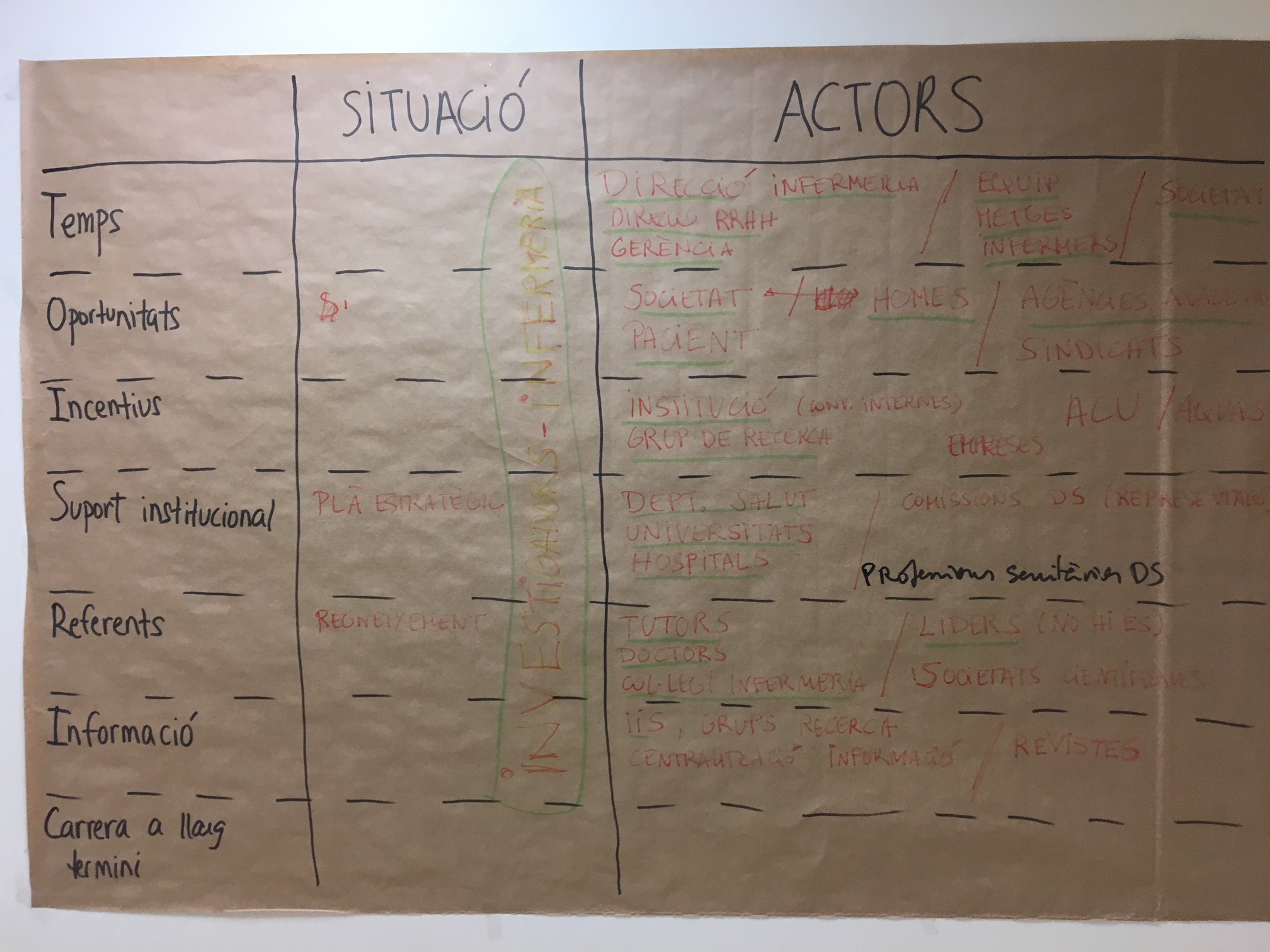
We would like to express our deepest gratitude to the nurses for their participation (readiness and motivation) who attended of their own free will and in their time off work ensuring thus that the session was a success. This demonstrates that from the AQuAS we have leverage to give support to those researchers who are motivated to driving the impact of their research.

At present, we are preparing other sessions that will enable mutual learning between researchers and the assessment agents at the AQuAS.

Post written by Núria Radó Trilla (@nuriarado).

Jornada SARIS: Participación en recerca Barcelona, April 4th 2018.

Cap a una recerca infermera amb (més) impacte

15 març
Núria Radó

Què fa que una recerca determinada tingui un impacte a la societat més enllà de l’estrictament acadèmic i sigui, realment, transformadora? Es poden planificar tot una sèrie d’accions que, com qui segueix una recepta de cuina, ens portin directament a l’impacte social desitjat? Lamentablement, la resposta és no. L’impacte és multifactorial i depèn de tants elements i actors diversos que es fa difícil d’establir una fórmula per garantir-lo.

Ara bé, això no vol dir que el fet que hi hagi recerca que obtingui un impacte social determinat sigui un fenomen totalment aleatori i que no hi hagi cap manera de preveure’l, facilitar-lo o promoure’l. Ja fa anys, des del grup d’Avaluació de la Recerca de l’Agència de Qualitat i Avaluació Sanitàries de Catalunya (AQuAS) i amb l’ajuda i complicitat de la comunitat de pràctica internacional ISRIA vam identificar una sèrie de facilitadors de l’impacte de la recerca.

Un facilitador fonamental són les persones i els valors, cultura i capacitat de lideratge que tinguin. Dos resultats de recerca exactament iguals poden tenir impactes diferents si la capacitat de lideratge, empenta i voluntat d’arribar més enllà de l’impacte acadèmic és diferent. Però amb això tampoc n’hi ha prou. L’estratègia, organització, col·laboracions i obertura que tinguin i promoguin les institucions seran un enorme facilitador o bloquejador pels investigadors que han realitzat la recerca.

Finalment, tant les persones com les institucions requeriran de dos elements indispensables per aspirar a l’impacte: d’una banda, una comunicació propera i eficaç amb els diferents actors socials que puguin jugar un paper en traslladar els resultats de la recerca, i de l’altra, una aproximació enfocada cap a la participació de tots aquests actors clau.

Parafrasejant Confuci quan deia allò de “explica-m’ho i me n’oblidaré, mostra-m’ho i potser me’n recordaré, implica-m’hi i ho entendré”, es tracta d’implicar tots els actors necessaris per produir el canvi real i fer que la recerca sigui transformadora.

És en aquest context que neix el SARIS, el Sistema d’Avaluació de la Recerca i Innovació en Salut, un instrument estratègic que aflora del PERIS (Pla Estratègic de Recerca i Innovació en Salut 2016-2020) amb l’objectiu d’avaluar la recerca en salut de Catalunya des de la perspectiva de voler, sempre, facilitar i influir per tal que aquesta tingui un impacte més enllà de l’acadèmia. Per fer-ho, s’ha definit la motivació i la implicació dels actors com un eix determinant per al seu desenvolupament.

El mes de novembre passat vam començar un seguit de sessions participatives amb les infermeres beneficiàries de la convocatòria PERIS 2017 en la qual es va finançar un línia d’intensificació de professionals d’infermeria.

Cal destacar que estrenar aquest eix amb la recerca infermera té tot el sentit per tres motius: per una banda, una de les prioritats temàtiques del PERIS és clarament “el desenvolupament de la recerca clínica i translacional que permeti incrementar els coneixements científics i tecnològics, fent èmfasi especial en els agents de l’atenció primària i la recerca en infermeria”. A més, l’ajut PERIS 2017 d’infermeria ha estat el primer en finalitzar i era adequat adreçar-nos a elles abans que ningú.

Per últim (last but not least), l’estadi en el qual es desenvolupa la recerca infermera, amb el pacient i la seva cura al centre dels seus objectius, fa especialment adient potenciar que aquesta recerca tingui un impacte directe en la salut. Així doncs, és important que la recerca en infermeria sigui capaç de demostrar l’impacte del que fa aquest col·lectiu professional, ja que el pot situar en un avantatge comparatiu amb altres disciplines de la biomedicina. En aquest sentit, la recerca infermera és intrínsicament translacional.

La primera sessió es va desenvolupar al voltant de la identificació dels actors influents i l’apoderament de la infermera per dur a terme una comunicació efectiva que amplifiqui les interaccions productives que calen per traslladar els resultats obtinguts en beneficis de més i millor salut per als pacients.

Volem agrair infinitament la participació (predisposició i motivació) de les infermeres que, de manera voluntària i fora del seu horari laboral, van assistir-hi i van fer que la sessió tingués una gran acollida, demostrant que des d’AQuAS tenim marge d’influència per donar suport a aquells investigadors que estan motivats per afavorir l’impacte de la seva recerca.

En aquests moments ja estem preparant altres sessions que serveixin d’aprenentatge mutu entre els investigadors i els agents d’avaluació d’AQuAS.

Post elaborat per Núria Radó Trilla (@nuriarado).

Pròximament: Jornada SARIS: Participación en recerca Barcelona, 4 d’abril de 2018.