El projecte VISC+ és una oportunitat per a la millora de la qualitat de l’atenció sanitària

26 febr.

Josep Maria ArgimonJosep Maria Argimon, Director AQuAS

VISC+ és un projecte emmarcat en el Big Data, la nova metodologia de la recerca observacional que aprofita la gran disponibilitat de dades que sorgeixen de la digitalització massiva de les activitats de la societat moderna, afegida a la potencialitat analítica de la tecnologia actual. La Unió Europea està destinant fons, en l’àmbit general i en el sanitari, a aquesta línia estratègica, tant per al valor afegit que pot aportar en la millora dels serveis públics com per a la dinamització en l’àmbit de l’emprenedoria. A tall d’exemple, entre els anys 2016 i 2020 la UE invertirà 500 milions d’euros en projectes relacionats amb el Big Data (en l’àmbit de la salut, l’energia i la fabricació), en els que les empreses privades n’hi aportaran 2.000 milions.

En el context europeu, una altra iniciativa a tenir en compte és la KIC Health (comunitats del coneixement i de la innovació) del European Institute of Innovation and Technology. Aquesta té un dels seus nodes a Barcelona, del qual l’AQuAS n’és membre associat. KIC Health té un pressupost de 2.100 milions per als propers anys i compta, com a exigència de la iniciativa, amb la participació del sector públic i privat. En aquest viver entre la iniciativa pública i l’empresa innovadora és on la metodologia abans referida hauria de trobar el seu terreny més prolífic, essent una de les línies estratègiques del KIC Health, al costat d’altres com el càncer o l’envelliment.

Continue reading

El proyecto VISC+ es una oportunidad para la mejora de la calidad de la atención sanitaria

26 febr.

Argimon JMJosep Maria Argimon, Director AQuAS

VISC+ es un proyecto enmarcado en el Big Data, la nueva metodología de la investigación observacional que aprovecha la gran disponibilidad de datos que surgen de la digitalización masiva de las actividades de la sociedad moderna, añadida a la potencialidad analítica de la tecnología actual. La Unión Europea está destinando fondos, en el ámbito general y en el sanitario, en esta línea estratégica, tanto para el valor añadido que puede aportar en la mejora de los servicios públicos como para la dinamización en el ámbito de la emprendeduría. A modo de ejemplo, entre los años 2016 y 2020 la UE invertirá 500 millones de euros en proyectos relacionados con el Big Data (en el ámbito de la salud, la energía y la fabricación), en el que las empresas privadas aportarán 2.000 millones.

En el contexto europeo, otra iniciativa a tener en cuenta es la KIC Health (comunidades del conocimiento y de la innovación) del European Institute of Innovation and Technology. Esta tiene uno de sus nodos en Barcelona, del que AQuAS es miembro asociado. KIC Health tiene un presupuesto de 2.100 millones para los próximos años y cuenta, como exigencia de la iniciativa, con la participación del sector público y privado. En este vivero entre la iniciativa pública y la empresa innovadora es donde la metodología antes referida debería encontrar su terreno más prolífico, siendo una de las líneas estratégicas del KIC Health, junto a otros como el cáncer o el envejecimiento.

Continue reading

The VISC+ project is an opportunity to improve the quality of health care

26 febr.

Argimon JMJosep Maria Argimon, AQuAS Director

VISC+ is a project under the Big Data, the new observational research methodology that makes use of the high availability of data arising from the mass digitization of the modern society activities, added to the analytical potential of current technology. The European Union is generally allocating and in particular in health area, both for the added value it can bring to the public services development and for the revitalization in the field of entrepreneurship. For example, between 2016 and 2020 the EU will invest 500 million Euros to Big Data (in health, energy and manufacturing related projects), while private companies will contribute 2,000 million Euros.

Similarly, the European Institute of Innovation and Technology’s KIC Health Initiative (communities of knowledge and innovation) has one of its nodes in Barcelona, and AQuAS is one of its associate members. KIC Health has a budget of 2,100 million for the coming years and counts with the participation of public and private sector, this being a requirement of the initiative. This space between public initiative and innovative company is where the aforementioned methodology should find its most prolific field, being one of the strategic lines, along with others such as cancer or aging issues. Continue reading

L’atenció sanitària sensible a les preferències: les causes de les variacions

19 febr.

Jordi VarelaJordi Varela. Editor del blog “Avenços en Gestió Clínica

Hi ha una part de la casuística (un 25% segons Wennberg), com l’hèrnia inguinal, les cataractes, les metrorràgies o l’artrosi de genoll, per la qual la medicina moderna té una resposta quirúrgica eficaç, malgrat que en l’aplicació de la tècnica sovint hi ha un marge per a la interpretació del metge, un altre per a la subjectivitat del malalt, com la percepció del dolor o l’adaptació a la manca d’agudesa visual, a més d’un factor importantíssim: la decisió del propi malalt. Hi ha homes que prefereixen portar un braguer abans que operar-se d’hèrnia i dones que volen viure amb la seva matriu, sempre que les molèsties i les metrorràgies els ho permetin.

Després d’aquesta introducció, vegem l’informe “Variations in Health Care, the good, the bad and the inexplicable” de John Appleby i col·laboradors, editat per King’s Fund el 2011, on s’afirma que les variacions en les taxes d’hospitalització són omnipresents i persistents, i fins i tot afecten a intervencions comunes de reconeguda eficàcia com el recanvi de maluc per a casos d’artrosi evolucionada.

Continue reading

La atención sanitaria sensible a las preferencias: las causas de las variaciones

19 febr.

Jordi VarelaJordi Varela. Editor del blog “Avances en Gestión Clínica

Hay una parte de la casuística (un 25% según Wennberg), como la hernia inguinal, las cataratas, las metrorragias o la artrosis de rodilla, para la que la medicina moderna tiene una respuesta quirúrgica eficaz, aunque en la aplicación de la técnica a menudo hay un margen para la interpretación del médico, otro para la subjetividad del enfermo, como la percepción del dolor o la adaptación a la falta de agudeza visual, además de un factor importantísimo: la decisión del propio enfermo. Hay hombres que prefieren llevar un braguero antes que operarse de hernia y mujeres que quieren vivir con su matriz, siempre que las molestias y las metrorragias se lo permitan.

Después de esta introducción, veamos el informe “Variations in Health Care, the good, the bad and the inexplicable” de John Appleby y colaboradores, editado por King’s Fund en 2011, donde se afirma que las variaciones en las tasas de hospitalización son omnipresentes y persistentes, e incluso afectan a intervenciones comunes de reconocida eficacia como el recambio de cadera para casos de artrosis evolucionada.

Continue reading

Preference sensitive health care: the causes of variations

19 febr.

Jordi VarelaJordi Varela. Editor of the blog “Advances in Clinical Management

There is a case-mix part (25% according to Wennberg) such as inguinal hernia, cataracts, metrorrhagia or knee osteoarthritis, for which modern medicine has an effective surgical response, although in the application of the technique there is often a margin for the doctor’s interpretation, another margin for the subjectivity of the patient, such as pain perception or adaptation to the lack of visual acuity, as well as a very important factor: the decision of the patient himself. There are men who prefer to wear a brace to hernia surgery and women who prefer to live with their uterus, provided that the degree of the discomfort and metrorrhagy allows them to.

After this introduction, let’s see the Variations in Health Care, the good, the bad and the inexplicable report by John Appleby and his collaborators, published by King’s Fund in 2011, which states that variations in hospitalization rates are pervasive and persistent, and even affect common interventions known to be effective such as hip replacement for advanced osteoarthritis cases.

Distribution rates of hip replacement in England 2009/10

Note that although adjusted for age and sex, the rate of hospitalization for hip replacement (with lighter blue line) in the graphic, are observed in 18 PCT (Primary Care Trust) that show a value of 60 interventions per 100,000 inhabitants per year, while at the other extreme, there are 20 showing a rate of 140. That is, citizens of the latter communities have a 2.3 times higher probability of being operated on for prosthetic hip replacement than the citizens of the former. The same report shows that these regional differences are extended to other elective procedures such as knee, cholecystectomies or coronary angioplasty.

Whichever way you look, this type of variation in the use of health care resources for procedures seemingly well identified and standardized, is universal, and this is seen when comparisons between systems (countries) are being made, but don’t disappear when, as in the English case, intra-communities and intersystem analysis are being made. If I may, I’ll next show a Spanish example from the Variaciones de la Práctica Médica (VPM) initiative that has the support of all autonomous regions. I have in hand the final report of the VPM research project: Variations in the use of knee arthroplasty in the National Health System, from which I have chosen this graph:


I think in the above graph it should be noted that, excluding outliers health areas (in light blue), there are Spanish territories where inhabitants have a probability of knee prosthesis intervention 6.4 times higher than inhabitants from the areas with the lowest rates. And this occurs in a health system that is considered one of the most fair and accessible in the world.

Where is the problem? What explains these extraordinary variations?

To answer these questions, there’s nothing better that to resort to a 1977 investigation led by a young Wennberg. The following table, published in Tracking Medicine by the same author (Oxford University Press 2010), there is a summary of the results of this work. It’s the comparison of two small communities: Middlebury in Vermont vs. Randolph in New Hampshire. As seen in the table, the two communities have the same socioeconomic characteristics, the same prevalence of chronic diseases, and the same doctor accessibility. However, the Middlebury citizens are hospitalized 67% more than those of Randolph, and undergo surgery 63% more.

This work is a benchmark for questions about the causes of variations in the use of health resources. According to Wennberg, if when demographic, socioeconomic and accessibility factors have been adjusted, such overwhelming differences still remain, one must draw the attention of the variations towards the medical practice and the availability of healthcare resources provided by doctors in each area.

El Observatorio de Innovación en Gestión de la Sanidad en Cataluña: presente y futuro

12 febr.

Montse MoaharraMontse Moharra. OIGS AQuAS

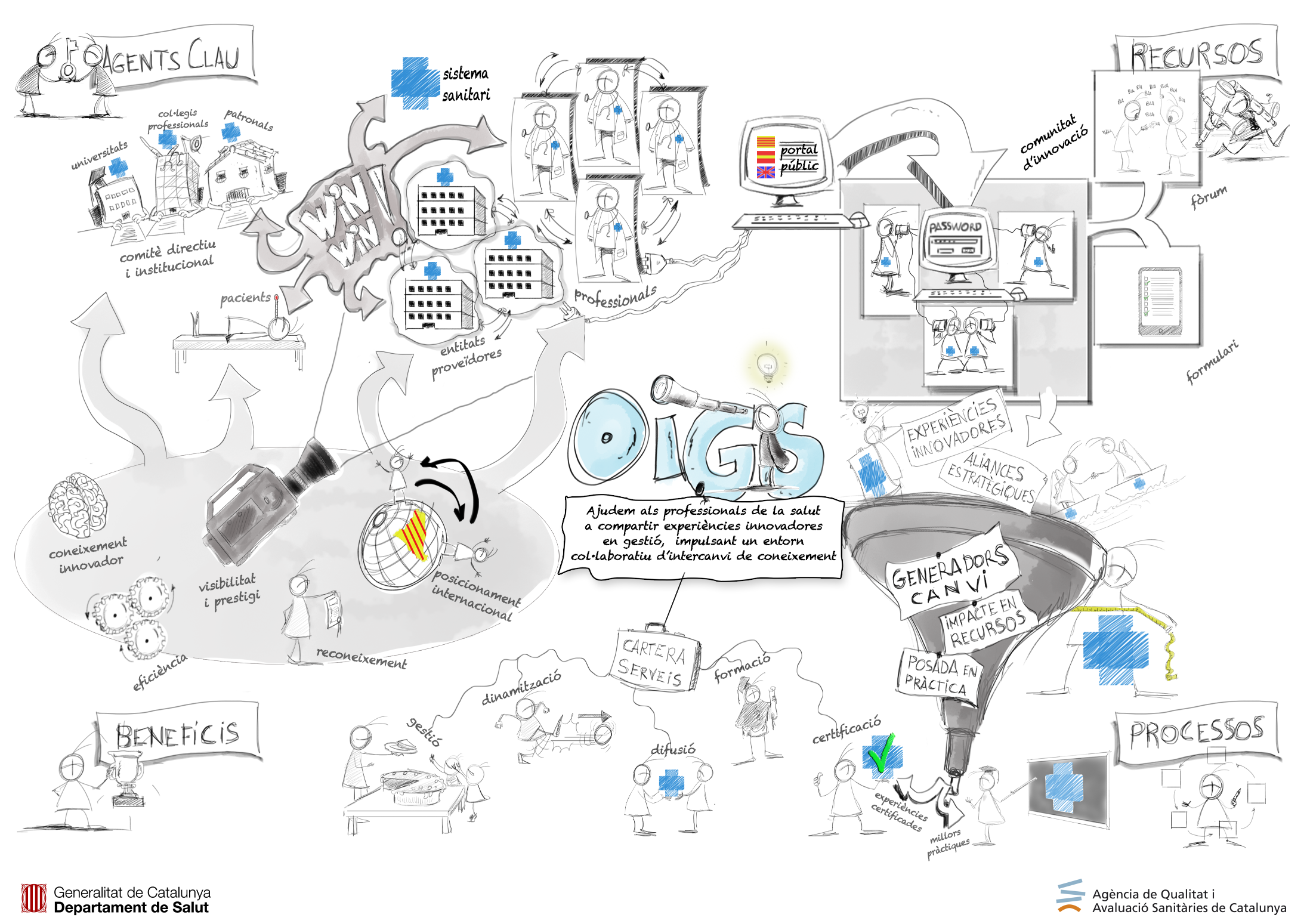
El sistema sanitario catalán nace de una realidad histórica singular que favorece la consolidación de un sistema caracterizado por la financiación pública, la provisión plural y la integración de todos los recursos en una red de utilización pública, lo que hace que sea un referente y fuente de innovación en gestión. En este contexto, en 2012 se creó el Observatorio de Innovación en Gestión de la Sanidad en Cataluña (OIGS) con el objetivo de recoger y dar valor al conocimiento generado a partir de las iniciativas innovadoras: las experiencias innovadoras, las alianzas estratégicas y las mejores prácticas. Actualmente, la OIGS recoge un total de 181 experiencias, de las que un 56% están relacionadas con la gestión de procesos asistenciales y estratégicos, un 14% con pacientes crónicos, un 14% con TIC y un 7% con fármacos.

OIGS ofrece además un espacio de aprendizaje sobre innovación a través de un portal público y de una comunidad de innovación que facilita la interacción entre los más de 400 profesionales usuarios que ya están compartiendo sus experiencias.

Continue reading

The Centre for Innovation in Health Management in Catalonia: present and future

12 febr.

Montse MoaharraMontse Moharra. OIGS AQuAS

The Catalan health system is the result of a remarkable historical reality that favours the consolidation of a system characterized by public funding, multiple provision and integration of all resources in a network of public use, which makes it a reference and innovation source in management.

In this context, in 2012 the Observatori d’Innovació en Gestió de la Sanitat in Catalonia (OIGS) (The Centre for Innovation in Health Management in Catalonia) was created with the aim of collecting and giving value to the knowledge generated by innovative initiatives: innovative experiences, strategic partnerships and best practices. Currently, OIGS includes a total of 181 experiences, of which 56% are related to the management of healthcare and strategic processes, 14% with chronic patients, 14% with TIC and 7% drug related.

OIGS also offers an innovation learning space through a public portal and a community of innovation that facilitates the interaction between over 400 professional users who are already sharing their experiences.

workshop

How can an innovative experience be registered?

One has to register with the innovation community and fill in a form with the experience data. The form content is reviewed by the OIGS and the experience is published on the website if it meets the established criteria: having been implemented within an organization, generating a change, having had an impact on resource optimization and being expansible to other organizations or systems.

When the experience is published, the willing organizations may present at any time, also through the innovation community, the self-assessment of the experience. OIGS reviews and evaluates the presented self-assessment and those experiences that exceed this evaluation, obtain a quality certificate issued by AQuAS. Thus, so far 19 experiences have been certified.

Identifying the best practices in health management

Starting from the process of reviewing management innovative experiments, identifying commonalities and required by CatSalut, so far three potentially scalable experiences throughout the healthcare system have been identified: the suitability of prescribing in primary and community care; the online preoperative and the online dermatology. However, this is an ongoing process that ought to facilitate identifying new best practices.

OIGS in the future

In the near future, OIGS aims to encourage the participation of professionals and organizations that are important to system innovation; to create knowledge networks through participation in research and innovation projects at European level and organizing specific thematic workshops. The innovation community will facilitate identifying experiences that can be part of potential interest groups and that will be able to respond to the specific challenges related to European funding such as innovative public procurement.

L’Observatori d’Innovació en Gestió de la Sanitat a Catalunya: present i futur

12 febr.

Montse MoaharraMontse Moharra. OIGS AQuAS

El sistema sanitari català neix d’una realitat històrica singular que afavoreix la consolidació d’un sistema caracteritzat pel finançament públic, la provisió plural i la integració de tots els recursos en una xarxa d’utilització pública, la qual cosa fa que sigui un referent i font d’innovació en gestió. En aquest context, l’any 2012 es va crear l’Observatori d’Innovació en Gestió de la Sanitat a Catalunya (OIGS) amb l’objectiu de recollir i donar valor al coneixement generat a partir de les iniciatives innovadores: les experiències innovadores, les aliances estratègiques i les millors pràctiques. Actualment, l’OIGS recull un total de 181 experiències, de les quals un 56% estan relacionades amb la gestió de processos assistencials i estratègics, un 14% amb pacients crònics, un 14% amb TIC i un 7% amb fàrmacs.

L’OIGS ofereix a més un espai d’aprenentatge sobre innovació a través d’un portal públic i una comunitat d’innovació que facilita la interacció entre els més de 400 professionals usuaris que ja estan compartint les seves experiències. Continue reading

InnoLife, una buena oportunidad para posicionar Cataluña en el ámbito de la investigación y la innovación en salud

5 febr.

Cristina AdroherCristina Adroher.

Entrados en el siglo XXI la innovación es una de las claves de la generación de conocimiento, de la mejora de la competitividad de la economía y del aumento del bienestar de nuestra sociedad. La capacidad de una sociedad para innovar es fundamental en una economía cada vez más intensiva en conocimiento. En este contexto, Europa se enfrenta a un reto importante, a pesar de que dispone de una base de investigación de excelencia, de empresas pioneras y de mucho talento creativo, a menudo es difícil que estas buenas ideas se transformen en nuevos productos o servicios. Como se apunta en un reciente informe del Consejo Asesor para la Reactivación Económica y el Crecimiento (CAREC), hay dificultad en la transferencia del conocimiento.

Para cambiar esta situación la Unión Europea ha establecido la Estrategia Europea 2020 que prioriza la consolidación de los resultados de la investigación y la promoción y la transferencia del conocimiento. Uno de los instrumentos destacados en el marco de esta estrategia es el Instituto Europeo de Innovación y Tecnología (EIT), creado en 2008. Esta institución tiene como objetivo mejorar la capacidad de Europa para innovar y, a través de las nombradas comunidades de conocimiento e innovación (KIC), integra los tres vertientes del conocimiento: la formación, la investigación y la innovación.

Continue reading